

Seniors are the ‘biggest surprise’ in first month of Lawrence rec center fees; also, a debate on free senior swim
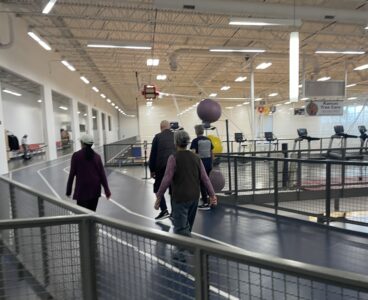
photo by: Sylas May/Journal-World
Sports Pavilion Lawrence members walk the track on Tuesday, Jan. 13, 2026, at the facility in west Lawrence.
Questions remain on whether Lawrence will hit its fiscal goal for the first year of rec center fees. But there’s no question that seniors will play a big role in getting it there.
This week, city leaders got an update on the first month of fees from interim Parks, Recreation and Culture director Lindsay Hart, and she said seniors were “our biggest surprise” so far. People over 60 make up more than 60% of the total rec center memberships sold in month 1; they were 58% of total visitors at Sports Pavilion Lawrence that month; and of the roughly $180,000 the department has made in membership fees, the Journal-World found that seniors made up about $100,000.
“It’s been really interesting to see how the numbers have turned out this first month, but the senior number is a lot higher than we expected,” Hart said. “… The annual senior memberships sold far exceeded what our original estimate was.”
With those figures come some new questions, too, about a free program for seniors that was a casualty of the new fees, and whether it would be wise to bring it back.
That program is the Wednesday senior swim at the Lawrence Indoor Aquatic Center. Through the end of last year, seniors could use the pool all day for free, and 182 attended it in January of last year, the department said in a report on senior swim earlier this month.
Even though the new rec center memberships don’t grant access to aquatic facilities, they were the reason that senior swim was discontinued. If it had stayed, the department said, there would be pressure to offer free senior days at other facilities, too.
“Offering a free senior swim day at the pool would create an expectation for similar free options at other recreation facilities, which would be difficult to sustain systemwide,” the department said in the senior swim report.
Some members of the City Commission have expressed interest in trying to bring senior swim back, or at least to help those seniors who used to attend but can no longer afford to do so. Vice Mayor Mike Courtney said Tuesday that he’d heard from at least six people in that position.
“Maybe it is less than 12 people or something like that,” Courtney said. “But I feel for (them), hearing them tell me about how it affects their joints. … If this takes three to four more months, I feel like that is doing the most amount of damage by not trying to help them out.”
While seniors do pay less for parks and rec memberships than other customers, Hart said there weren’t many options they could use for financial aid. The city does offer a scholarship program for aquatics, but eligibility is based on certain proofs of financial need.
Specifically, the city requires people applying to provide “documents that show the individual receives state or federal benefits.” It lists examples such as a KanCare insurance card, a free or reduced-price lunch letter from the school district, or documents from the Housing Authority, DCF or SNAP. Social Security and Medicare, however, don’t qualify you, because they’re granted to all seniors regardless of their financial status. (The application form can be found at assets.lawrenceks.gov/lprd/forms/adultscholarshipform.pdf.)
The Journal-World reached out to the city last week to ask for examples of qualifying documents that seniors might be more likely to have. As of Friday afternoon, the city had not provided any such examples.
“Unfortunately, many of them don’t qualify for (the scholarship program), because the scholarship program is based on income, it’s not based on age,” Hart told the commission on Tuesday. She said that the city would be happy to discuss the matter with seniors who were affected, “but we need to be consistent across the board with all of our community, because other people and other programs have the same concerns.”
Fairness wasn’t the only issue. Another one was the fact that seniors made up such a large chunk of the rec center revenue, and that there are unknowns about how much money the memberships will bring in.
Commissioner Mike Dever said he was hesitant.
“If we’re going to start opening the doors back up and giving back passes to a population who has signed up for two-thirds of the passes at our (Sports Pavilion Lawrence) already, it just seems like a bad idea to me,” Dever said. He added that seniors are “the ones that are using it the most, they’re getting the most benefit out of it, they have the most free time, and they have the most – technically speaking – the most money available to them to spend of all of us in Lawrence.”
Dever also said there just wasn’t enough information yet about how the parks and rec changes were working.
“I can’t make any decisions on one month worth of data,” Dever said. “That’s how I feel.”
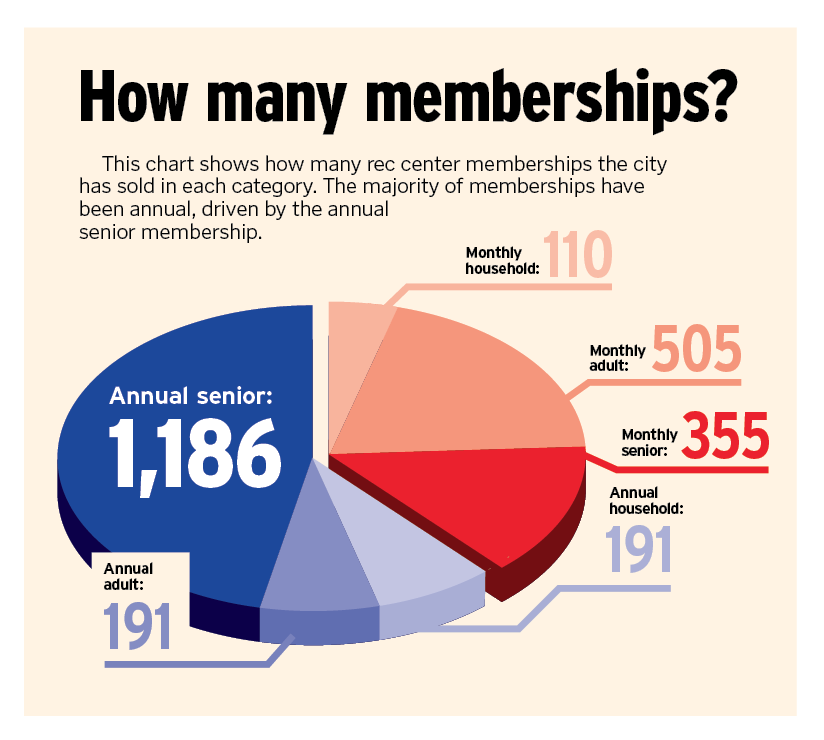
Some of the metrics are clearer than others. Parks, Recreation and Culture had goals of 2,250 paying memberships issued and 3,000 total memberships issued that it set last fall, and it’s now passed both of those goals, with 2,542 paying memberships and 862 free memberships for youth, low-income residents and users of the Community Building.
What complicates those figures is that some of the paying memberships are annual, and others are only monthly. About 38% of the memberships sold in month 1, or 973, were monthly memberships, and the rest were annual memberships.
And Hart said that even if the department hit its goal for total memberships sold, it could still miss its revenue goal of $450,000 from membership fees in the first year.
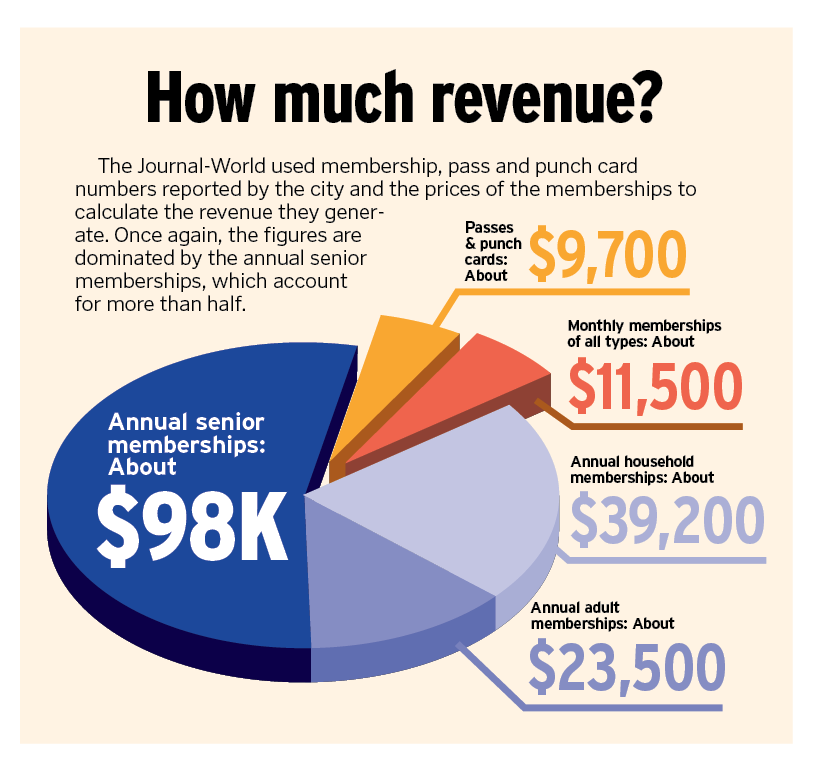
A closer look at the report shows that in the first month, the department made about $182,000 from membership fees, day passes and punch cards. However, 90% of that revenue appears to come from annual memberships, which brought in about $160,000 in the first month.
(Note: The report itself doesn’t break down how much of the revenue comes from each source. To get that figure, the Journal-World had to calculate it using the prices for each type of membership and the numbers of memberships of each type listed in the report.)
The income from monthly memberships, meanwhile, was about $11,500 in the first month, and the income from punch cards and day passes was about $9,700. Hypothetically, if those figures were to stay constant from month to month, the department would take in about $415,000 total between annual memberships, monthly memberships, punch cards and day passes, which would be $35,000 short of the $450,000 goal. If monthly memberships expire at a rate faster than new memberships are added, the shortfall would be even greater.
Expect the discussion on rec center fees to continue at the City Commission’s meetings as more data comes in. The commission has asked for regular updates from Parks, Recreation and Culture on the issue.
Here are some more stats from the rec center report:
• How seniors and other groups compare: In both numbers and financial impact, senior memberships are far outpacing memberships for adults and families.
The senior membership is the least expensive of the city’s paid membership options. It costs $8 monthly or $80 annually for residents, and $10 monthly or $100 annually for nonresidents. For comparison, the adult membership for residents costs $12 a month or $120 a year, and the household membership for residents costs $20 a month or $200 a year.
In the first month, more than 1,180 annual senior memberships and more than 350 monthly senior memberships were sold. They accounted for more than $100,000 of the department’s revenue. Annual adult and household memberships, meanwhile, were at 191 each, and monthly adult and monthly household memberships were at 505 and 110, respectively.
• Hundreds of nonresidents: The vast majority of memberships – 2,195, or 86% – were for people living within the city limits. But there were 347 memberships, 14%, purchased by nonresidents. These accounted for more than $26,000 of the department’s fee revenue.
Nonresidents were even more prominent in the day pass figures. Just over 500 of the 724 day passes, or 70%, were purchased by Lawrence residents, and 216, or 30%, by nonresidents.
• … And hundreds of youth: Youth memberships are free for all people under 18 who live in Douglas County, regardless of whether they’re inside the city limits. In the first month, 442 of them had signed up.
The department also sold a handful of memberships for out-of-county youth, who are charged a fee: one annual membership and three monthly ones.
• Free Community Building: Aside from Sports Pavilion Lawrence, which had 14,479 visits in the first month, the most-visited rec center is the Community Building, which still has free access. It was visited 1,261 times, compared to 918 for the East Lawrence Recreation Center and 480 for the Holcom Park Recreation Center.
• A membership goal that hasn’t been met: One goal the city hasn’t surpassed is the number of memberships specifically for people with financial hardships. The city calls these “Qualified Access Memberships,” and its goal set in September 2025 was to distribute 300 of them in the first year. Right now, it’s distributed 126.
The requirements for Qualified Access Memberships are similar to those for scholarships; you must have documents showing that you receive federal or state benefits. An application form can be found at lawrenceks.gov/prc/membership.
City Government

Lawrence is charging water, sewer customers a special tax not required by state or city law

Lawrence housing market strains residents as development fails to keep up, city’s affordable housing study finds

Property tax protest bill would let a few dozen voters block tax increases in some parts of Douglas County
Portion of 19th Street to close during much of April for stormwater structure replacement

With water and sewer rates soaring, a city utility fund has had multiple financial discrepancies
