

Heavy debris in Kansas River damages Bowersock dam, creating low water levels near Lawrence water plant
Kaw River Water Treatment plant is still operating despite lower levels
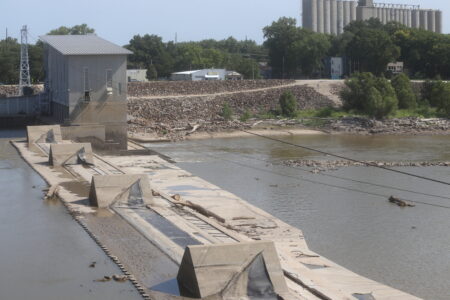
photo by: Chad Lawhorn/Journal-World
The Bowersock Dam on the Kansas River is pictured on Aug. 13, 2026.
A portion of the Bowersock Dam on the Kansas River has failed, but it is not creating any flooding concerns. Quite the opposite, actually.
The dam, which sits on the stretch of the Kaw that runs alongside downtown Lawrence, isn’t a flood control dam but rather helps provide water for Kansas’ only hydroelectric power plant, the Bowersock Mills & Power Company.
The dam, though, does more than that. It also ensures there is a sufficiently deep pool of water upstream of the dam so that the city of Lawrence can efficiently suck water out of the Kansas River to feed one of Lawrence’s two water treatment plants.
Anyone driving over the downtown Kansas River bridges in recent days might notice there is far less water in the river than normal. Wide stretches of muddy bank that recently were covered with water are now exposed, and waterfowl are standing in the middle of the river in places.
The reason for the sudden drop in water levels was the bursting of a bubble, so to speak. The concrete dam is topped with four, large, inflatable rubber bladders that add height to the dam. One of those four bladders was punctured by massive amounts of floating trees and other debris, recently, Sarah Hill-Nelson, co-owner of Bowersock Mills & Power Company told the Journal-World on Thursday.
“The No. 2 bladder is ripped from end to end,” Hill-Nelson said.
The result is that there is a large gap on the dam that water is able to flow through, which means the water levels just upstream of the dam– called a pond, in river terminology — have dropped by about six feet, Hill-Nelson said.
“The city of Lawrence is still able to draw water when the pond is this low, but it is not ideal for anyone,” Hill-Nelson said.
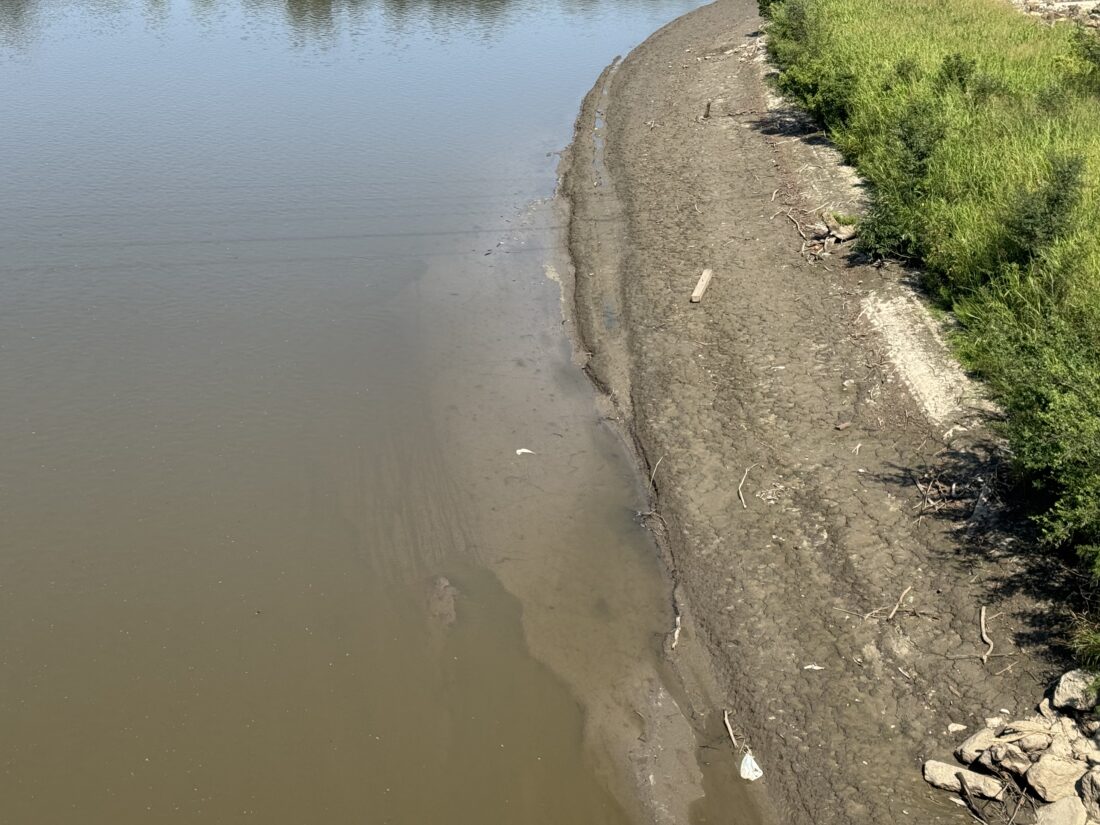
photo by: Chad Lawhorn/Journal-World
Muddy banks, pictured on Aug. 13, 2026, show how far the Kansas River has fallen due to damage at the Bowersock Dam.
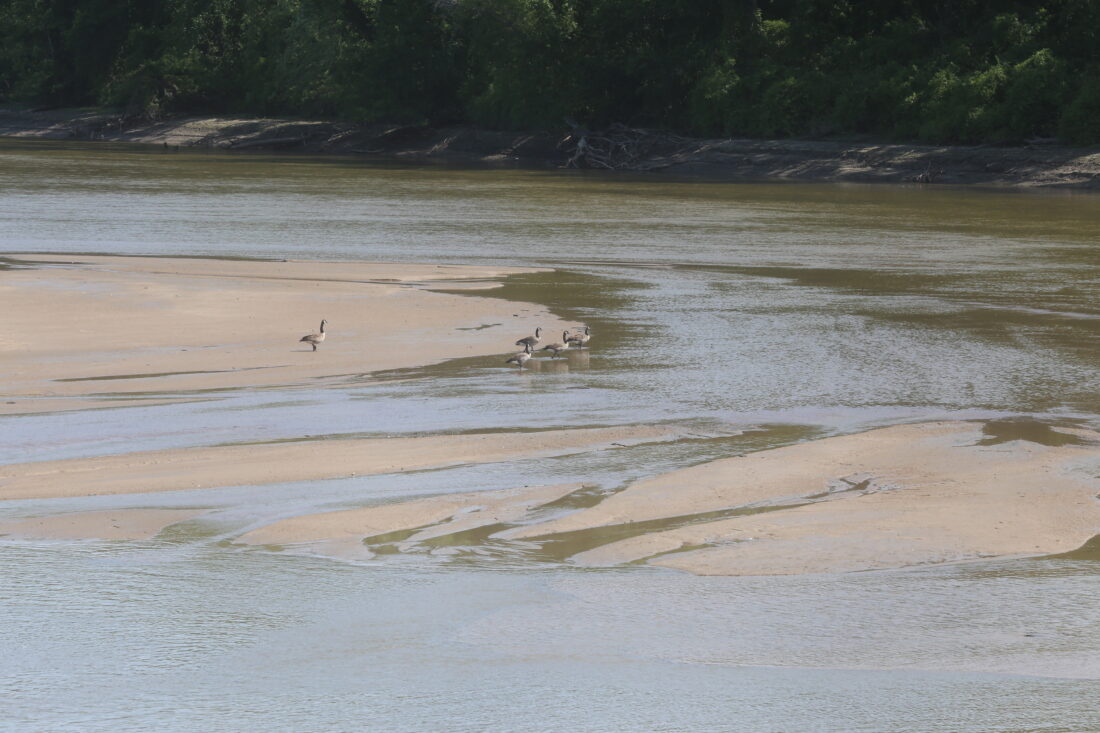
photo by: Chad Lawhorn/Journal-World
Waterfowl , pictured Aug. 13, 2026, stand in the middle of the Kansas River near a point where the city of Lawrence sucks water to supply in Kaw River Water Treatment plant.
The saving grace is that only a top portion of the dam has failed. The concrete portion of the dam, which is rarely seen because it is always underwater, is holding up just fine. That portion of the dam is keeping water levels high enough that the river has a sufficient pond of water for the city to operate its water plant.
Hill-Nelson said city officials have done a good job of preparing for a situation like this, and have the infrastructure in place to keep the water plant operating in low-water environments. Hill-Nelson said her understanding, though, is the water plant operates less efficiently and has more challenges with filtration when water levels are this low.
A city spokesman confirmed Thursday that the plant continues to operate despite the low water conditions.
“Our treatment operations are working well, and we’ve been in frequent communication with the Bowersock team during this event,” Michael Leos, a spokesman for the city said. “The water treatment team will continue to monitor conditions throughout the week.”
The system is set up that Lawrence could provide adequate water supply with only one of the two plants functioning, but that would be far from ideal. The current situation, though, serves as a reminder that the Bowersock Dam — which dates back to the late 1800s when Hill-Nelson’s ancestors built it to power an industrial empire — is critical to keeping the city’s Kaw Water Treatment Plant operational.
“The city has done a good job of protecting its infrastructure so that it can operate when the water is low like this,” Hill-Nelson said. “If the dam were to go away, that would be another story. They would really have to figure out what to do.”
There’s no reason to believe the bulk of the dam is in any jeopardy. But the current situation is plenty complicated, Hill-Nelson said. The large rubber bladders are custom-made. She estimates it would take four months for a bladder to be produced and delivered to Lawrence. The cost would be upwards of $300,000 for the purchase of the bladder.
How much it would cost to install the bladder is unclear. The operation would require the area around the dam to be completely drained of water. Hill-Nelson, on the advice of engineers, already has begun looking into the feasibility of procuring a “water fence” that would act as a temporary dam upstream of the actual Bowersock Dam. The portable water fences are used in a variety of emergency situations, including when Tampa General Hospital erected such a fence in 2024 when the Florida city was threatened by a pair of hurricanes.
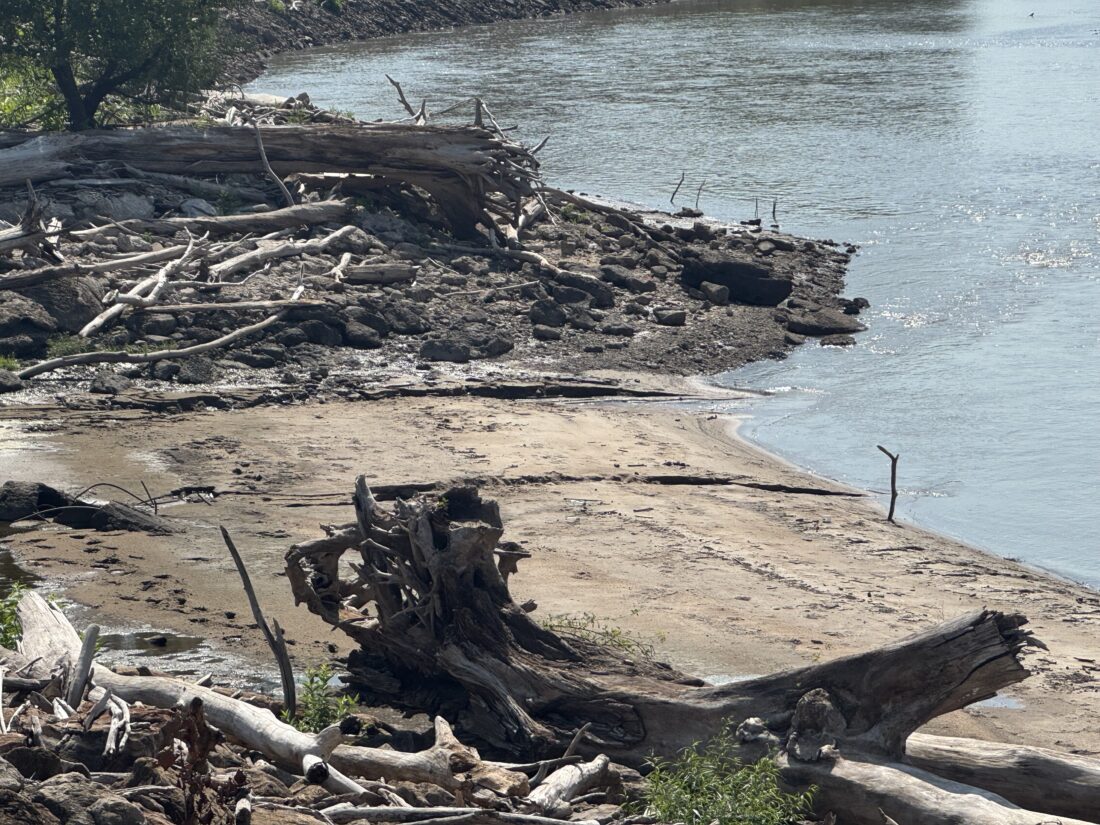
photo by: Chad Lawhorn/Journal-World
Large debris is pictured Aug. 13, 2026 along the edge of the Kansas River in downtown Lawrence.
The water fence is another cost component that is uncertain. Then, there is the question of whether filling the current gap in the dam with a new rubber bladder is even the right approach? The answer to that question depends, in part, on whether the amount of trees and debris that have floated down the river this spring and summer represents the new normal for the Kansas River.
“This year we had really, really large debris,” Hill-Nelson said.
It was one of those pieces of debris that ripped the bladder and created the current problems. There’s no guarantee that wouldn’t happen to a newly-installed bladder.
The rubber bladders were installed in 2013 — they replaced a system of wooden fence-like boards that could be raised and lowered on the dam — and this is the second time a rubber bladder has failed. The first time was in 2021, when a seam on the bladder separated. It was able to be stitched back together. This year is the first time one of the Lawrence bladders has been destroyed beyond repair.
It also is the first time a 1,000-foot long logjam has been documented upstream of the dam. That log jam was on the Smokey Hill River — which flows into the Kaw — in Salina. City officials there reportedly spent more than $1 million to clear the river of the logjam. Work to clear the logjam lasted into late December.
It is not clear that escaped debris from that logjam played a role in the Lawrence incident — although Hill-Nelson has asked her insurance company to review that possibility — but the fact such a large logjam developed in the first place is concerning.
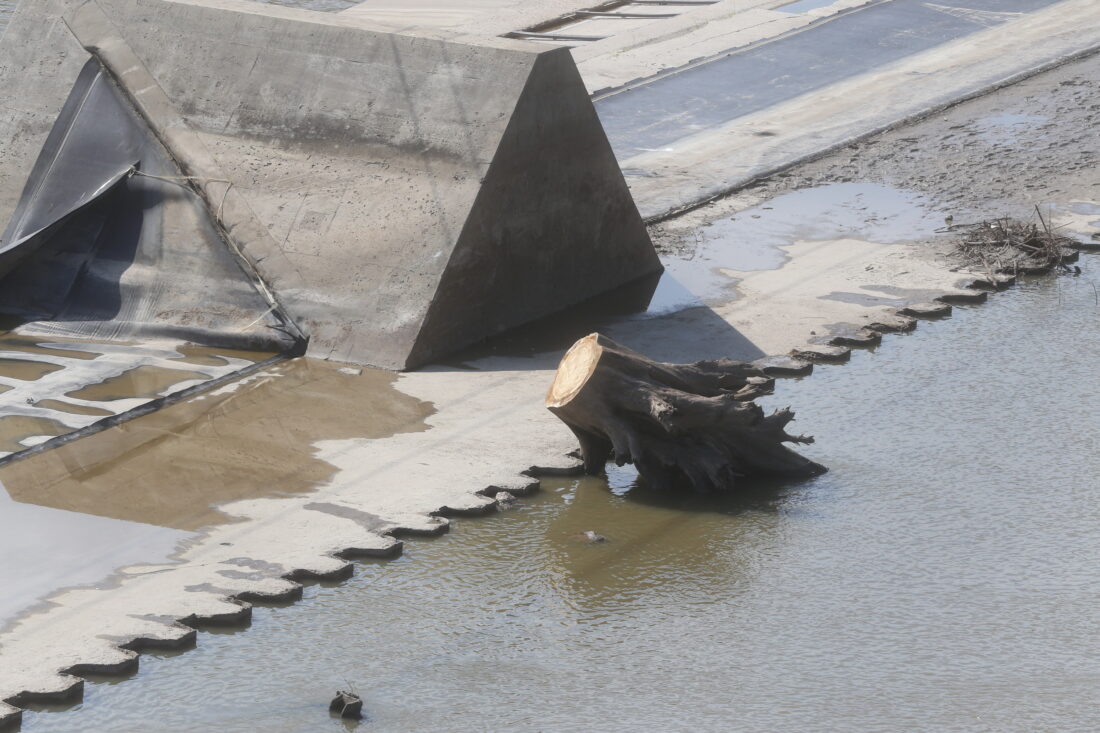
photo by: Chad Lawhorn/Journal-World
A large tree stump rest along the edge of the Bowersock Dam on Aug. 13, 2026.
Water from an approximately 60,000-square mile area in Kansas, Nebraska and Colorado flows into the Kansas River. As rainstorms become more intense, the potential for entire trees to wash away becomes greater. Lawrence residents saw that firsthand as there were several scenes of large trees in the city simply tipping over due to saturated soils from heavy rains this spring and summer.
“We haven’t been getting our normal spring rains, but we’ve been getting big three-inch rains at a time,” Hill-Nelson said. “Some people might attribute that to climate change.”
If indeed those heavy rains are the new normal, Hill-Nelson said it may make sense to replace the destroyed rubber bladder with a steel gate-type of structure. That type of replacement will come at a higher cost than the rubber bladder, Hill-Nelson said.
The city of Lawrence does set aside money every year for dam maintenance — given that the dam is critical to the city’s water plant operations — and that money is sitting in an escrow account, Hill-Nelson said. But just how much money is available and how much of it the city would spend on this project is unclear.
That’s the status of much that surrounds the dam currently.
“I can’t say to anyone in the community that we have a clear answer on how we are going to manage this,” Hill-Nelson said. “It is one day at a time right now.”
To complicate matters, the Bowersock power plants — there’s one each on the north and south sides of the river — are not fully operational currently. One of the plants got hit by a lightning strike during an April thunderstorm, which destroyed one of the company’s turbines.
Hill-Nelson said Bowersock currently is working with the city of Lawrence to coordinate operations to fix the dam. She also said Bowersock is in contact with the University of Kansas. KU has a boathouse just upstream of the dam that houses the KU rowing program. The low water levels in the river are expected to cause significant disruption to KU rowing activities, she said.
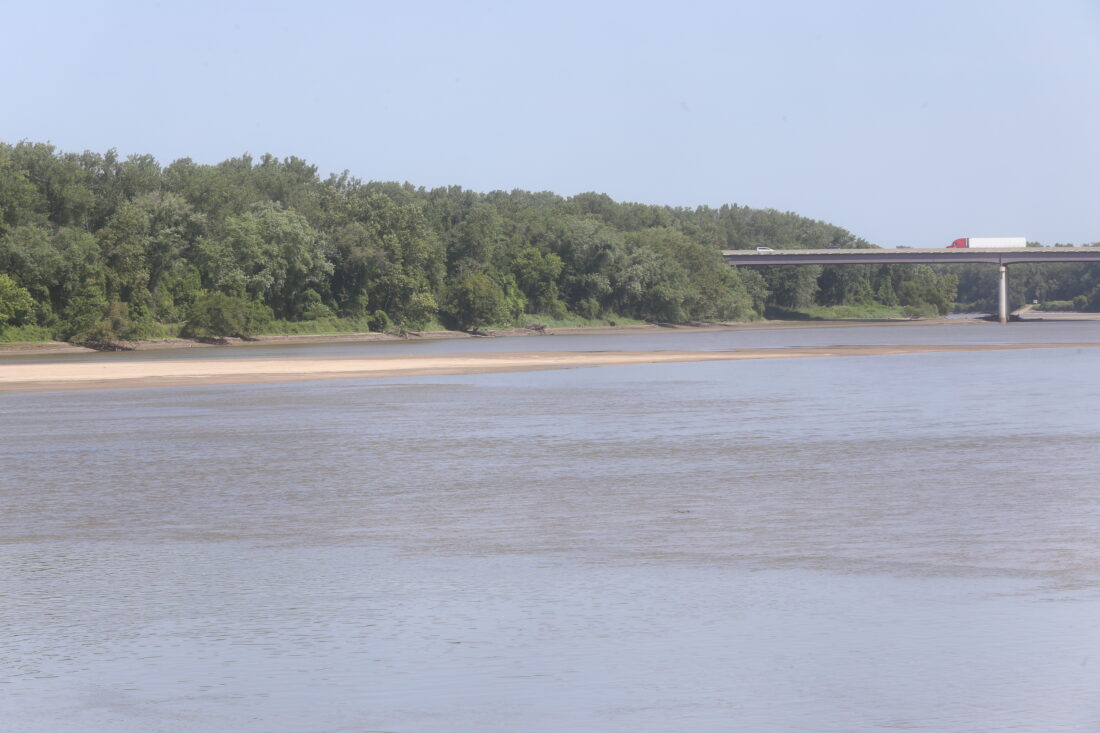
photo by: Chad Lawhorn/Journal-World
Water levels upstream of the Bowersock Dam on the Kansas River, pictured on Aug. 13, 2026, are about six feet lower than normal due to problems at the Bowersock Dam.
City Government
As they approve bikes plan, Lawrence city leaders ask about data collection, Kentucky and Tennessee streets

Lawrence city leaders want to toughen tobacco licensing rules ‘sooner than later’

Algerian government invites Mayor Brad Finkeldei, Lawrence delegation for a visit
Construction on Wakarusa Drive to resume; city manager says KDOT’s secretary has apologized for delay
Evacuation drill planned Tuesday at Lawrence City Hall
