Split Lawrence City Commission votes to keep rec center fees, despite public opposition
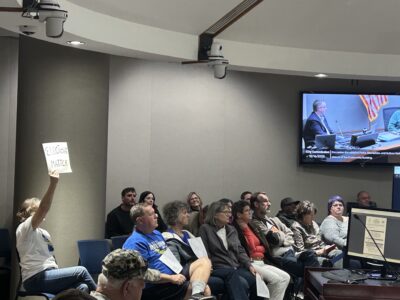
photo by: Bremen Keasey/Journal-World
Several people holding signs during Lawrence's City Commission meeting that expressing their opposition to a fee plan for the city's recreation centers. Despite many residents voicing their opposition to the plan, Commissioners voted 3-2 against pausing the plan, citing concerns about the budget impacts to the city.
After a lengthy discussion regarding the start of a membership fee plan for Lawrence’s recreation centers, the City Commission on Tuesday night voted against pausing the fee plan and using other funding options to keep the facilities free for next year.
Commissioners voted 3-2 against a pause with Vice Mayor Mike Courtney and Commissioner Kristine Polian voting to pause the fee plan; Mayor Brad Finkeldei, Commissioner Mike Dever and Commissioner Amber Sellers voted to move ahead with the fee program.
As the Journal-World reported, as part of the 2026 budget, the commissioners approved a membership fee plan to enter the Parks, Recreation and Culture department’s three recreation centers. Fees for Lawrence residents would be $12 a month or $120 a year for adults, $8 a month or $80 a year for seniors, and $20 a month or $200 a year for families; fees for nonresidents would be higher. Additionally, the commission asked that the rec centers allow free entry for Lawrence youth under 18 and for lower-income residents.
While the plan was approved in September along with the budget under the previous commission, the decision for the fee plan was unpopular with the public. Voters in November elected two newcomers to the commission — Courtney and Polian — who both expressed opposition to the city’s plans to begin charging entrance fees to the city’s recreation centers, with the fees set to begin next month. Tuesday’s meeting was the last time the newly-seated commission would meet before the fees would start on Jan. 5.
Courtney’s plan hoped to get rid of the membership fees — at least temporarily — and use other solutions to cover the parks department’s budget gap without getting additional fees from the public. The department was tasked by the city with cutting $1.8 million from its 2026 budget — nearly 10% — as part of citywide budget cuts of $6.5 million. City staff has estimated that the new membership fees for the recreation centers would generate $450,000 per year.
Courtney argued his plan would use certain financial solutions included in the PRC’s master plan that are “untapped, low-hanging fruit.” His plan would create a new foundation that would allow individuals and businesses to make donations that would directly serve the parks department, delay the hiring of a new parks director until 2027 — expected to save $103,000 in salary and benefit costs — and reallocate $250,000 from the city’s general fund balance to fund the department.
Courtney said implementing the plan would be a “productive pause” that would give the commission and city staff time to better understand the usage rates at the city’s recreation centers and see what funds the public could raise to cover the fees. He noted many of his recommendations — like the creation of a foundation — come directly from the department’s master plan, and he said he heard while he was campaigning that people would be willing to “open their checkbooks” and give to a foundation to make sure fees aren’t implemented.
“This takes a leap of faith based on a solid plan,” Courtney said.
Around 30 residents attended the meeting, some holding signs against the implementation of a membership fee program for the recreation centers. Eighteen people spoke during public comment against the fee program, with most saying they agreed with Courtney’s plan of a pause on potentially implementing fees. Not a single person spoke in favor of the membership fee proposal during public comment.
Taylor Bussinger, a member of the Parks and Recreation Advisory Board, was one of the residents who spoke. He noted that he could not personally support the fee plan because he saw the fee plan as an equity issue, saying the city should “be working to remove obstacles” instead of adding them.
Bussinger also noted that the public was very against the plan, with a city survey saying 81% of respondents opposed adding fees.
“(The City) Commission should reflect the voice of the people, not override it,” Bussinger said.
While there was a lengthy discussion and many commissioners noted they agreed with aspects of Courtney’s plan, the commission ended up not changing any of part of the current fee schedule.
Commissioner Amber Sellers said she felt that the city would need to implement many of the things that Courtney had proposed, but she viewed that those other fiscal options can be done in combination with the fees.
Sellers said she felt this was a time to work to stabilize the budget for the PRC department and implement more things to strengthen the department’s services. In the future, if the department gets back on stable financial footing, then the commission can eventually remove or alter fees, so focusing on that one topic is like “stuffing [the overall problems] into a box” and ignoring it.
Mayor Finkeldei said while he doesn’t like adding the fees or raising taxes, the budget issues for the PRC also impact other aspects of the city’s budget, like police or fire fighters.
“I appreciate that fees are not popular, but there are other things I like less,” Finkeldei.
Finkeldei also said that while residents were not happy with the fee proposal, he also said he felt commissioners addressed the top concerns that residents had about the fee proposal. He said the top three reasons why people did not support the fee proposal in the city survey were concerns about costs for low-income residents, costs for seniors with fixed incomes and access for children. Commissioners changed the plan so it won’t charge low income residents and children and has a discount for seniors.
Although the main topic of pausing the implementation of fees was voted down, Courtney was able to secure a win through a motion of keeping the Community Building, 115 W. 15th St., open without a fee for a three-month trial period. Finkeldei and Dever both said they wanted to ensure the building was still open, and the commission voted unanimously to keep the Community Building open with its current operating hours for a three-month period. The cost to the city on that is estimated to be about $12,500.
City Government
Split Lawrence City Commission votes to keep rec center fees, despite public opposition
Iowa Street ready to reopen ahead of schedule after reconstruction work

City’s wish list for Legislature includes local control, law against organizations bringing homeless to Lawrence and more

Commissioners to consider allocating $80,000 for proposed East Lawrence loft project to boost its standing for state tax credits
City commissioner creates plan to eliminate planned entrance fees at city recreation centers