City staff recommends not reopening Ninth Street for World Cup; also, a nearly $5M change to a stormwater project
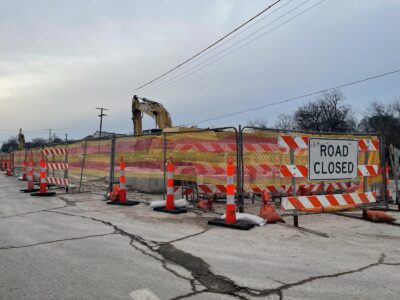
photo by: Sylas May/Journal-World
Ninth Street is pictured looking west on Friday, Dec. 5, 2025.
On Tuesday, Lawrence city commissioners will consider two big items related to stormwater improvements near downtown: one involving the calendar, and another involving a crack.
The one involving the calendar is a recommendation from city staff about the Ninth Street reconstruction project’s timeline. Staff is going to recommend a schedule that would not reopen the street partway through its reconstruction for the FIFA World Cup.
The one involving a crack is a nearly $5 million change order to the city’s Jayhawk Middle Reach Watershed Project. Part of the change order is to reroute a storm sewer near Tennessee Street that currently runs under a structurally failing area of Lawrence’s outdoor pool.
Ninth Street is already closed between Indiana Street and Louisiana Street for stormwater work, as the Journal-World reported — an approximately $20 million project to replace storm sewers in central Lawrence that are more than a century old. The work on Ninth Street will extend west to Mississippi Street in early 2026, and the city was considering two options for its timeline because of the World Cup, for which Lawrence is expecting an influx of tourists and could serve as a base camp.
One option would keep the currently closed stretch of Ninth Street shut until July 2026, as the Journal-World reported. The other option, developed in response to the World Cup, would temporarily reopen the street in April 2026, leave it open through December 2026, and then close it again and keep it closed until April 2027.
On Friday, Michael Leos, a spokesman for the city’s Municipal Services and Operations department, confirmed that staff would be recommending the first option that would not reopen the street partway through. He said staff’s opinion was “based on a multitude of factors including feedback from impacted business owners.”
That recommendation will be presented to the City Commission at its meeting on Tuesday, Leos said. It appears on the commission’s agenda in a broader memo about the other stormwater-related issue the commission will tackle next week: the $4.8 million change order.
This change order covers two separate changes to the original scope of the project. One of them actually involves the Ninth Street work, and whether some improvements can be added on now to avoid yet another street closure in the future.
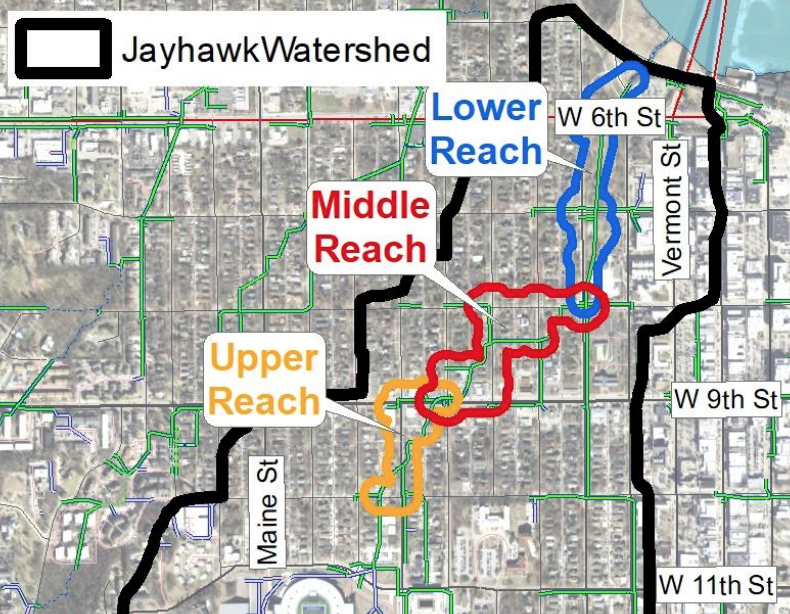
photo by: Screenshot/City of Lawrence
The three “reaches” of the Jayhawk Watershed. The city’s current stormwater projects are in the middle reach.
The stormwater projects going on now are part of the broader Jayhawk Watershed Project, which involves multiple areas of the watershed. The area that the current projects focus on is the “middle reach,” which was deemed a high priority to alleviate the risk of flooding during storms.
But there’s also an “upper reach,” which Engineering Program Manager Nick Hoyt told the Connected City Advisory Board last month was not as high of a priority. That’s because the storm sewer runs downhill in this area, so there wasn’t as much of a flood risk.
“All the water would just rush down to Mississippi,” he said.
But the University of Kansas’ Gateway district changed that calculus. As part of the city’s agreements with KU about the Gateway project at the stadium, about $14.5 million of the funds from the stadium’s Tax Increment Financing district will be available for the city to use for infrastructure projects in the general area of the stadium. And that gives the city the ability to fund the upper reach.
The original plans for the storm sewer at Ninth and Mississippi were drawn up before the city knew it would have funding for the upper reach, Hoyt told the advisory board. “What we want to do, now that we know that the upper project is funded,” he said, is get the storm sewer at Ninth and Mississippi so that it can connect to the upper reach when it’s eventually constructed.
Doing it at the same time as the other work on Ninth would avoid the need to close the street again later on, Hoyt said.
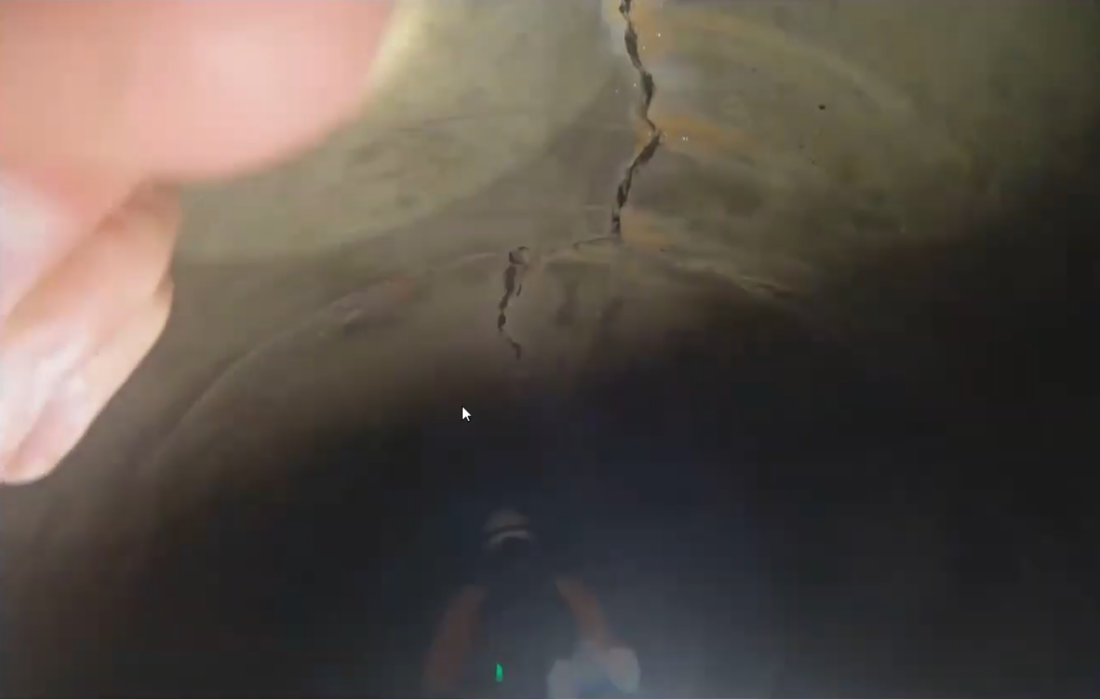
photo by: Screenshot/City of Lawrence
A video taken by workers shows a large crack in the storm sewer near Tennessee Street.
Then, there’s the other part of the change order, which gets us back to the crack.
The crack is inside of a storm sewer tunnel that runs beneath Lawrence’s outdoor pool – specifically, beneath the zero-depth entry part of the pool whose structural problems spurred the city to approve a renovation project in 2024.
At the advisory board’s meeting, Hoyt showed the board a claustrophobic video from inside the tunnels that reveals the crack. A crew can be seen walking in the storm sewer tunnels as part of the work being done on Tennessee Street, and partway through, they look up and see the flaw in the tunnel’s ceiling.
“This crack being directly under the failing part of the pool … that seems like something we should not do,” Hoyt said.
Hoyt said the city had discovered partway through the project that the tunnel passed under the pool. Originally, it was thought that the tunnel was farther to the west than it actually was.
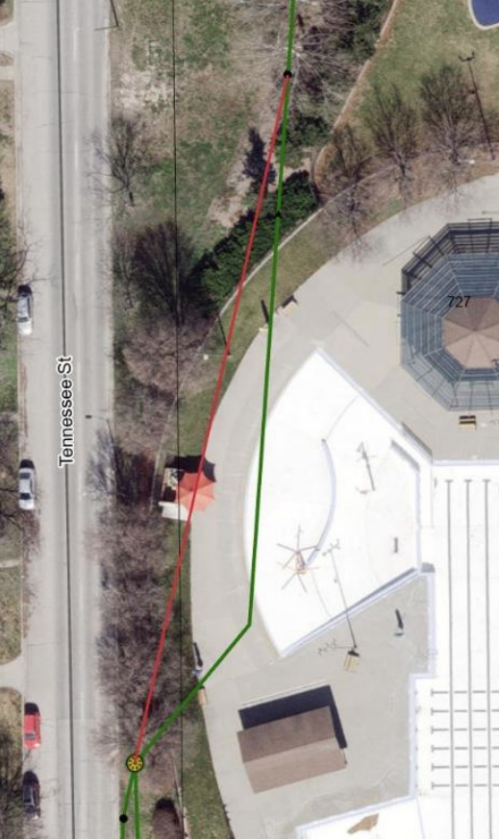
photo by: Screenshot/City of Lawrence
The red line shows what the storm sewer route was believed to be at the start of the Tennessee Street construction. The green line that passes under the Outdoor Aquatic Center is its actual route, which was discovered later.
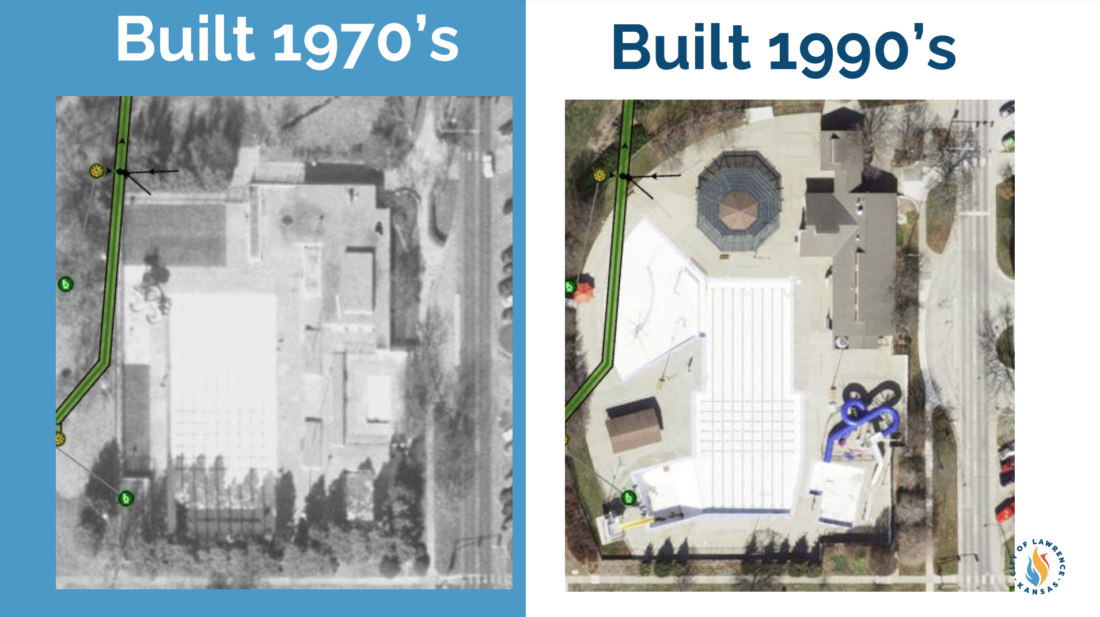
photo by: Screenshot/City of Lawrence
Two side-by-side photos show a storm sewer, in green, and the Lawrence outdoor pool in its old and new configurations.
He showed the board two photos of the outdoor pool – one of them as it was first constructed in the 1970s and one of them of the current pool configuration – with the route of the storm sewer superimposed on them. In the 1970s image, well before the shallow pool was added in the 1990s, the storm sewer runs nearly parallel to the west side of the pool. He wondered if the sewer had been relocated as part of the pool project back then, and if the renovation in the ’90s had simply overlooked it.
“It seems like they were pretty aware of where the storm sewer was when they built the pool in the ’70s,” he said. “When they built the pool in the ’90s, not so much, maybe.”
The change order would reroute the storm sewer project so that it no longer runs beneath the pool. Instead, it would pass through Watson Park beneath the basketball courts, where it would link up with the tunnels on the south side of Seventh Street.
Hoyt said the change would be an expensive one. “We’re putting in about 500 feet of 7-by-7 box,” he said. “… Installing the pipe’s about $2,000 a foot, times 500 feet. When you start adding the other stuff in, just this part is a multimillion-dollar change.”
But it’s a necessary one, he said, if the pool renovations are to continue on schedule. The pool is being renovated in phases, with the first phase focusing on the restrooms and other building improvements and the second phase focusing on renovating the aquatic areas themselves. The first phase is expected to be completed before the 2026 swim season, and the second phase is expected to start right after the 2026 swim season ends.
The goal, Hoyt said, was to get started on the changes to the storm sewer by June at the latest, so that the portion under the pool could be abandoned by the time the construction on the second phase begins.
“We don’t want to build the new pool over the storm sewer,” Hoyt said. “We want to get that part right.”
The City Commission will meet at 5 p.m. Tuesday at Lawrence City Hall, 6 E. Sixth St.
City Government
City staff recommends not reopening Ninth Street for World Cup; also, a nearly $5M change to a stormwater project

Lawrence City Commission to receive search firm proposals for city manager hiring process
In a new kind of debate, a circle of citizens asks whether Lawrence is doing enough on housing
City to host open house on Wednesday to discuss ideas for North Lawrence development, improvements
‘It’s going to be a great year’: In his 2nd stint as mayor, Finkeldei says he’s excited to help Lawrence grow