Lawrence City Commission to discuss possible transition to 100% renewable energy

photo by: City of Lawrence
Solar panels are installed by Good Energy Solution at the City of Lawrence's Prairie Park Nature Center in this photo from November 2014.
City leaders will soon discuss whether to commit to running on all renewable energy in the coming years.
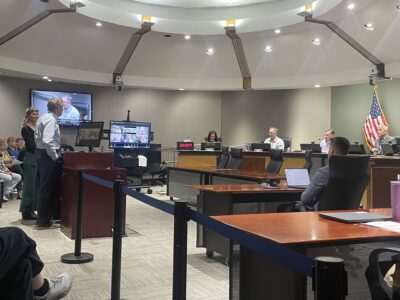
As part of its meeting Tuesday, the Lawrence City Commission will receive a recommendation from the Sustainability Advisory Board to adopt a policy committing to 100% renewable energy for city operations and, ultimately, the entire community.
Lawrence-Douglas County Sustainability Director Jasmin Moore said cities have some of the largest utility accounts and can therefore lead by example when it comes to energy use.
“By the city adopting this goal, in terms of committing to transitioning its own energy sources to renewable as well as setting a community goal, then it can send a signal to the utilities and to the community overall about our commitment to moving away from fossil fuels,” Moore said.
The city operates dozens of facilities, including police and fire stations, recreation centers, swimming pools, water treatment plants, a nature center, a golf course and multiple historic buildings. The city also has vehicle fleets for many of its operations, as well as its trash, recycling and compost services.
The Sustainability Advisory Board breaks its recommendation for the city’s clean energy goals into several steps. Initially, SAB recommends that the city use 100% renewable energy for the electricity needs of its municipal operations by 2025 and for electricity communitywide by 2035. By 2040, SAB recommends the city use 100% renewable energy for all energy sectors of its municipal operations, including electricity, heating and cooling, and transportation. By 2050, SAB calls for the city to achieve the ultimate goal of using all renewable energy for all energy sectors communitywide.
Moore noted that the local utility company, Evergy, has already been increasing the amount of its energy that is supplied by renewable sources. Moore said meeting the first goal could be as simple as buying into Evergy’s available renewable energy credits or entering an agreement with Evergy to supply the city’s power through only renewable sources. She said to supply all the city’s energy needs through renewable sources would be more challenging.
“That’s going to be a little bit tougher, and that’s why the Sustainability Advisory Board set goals for that to be further out,” Moore said. “Transitioning fleet over from diesel or gasoline to electric vehicles, that’s going to be a more costly transition at this point. And hopefully the technology will continue to evolve and that will become more affordable in the future.”
The recommendation does not lay out how the city would achieve 100% renewable energy for all its energy needs and ultimately all energy communitywide. Moore said it was difficult to imagine what technology would be available 10 years from now and even five years from now and that the board hoped the commission would adopt the goals and direct city staff to work on developing those strategies.
A memo to the commission regarding the recommendation states that the commission should identify a realistic implementation and transition plan to achieve the goals by the deadlines. It states that the commission should create a task force to make the plan or to include the plan in the upcoming update to the city’s climate plan.
The memo goes on to state that the cost of implementing the renewable energy goals are unknown at this time but that technologies are evolving quickly and costs for renewables such as wind and solar have been falling. A previous analysis also indicated the city could have saved about $115,000 annually by signing onto a renewable energy agreement that Westar, now Evergy, previously offered the city.
The city would not be alone if it decided to adopt such a goal. SAB’s recommendation states that 137 cities, 11 counties and nine states, districts or territories in the United States have committed to using all renewable energy, and six U.S. cities have already achieved it.
The SAB recommendation also notes that the city and community have already begun using some renewable energy. The city has installed solar panels on Fire Station No. 5, the Prairie Park Nature Center and has one solar powered parking light as a pilot project, according to the SAB report. Lawrence residents have also begun using renewable energy. In total, approximately 4,806 of the city’s 48,430 energy customers, or 10%, are already voluntarily paying slightly higher rates or other fees to utility companies to use or support renewable energy sources such as wind and solar.
In other business, the commission will receive a staff report on the city’s upcoming update to the Climate Action and Adaptation Plan. The city allocated $75,000 as part of its 2020 budget to update the plan, and the process is expected to get underway early next year.
City Government
Opinion: Local government made a small mistake. Taxpayers shouldn’t be on the hook to fix it

As club cancels ‘Beetlejuice’ screening at Oak Hill, city says there are no specific rules about events at cemeteries
Opinion: An $80 million Hail Mary that combines Costco and Lawrence’s love of trails
Lawrence Police Department receives KDOT’s top traffic safety award for second straight year
Lawrence City Commission approves extra layers of oversight for data centers, asks for patience on further regulations