Lawrence Virtual School faces financial challenges in midst of steep enrollment drop

photo by: Lawrence Journal-World
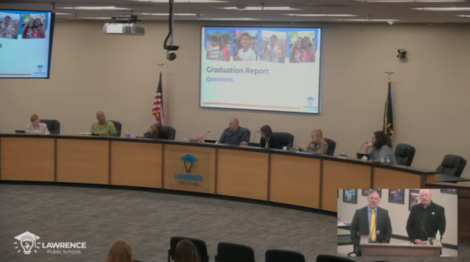
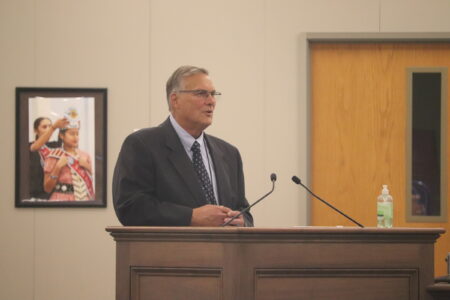
The Lawrence school board will meet on Monday, August 26, 2024 at the Lawrence district offices, 110 McDonald Dr.
A large enrollment drop at the Lawrence Virtual School is creating financial challenges for the longtime program that provides remote learning to students both in Lawrence and across the state.
According to the unaudited enrollment figures for the 2023-24 school year, Lawrence Virtual School (LVS) enrollment is down by 699 K-12 students compared to the pandemic-riddled 2020-21 school year. At a work session of the Lawrence school board on Oct. 23, board members were told that state funding also is taking a hit, in part because many of the students who remain in the program are counted as part-time students by state officials.
Patrick Kelly, the district’s chief academic officer, said that virtual school base aid had recently increased to $5,600 per full-time equivalent (FTE) student, compared to a traditional student that receives $5,088 in base aid. But if a virtual school student is considered to be part-time, the district receives only $2,800 per student.
The part time rate doesn’t do enough to cover the district’s costs, board members were told.
“If a student is not full-time, it has a big economic impact on us,” Kelly said, later adding that it can also boil down to a matter of fit for the student. “Part-time students are not cost-effective for us, but sometimes that is the right thing for those kids.”
Board members also were told that the state and the school district aren’t always on the same page in determining whether a student is full-time or part-time.
LVS Principal Zach Harwood told board members that full-time and part-time equivalency statuses are determined by the tracking of virtual minutes, and that “we’ve run into some limitations in our ability to track” that.
“It’s led to a substantial number of students who are full-time but are being counted as part-time by the state auditor,” he said.
Younger students decline
Kindergarten through eighth-grade students account for the bulk of the enrollment drop over the past three years, with 560 fewer students in K-8 classes. The district’s unaudited number for its Sept. 20 enrollment headcount checked in at 260 students in K-8 classes. That’s down from 820 such students during the 2020-21 school year.
The latest numbers show a particular trend toward shrinking kindergarten classes, where it is now to the point the current virtual school kindergarten class is extremely small. Kindergarten enrollment has dropped from 63 students three years ago to nine for the latest unaudited numbers.
Other grade school classes also are operating with small numbers. Fifth-grade enrollment, for example, has plummeted from 108 two years ago to (unofficially) 22 for the most recent year, with similar numbers across-the-board for K-8 enrollment.
Board members also briefly heard that high school enrollment was dwindling at the virtual school. Freshman enrollment has declined by 58 percent, from 120 in the 2020-21 school year to 50 currently. Enrolled seniors have also decreased from 128 last year to 104 this year, while enrolled juniors have increased by six since last year, according to the unaudited report provided to the Journal-World by the district.
More competition
Some of the enrollment drop likely can be attributed to parents who sent their children to virtual school during the pandemic, but now are more comfortable sending their students to traditional brick-and-mortar schools.
“We saw a pretty drastic (attendance) increase during COVID-19, and it’s dropped off a little since then,” Harwood said.
But that’s not the only factor. Part of the situation is simply more competition. Board members were told there are 64 virtual schools operating in the state, more than triple the number since 2017. That’s a far different competitive environment than what Lawrence Virtual School faced years ago. Founded in 2004, the school was one of the first virtual schools to operate in the state, and its enrollment showed that it was attracting students from far and wide. The district’s website touts that the virtual school had enrollment that exceeded 1,200 students in some years, peaking at 1,311 in 2021. The total unaudited K-12 enrollment now is at 612, and board members were told that most students come either from Lawrence or the Kansas City metro area.
School Board President Kelly Jones said the increased competition may be creating a greater need for the Lawrence Virtual School to do more strategic planning, around enrollment goals and marketing. Board member Bob Byers also said he wanted discussion about how much student recruitment the virtual school should undertake.
Kelly said that LVS has advertised in the past and that “there will be those that think we need to continue to do advertising.” Kelly added that the district needs to figure out how to extract the “best bang for the buck” and also how to generate more word-of-mouth advertising from students and families that have been pleased with the virtual school.
Amanda Gorman, who has taught at LVS since its inception in 2004, said that recruitment was primarily addressed through information sessions with families statewide, in which curriculums were presented to the families of prospective students. Fellow LVS teacher Vicki Case also said that she has “spent many a summer out on the road doing those information sessions.”
“Those opportunities to talk to people is where we get our best bang for the buck,” Case said.
Board members, though, also were told of workload and concerns that are developing with staff at the virtual school. Those issues run the gamut from a lack of time to complete grading and other such tasks during the traditional work week to concerns about professional development for virtual school teachers.
LVS lists more than two dozen teachers in its staff directory, plus several that serve in non-teaching roles. Kelly said that LVS has been working with other districts to try to gain a better understanding of teacher to staff ratios for a virtual school.
“But it’s very different for different districts (because) the model is different,” Kelly said.
K-12 Education
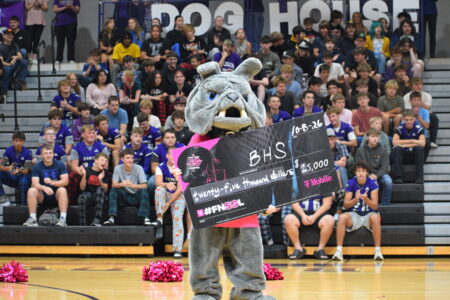
Baldwin High already has won $25K and is competing for $1M through national sports program
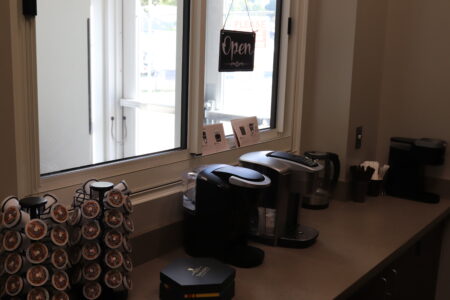
A student-run coffee shop will open at Community Connections at Pinckney next week
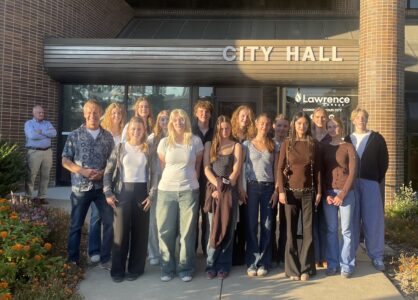
‘No day is like the other here’: Students from Lawrence’s German sister city discover football, new foods and new friends on exchange
Lawrence school district identifies $73.9 million in deferred maintenance and facilities needs

Lawrence school board to bring back public comment after 9-month hiatus