Criminal Justice Coordinating Council signals interest in implementing a night court session at Lawrence’s municipal court

photo by: Douglas County
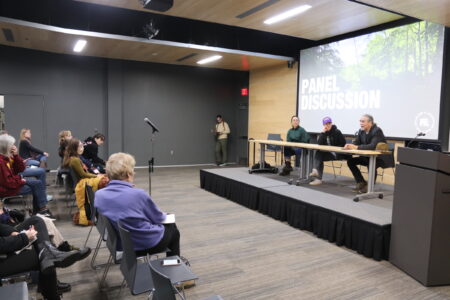
Douglas County's Criminal Justice Coordinating Council met Tuesday, March 14, 2023 and members voiced an interest in implementing a night court session at Lawrence's municipal court.
Members of Douglas County’s Criminal Justice Coordinating Council signaled Tuesday that they’re interested in trying to get a night court session implemented at Lawrence’s municipal court.
Lawrence City Commissioner Brad Finkeldei, a nonvoting member of the council, brought up the idea during the CJCC’s meeting Tuesday, which was focused on the group’s work plan for the next year. The council didn’t set a specific agenda for the coming year the last time it met in February, but it did more loosely discuss tackling issues of racial disparities and the Douglas County Jail population.
Tuesday’s meeting was a continuation of that discussion. The county’s Criminal Justice Coordinator, Katy Fitzgerald, told the council this week that the ideas she’s come up with in the past month involve forming new work groups dedicated to accomplishing specific outcomes, such as a set of groups focused on finding different ways to improve court appearance rates.
Finkeldei told the group that while he thought the Douglas County District Court would likely have a harder time implementing it, he was interested in the City of Lawrence looking into an evening municipal court session, and Douglas County District Attorney Suzanne Valdez said she agreed.
“I think we’d be willing to staff a night court,” Valdez said Tuesday. “One of the things that we see is that people have jobs and you have to have flexibility. The (8 a.m. to 5 p.m.) model of how government works, that’s fine, but we would love to be able to staff a night court. But we’d have to have the courts willing to do it.”
Other cities in the county are a step ahead of Lawrence on this front. Finkeldei said Eudora already has a night court option — the city’s website notes that municipal court is held on the third Wednesday evening of each month at 6 p.m. — and another council member, criminal defense attorney Shaye Downing, told the group that Baldwin City expects to start hosting night court every other month in the near future.
Chief Judge James McCabria said he, too, has thought a night court would be a good idea for a long time, but it wouldn’t be without its logistical and staffing issues for the district court. McCabria said he thought the municipal and district courts could start by discussing the issue together and then diverge later on if needed.
“I would definitely say there are considerations,” McCabria said. “I never like to think of something as impossible. Sometimes that’s the case. The other complicating factor for district court is in municipal court, you generally have one judge who’s seen everybody who’s there and in district court you have different judges assigned different levels of cases. If one judge issues a failure to appear warrant, they may not feel comfortable with another judge handling a docket where they don’t have the history of that case. They may not feel comfortable with an administrative way of dealing with it.”
Failure to appear rates were one of the key data points the council gleaned from a study of the county jail’s population presented by a Brooklyn-based criminal justice reform nonprofit, the Vera Institute of Justice, at the end of 2022. That study examined bookings at the jail during the past five years and found that the majority were for minor, nonviolent charges, and also that there were disparities in jail admissions that suggest law enforcement officers are more frequently arresting Black people relative to the general population.
Tuesday’s work group possibilities focused predominantly on points from that study, like failure to appear and probation violations being the two highest contributors of days spent in the jail. Fitzgerald said another work group, for example, could look into alternative responses to probation violations for both the district court and municipal court probation caseloads. Other groups might focus more on addressing racial disparities and the jail review process, using data to evaluate which specific populations of individuals may be driving the jail population issues as a whole.
Douglas County Administrator Sarah Plinsky, for her part, told the group she liked the idea of using such data to look for larger trends.
“I think it’s also really hard for us to measure success in this space,” Plinsky said. “Currently, the jail shares information weekly, and we know stuff happens from it. To sort of be able to put a checkmark next to that name and say ‘This person’s case was reviewed because of this report’ is … a little difficult to monitor. But I also want to stress to this group and to the public that this data is being shared, this information is being shared and reviewed by all of the stakeholders in the system on a regular basis.”
Other News

Theatre Lawrence’s production of ‘The Cottage’ is a little bit Noel Coward, a little bit John Cleese
Burn ban in effect for Douglas County; severe weather expected Tuesday afternoon and evening
A burn ban has been issued for Douglas County because of a "very high" fire danger index. According to the ...
Welcome center, preschool expansion, more college credit options among Lawrence school district’s plans for 2026 and 2027

The little details helped Lawrence attract Algeria for the 2026 FIFA World Cup; how organizers secured the team and what work needs to be done
FBI says threat that caused Kansas City International airport to be evacuated found ‘not to be credible’