Lawrence-area parents crowdsourcing infant formula via social media amid national shortage
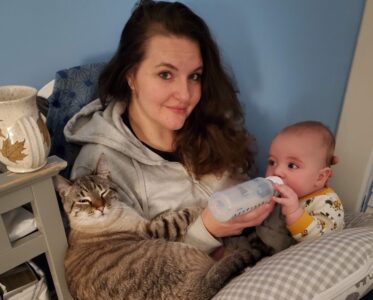
photo by: Contributed
Megan Luttrell, of Baldwin City, is pictured with her 6-month-old son, Rowan Luttrell-Guss. Luttrell has not been able to breastfeed successfully and has felt the impacts of the nationwide infant formula shortage.
The infant formula shortage affecting America is making a local impact, and Douglas County parents are scrambling to find alternatives.
The problem began in mid-February when the largest infant formula manufacturer in the country, Abbott Nutrition, initiated a voluntary recall of certain batches of powdered formula — Similac, Alimentum and EleCare — following concerns of a bacterial contamination at an Abbott manufacturing facility in Michigan and the death of two infants.
Both Kansas’ government and the federal government have taken recent action to help mitigate the issue. That includes strategies like, at the state level, Kansas Gov. Laura Kelly broadening which formula products those receiving WIC benefits — supplemental foods and health care referrals for low-income pregnant and postpartum women — are eligible to receive. Federally, President Joe Biden signed the Access to Baby Formula Act into law over the weekend, providing federal agencies with options to help vulnerable families buy safe infant formula.
Nevertheless, store shelves across the country are still largely bare. It’s a challenge that has forced many local parents to crowdsource their infant formula. Many area social media groups have seen an influx of posts informing others about where certain types of formula are in stock in town. One Facebook group geared specifically toward that effort, “Lawrence Baby Formula Connection,” had 170 members as of Tuesday afternoon.
Megan Luttrell, a musician who lives in Baldwin City, is one of the mothers in that group. Luttrell spoke to the Journal-World Tuesday afternoon about her personal experience with navigating the shortage and how it’s affected her 6-month-old son, Rowan Luttrell-Guss.
“I’m not entirely sure who started it, but I am so grateful that they did,” Luttrell said of the group. “It’s amazing to see all these moms and other parents banding together to help each other out.”
Luttrell said she relied on formula to feed Rowan because she was unable to breastfeed easily. She said she tried at first but didn’t produce enough milk, so she and her husband decided to consult with their pediatrician and supplement with an infant formula.
They were advised to go with a type of Similac formula, one of the brands that was recalled. It soon started disappearing from shelves, so the pediatrician suggested a different brand, Enfamil. Their pediatrician provided some sample cans to make sure Rowan would react favorably to the switch.
“He did fine with them, and then when I go to buy that brand, I couldn’t find it anywhere at all,” Luttrell said. “I mean, it was gone from the shelves. The shelves were basically empty.”
Luttrell rattled off a list of retailers that she checked with no luck: Target, Walmart, CVS, Walgreens, Costco, Amazon. Rowan was supposed to be eating a sensitive formula, but the family eventually had to switch to the regular formula out of necessity. Even that proved difficult to find.
Along with the small army of local parents keeping each other informed on the Facebook page, Luttrell said she’s enlisted the help of her father in Colorado and in-laws in Baldwin City to find more stock wherever possible. A friend and fellow parent living in Massachusetts has even mailed formula to Luttrell here in Kansas.
“It’s incredible to see these people really wanting to help each other, and there’s always a sense of guilt, you know, if I pick up the last can off the shelf,” Luttrell said. “I’m sitting there worried about ‘What about the next person who comes along and is trying to get what I’m getting?'”
•••
Local health care providers, like Lawrence-Douglas County Public Health, have been trying to fill in the gaps. Health department spokesperson Daniel Smith told the Journal-World in an email Monday that the department’s WIC team has been inundated with calls about the shortage from clients and other community members, and they’ve also noticed the surge in activity on social media around formula distribution and access.
Smith said while the WIC team does supply formula for its clients, it isn’t able to provide formula on a broad basis. With that in mind, the health department actively updates a list of WIC-eligible substitutions for any types of formula clients can’t find on shelves.
Otherwise, Smith said the health department has been directing clients to contact local pediatrician offices or Just Food if they’re in need of formula and also asking those who wish to donate spare formula to connect with Just Food.
But finding an alternative to those recalled formula brands isn’t quite as simple as just picking another one. In Rowan’s case, his pediatrician recommended a specific type of formula, and switching away from it has caused side effects like daily diarrhea.
Tonia Berry, pediatric clinic manager with Panda Pediatrics, told the Journal-World that pediatricians specifically prescribe certain formulas to accommodate certain health conditions and allergies. Berry said the practice has been encouraging its patients to work with their physicians to determine individualized treatment plans that can help mitigate the limitations in what’s available right now.
On top of that, a baby’s first few years of life are crucial to their development, Berry said, and that starts with making sure they have all the nutrients they need to be healthy.
“No one’s plan of treatment, essentially, is the same,” Berry said. “It’s all based upon that child’s needs. We understand that it is a shortage and it is a huge deal, but we also recommend contacting your pediatrician.”
Berry said Panda Pediatrics has been getting daily calls from concerned parents. Their main phone line, (785) 842-4477, can direct established patients to a nursing triage line for more immediate concerns, or the phone tree can also help direct new patients to establish care.
The practice has its own limited stock of infant formula it shares with established patients, which Berry said has already been purged of any recalled batches. They’ve also been disseminating a product locator tool provided by Abbott to help patients track down restocked Similac formula.
“We’re making sure that we’re paying close attention to everything that we have, as well,” Berry said.
•••
Luttrell said she considers herself one of the lucky ones; though Rowan has to deal with an upset stomach caused by switching off sensitive formula, he doesn’t have an allergy that could cause even worse effects. Luttrell said she worries for other moms who have infants with very specific formula needs and are struggling for access.
But another unfortunate effect of the formula shortage has been the prevalence of comments questioning why parents who are struggling don’t just breastfeed. Luttrell said those comments “cut her to the core.”
“I tried so hard to be able to do that for him, and I physically couldn’t do it,” Luttrell said. “There’s so much judgment still against moms that use formula for whatever reason, even if you can breastfeed and you choose not to; it’s no one’s business.”
That’s why Luttrell said she believes people should have more empathy toward mothers who can’t or choose not to breastfeed. Especially given the challenge of the formula shortage by itself, Luttrell said adding those comments to the pile can be especially painful.
Beyond that, Luttrell said seeing parents and other community members supporting each other locally has nevertheless been inspiring — and has been indicative of the “heart of Lawrence,” she said.
“The Facebook group and just that general (idea) of ‘Let’s help each other out,’ I just think that speaks so much to what Lawrence is all about,” Luttrell said.
Health
Florida’s dengue outbreak is largest in a US state in decades
NEW YORK — Florida’s current dengue outbreak is the largest in several decades of any U.S. state. State ...
Doctors warn about risks of energy drinks to kids
Kansas measles cases grow to 5
TOPEKA — Five measles cases reported in Kansas are related to out-of-state travel, health authorities said ...
Lawrence city leaders want to toughen tobacco licensing rules ‘sooner than later’

At 40, her first mammogram changed everything: LMH Health nurse urges others to get screened