While county leaders agree crisis center talks are progressing, they have questions about Bert Nash’s interest in operating it
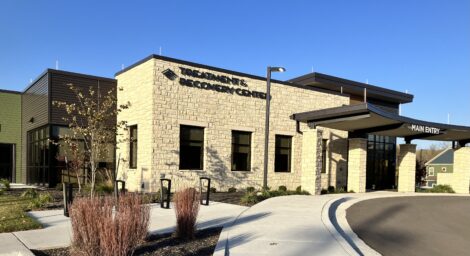
photo by: Kim Callahan/Journal-World
The Treatment and Recovery Center of Douglas County is pictured on Saturday, Oct. 22, 2022.
Douglas County leaders agreed Wednesday night that discussion around who will run the county’s behavioral health crisis center was progressing, but they had many questions for the local provider that’s now being recommended as the entity to take charge.
Until about four hours into Wednesday’s Douglas County Commission meeting, a nonprofit called Behavioral Health Partners had been the entity vying to operate the Treatment and Recovery Center of Douglas County. But BHP board member Nancy Thellman, speaking on behalf of the board, told commissioners that the board was recommending that Bert Nash Community Mental Health Center be the operator instead.
It wasn’t clear Wednesday night exactly how long Bert Nash has been preparing itself to be a candidate for operating the facility, but Bert Nash CEO Patrick Schmitz did run through a list of actions Bert Nash has taken recently to that end. That list aligned with some of the information he and other members of the TRC staff shared during the presentation earlier in the night. Schmitz is also a BHP board member.
For one example, Schmitz said Bert Nash has initiated a transition of all TRC-dedicated staff stationed at LMH Health over to Bert Nash, and has discussed transferring the facility’s current temporary private psychiatric hospital license from BHP to Bert Nash with the Kansas Department for Aging and Disability Services. Schmitz said Bert Nash also secured $1 million in bridge funding from KDADS on Wednesday to support a continued partnership toward operating the TRC.
Schmitz also said, notably, that all existing TRC contracts have been shifted to Bert Nash or eliminated if they’re no longer needed, and he asserted Bert Nash’s readiness to begin talking about a lease and operating agreement before the end of the month.
“We have initiated with our legal counsel the work necessary to complete operating agreements and a facility lease, and we anticipate being able to enter into conversations on these documents prior to and following the Christmas holiday,” Schmitz said.
Finally, Schmitz said he’s personally committed to meeting with Douglas County Administrator Sarah Plinsky once per week at a minimum to review progress and address any of the county’s concerns, and said the same of his willingness to appear before the commission.
Schmitz told the commission that Bert Nash has contracts for strategic communications, website management and public relations, and it’s also currently evaluating a scope-of-work proposal from an additional national expert in crisis service program design, financing and evaluation. That consultant is the Boston-based Technical Assistance Collaborative, a nonprofit organization that, among other functions, provides policy leadership and consultation in a number of areas, including health care.
That nonprofit would join Arizona-based Connections Health Solutions, which is already under contract with the county for consulting services. Plinsky has previously confirmed to the Journal-World that the county’s conversations with Connections have included the possibility of going beyond just acting as a consultant, though.
…
Commissioners had no shortage of questions for Schmitz at the end of Wednesday’s presentation. Commissioner Patrick Kelly asked how Schmitz envisioned Bert Nash would go about gathering community feedback about the center if it does become the operator, and Schmitz said that’s something he sees as important. He said there would be increased opportunities for folks to offer feedback through public listening sessions.
Schmitz also floated the idea of reconstituting or changing the Douglas County Behavioral Health Leadership Coalition to make it more robust in its oversight, possibly in a similar fashion to the county’s Criminal Justice Coordinating Council.
Kelly also asked about the facility’s executive director role, which apparently remains unfilled after previous executive and medical director Dr. George Thompson submitted a contentious resignation letter last month. Specifically, Kelly wanted to know who has the authority and is ultimately responsible for the TRC’s function.
“If you agree to this shift, it’s me,” Schmitz said. “You get to call me up here when you’re unhappy or when you’re happy. When you’re happy, let’s bring (the TRC staff), but when you’re unhappy it needs to be me standing here or sitting in (Plinsky’s) office having difficult conversations, which we are not afraid to do.”
Commissioner Shannon Reid asked about what Bert Nash’s interactions with Connections have looked like, and added later that she doesn’t want to remove the for-profit company from the equation since it has been a partner for the county for a while. Schmitz said he personally hasn’t communicated much with Connections consultants, and as a result it would be “challenging” to say what the company’s role might look like moving forward. He did note, however, that he’ll be speaking with Connections on Friday to hash that out.
“I believe there’s a value for an ongoing consultant to evaluate and help us finish this project — and I’m not talking like two days after opening; I’m talking a long-term, 12-month, 18-month ongoing evaluative kind of agreement with an entity that can truly act in an independent manner in how effectively we are spending taxpayer dollars and how we are doing an excellent job in caring for individuals,” Schmitz said. “I welcome that; I just want to make sure that we have clarity about what the role is, what the purpose is and what the value is for that.”
Reid said that information and context gleaned from those conversations would help inform the choice of who runs the center. The commission didn’t take any action on that front or lay out a timeline for when the county might be ready to make that choice, but Reid did say she felt that Wednesday’s presentation helped to move things much closer to that goal.
“… Moving towards an operating agreement, negotiating that with the county and an operator, is a critical priority for the county, and I believe that we are on the cusp of that,” Reid said.
Kelly, however, still had some concerns based on information in the presentation about the TRC, like figuring out whether the facility’s staff is ready to treat every patient who walks through the doors, regardless of severity. Kelly noted that those concerns can still be resolved and hoped that leaders could establish some benchmarks for how to accomplish that.
Both Reid and Kelly shared some regret over how the conversation around operating the TRC has played out. Kelly, for his part, said there’s some work to be done to “figure out a way that we can evaluate ourselves without beating each other up,” whether that be through a third party or otherwise.
“Sometimes, as a community, we’re our own worst enemies,” Kelly said. “And I have to say with this whole process, I’m a bit ashamed how it went. I really wish it had gone better. I don’t know that we’re there yet, I still think we have work to do. But tonight — to me, at least — we got a lot of the information that we’ve been missing and I’m appreciative of that.”
Other News

U.S. Sen. Roger Marshall faces Democratic, Libertarian challengers in general election

Incumbent Douglas County commissioner and newcomer challenger face off for District 5 seat
Primary winner faces incumbent’s write-in campaign in Douglas County Commission District 4
A student-run coffee shop will open at Community Connections at Pinckney next week
Douglas County commissioners to discuss proposed changes to funding agreements with community partners