Citing mandate from voters, Douglas County Commission moves forward with new model for indigent defense
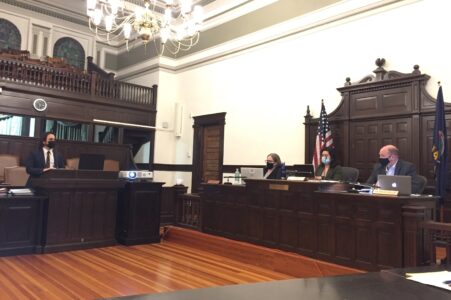
photo by: Rochelle Valverde
Kansas Holistic Defenders Chair Sam Allison-Natale answers questions from the Douglas County Commission as part of its meeting Nov. 17, 2021.
Douglas County leaders have voted to move forward with a new more holistic model for handling public defense for people who are accused of crimes and cannot afford attorneys.
As part of its meeting Wednesday, the Douglas County Commission voted unanimously to award a contract for indigent defense services for misdemeanors to Kansas Holistic Defenders for 2022. Commissioners agreed that the system needed to change to better support those accused of crimes and address inequities in the criminal justice system.
Commission Chair Shannon Portillo, who focused on criminal justice issues as part of her campaign, said addressing indigent defense was a mandate from voters and that it was important to spend taxpayer money in ways that “really fit with the values of our community.”
“It is important that we play our role of collecting community feedback, hearing what the mandate is of our voters,” Portillo said.
The decision was made after the commission received competing proposals to provide indigent defense for people accused of misdemeanors, and some criticism about the county’s process from those involved with one of the proposals.
In February, KHD proposed that it help provide indigent defense for misdemeanors using a different model that offered broader, holistic support to those accused of crimes. KHD requested $425,000 in county funding for 2022 to provide another option in addition to the existing panel. The commission set aside that funding as part of its 2022 budget, but the allocation was not finalized until Wednesday’s vote.
Last month, the county received a second proposal to provide a similar service from another attorney group, Douglas County Defense Services. DCDS requested $525,000 in county funding for 2022. The group includes some attorneys who previously criticized KHD’s proposal and some who have also served on the panel. Some involved with the group also recently criticized the county’s process for considering the change.
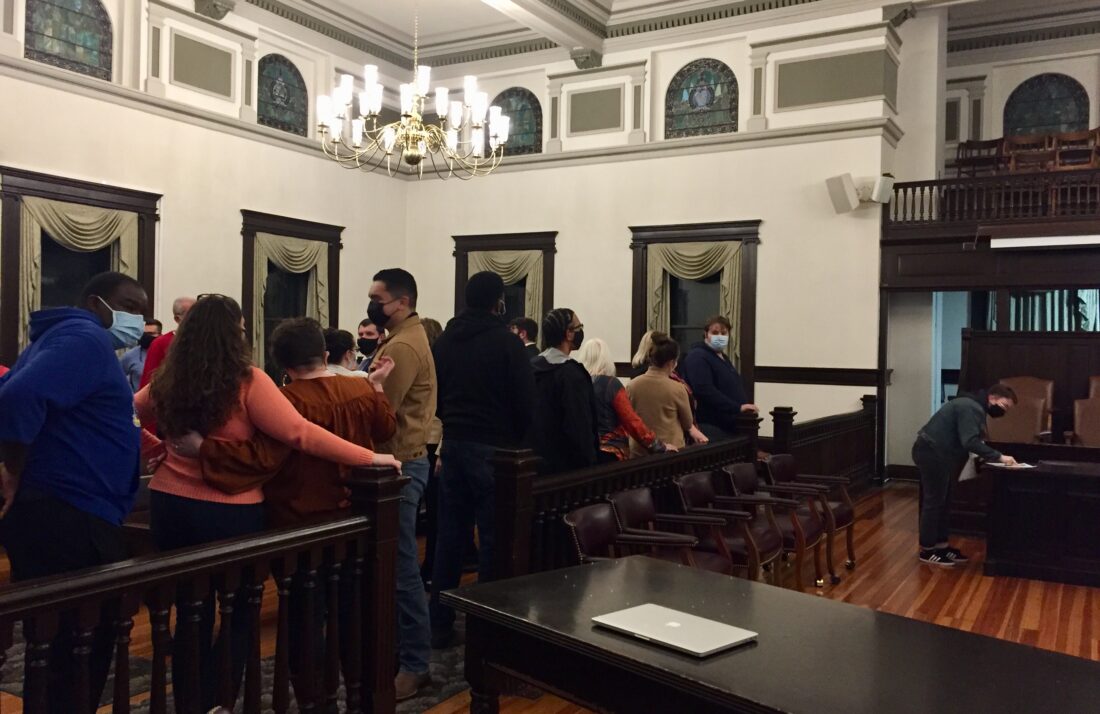
photo by: Rochelle Valverde
Members of the public line up to make comments to the Douglas County Commission as part of its meeting Nov. 17, 2021.
One of the key differences between the two proposals is that KHD would operate under what is known as an institutional model, meaning that the attorneys would be part of the same office and work as a team. The DCDS would essentially contract with seven attorneys.
The county’s Indigent Defense Services Work Group recently stated in a report that there are multiple benefits to an institutional model, including ongoing training and mentoring for attorneys; data collection and analysis; a clear point of contact for defense attorneys; and opportunities for collaboration with other offices in the criminal justice system and community, among others. The report also noted that Gov. Laura Kelly’s Commission on Race, Equity, and Justice (CREJ) has made a formal recommendation that communities with more than 100,000 residents should adopt institutional models. The CREJ argued that those communities would decrease the current racial disparities by engaging with institutional defense models and should immediately move toward implementation, according to the report.
Commissioner Patrick Kelly said he recognized there were some issues with the county’s process and that the county needed to continue to work on that, but that it was important for the county to makes changes to improve public defense and that looking to new models was sometimes needed.
“But often change comes from actors who are outside of the system and that can be pretty disruptive for those who are inside of the system,” Kelly said. “The three of us are inside of the system, the courts are inside of the system … it’s hard to see when you’re in the system how to operate better.”
Commission Vice Chair Shannon Reid, who along with Portillo focused on criminal justice issues as part of her campaign, also agreed that such as change was a mandate from voters.
“For me, it has been a mandate of our community for some time to change the way that defense services are provided for poor people in our community,” Reid said.
The commission heard an hour and a half of public comment, and several people spoke in favor of KHD’s proposal and its goal of providing more holistic indigent defense. Supporters of DCDS’s proposal, however, questioned whether attorneys that will serve with KHD would be experienced enough and raised concerns about the potential for conflicts under their model that would cause a significant number of cases to have to go the panel instead of to KHD attorneys. KHD Chair Sam Allison-Natale said he anticipated about 10% to 15% of cases would need to go to the panel because of attorney conflicts.
As part of the vote, commissioners also directed county staff to develop a community partner agreement with KHD. Commissioners expressed concern about potential inequity between those served by KHD attorneys and the panel, and requested that county staff have additional conversations about how to ensure those clients also received the same level of support and services. Details of those discussions will be brought back to the commission as part of a future meeting.
County Government
Douglas County commissioners express interest in fireworks sales dates that include a weekend

Douglas County commissioners to discuss whether to increase the number of days fireworks can be sold in the county
Housing Stabilization Collaborative’s new system directs rental and utility aid to more vulnerable households, review finds
Housing Stabilization Collaborative’s request for city trust fund aid won’t be considered because it was filed late
Douglas County commissioners discuss tracking results of awarded funding to community partners