

Lawmakers hear pointed comments from public, calls for an independent commission at redistricting town hall meeting in Lawrence
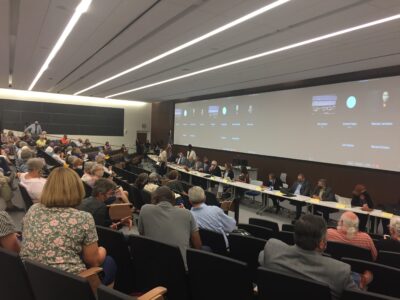
photo by: Rochelle Valverde
Kansas lawmakers prepare to host a town hall at Capitol Federal Hall, 1654 Naismith Drive, on Aug. 13, 2021, about the redistricting process.
Lawrence residents and other attendees did not hold back during a town hall meeting Friday hosted by Kansas legislators as they prepare to redraw the state’s political boundaries.
The House and Senate redistricting committees scheduled a total of 14 town hall meeting across the state this week to give residents a chance to provide input on the redistricting process as the committees prepare to redraw congressional, legislative and State Board of Education districts next year. About 100 people attended the event in Lawrence, the last of this round of town hall meetings, and several took the opportunity to urge lawmakers to make fair redistricting decisions or to say that they did not think elected leaders could be impartial in decisions that affected future elections, and that an independent body should complete the task.
Sonja Czarnecki, a member of the League of Women Voters of Lawrence-Douglas County, said that the league has for decades advocated for an independent commission to draw congressional and state legislative maps.
“We know that no matter how legislators might fight the temptation to draw maps that benefit them or their party, that temptation is averted with an independent commission,” Czarnecki said.
The U.S. Census Bureau released its first data for cities and counties Thursday. As the Associated Press reported, lawmakers must account for shifts in population across Kansas and make districts as equal in population as possible, but political considerations such as protecting incumbent lawmakers and helping each party’s chances in the 2022 elections are likely to play a big role.
In the absence of an independent commission, Czarnecki said the league, which is a nonpartisan organization, called for lawmakers not to use district boundaries to dilute the voting power of communities of Indigenous people and people of color. She asked for a transparent process that kept communities intact and followed political boundaries of cities, counties, school districts and townships as much as possible. Regarding Lawrence in particular, she noted that until roughly 10 years ago, the city was split between two congressional districts and that should not happen again.
Patricia Willer, chair of the Douglas County Democrats, said the organization strongly feels that minority voting strength should not be diminished. Willer said the DCD requested that when establishing districts for the state Legislature, the committee should not split up Douglas County. She said that currently there are portions of the county assigned to districts that consist largely of parts of other counties, which splits up the community.
“Douglas County is a community and would be well served to be made whole,” Willer said. “Our rural areas that have been assigned elsewhere have strong identification with the services, government and issues of Douglas County, so we hope that you will consider that.”
Douglas County Clerk Jamie Shew, speaking to the practical challenges for his office, asked that precincts be kept whole. He gave the example of Willow Springs Township, which has about 1,100 voters. In the recent past, it was divided horizontally by a House district and vertically by a Senate district, giving the township four districts and meaning that a primary election would require eight different ballots for 1,100 people.
“Whatever changes you make, if you can keep precincts whole, that is vital for all of us,” Shew said.
Several speakers also criticized the condensed five-day schedule of town hall meetings as well as the timing of some of the meetings, saying that it limited many residents’ ability to attend. Friday’s meeting began at 1:30 p.m., and speakers said they hoped additional town hall meetings, including more meetings in the evenings and on weekends, would be held to give the public a better opportunity to attend. To that point, one woman who had signed up to speak entered the meeting just as it was being brought to a close, hoping she could still give her input.
Topeka resident Glenda Overstreet Vaughn said she was working that day and was still on her way to the meeting — listening to it in the car — when she heard her name being called to speak. Vaughn said that considering that the U.S. Census reported an increase in minority populations and that some of the lawmakers supported recent voting law changes that critics say restrict the ability to vote, they could not be trusted to do the important work of redistricting.
“There are a number of you that sit at this table that were very instrumental in pushing for those restrictive voting (laws), so that concerns me greatly about the ability for you to be impartial in looking at some of the things that we need to have done with respect to redistricting,” Vaughn said. “That being said, I look at what Maya Angelou said, and she said ‘When someone shows you who they are, believe them.'”
Vaughn, stopping briefly because of loud applause from the audience, said she hoped the lawmakers had the professionalism within them to be able to delegate the responsibility of redistricting to a more neutral, independent body. She said with an independent commission, Kansas residents could feel that they’d be impartially represented.
State Rep. Chris Croft, an Overland Park Republican and chairman of the Kansas House Redistricting Committee, told attendees at Friday’s meeting that the redistricting process would be a transparent process and that their input was important.
“What we asked you for today you’ve given us in spades, and we appreciate that,” Croft said.
Responding to the criticism about the schedule for the town halls, Croft said that the week’s meetings were not intended to be the extent of the opportunities to provide feedback. He said the redistricting process would include additional town hall meetings in the future and that once maps were proposed, there would be hearings and other steps ahead of the approval. He said additional comments could be sent to redistricting@klrd.ks.gov, submitted via KSlegresearch.org, or mailed to the Kansas Legislative Research Department offices in Topeka.
State Government
Constitution Day program goes global with mock trial for third graders
Records request shows questions about how transgender voters must register for elections
TOPEKA — A Kansas Republican Party officer called the Secretary of State’s Office in July to ask why a new ...
Kansas governor candidates debate who is more extreme, issues ranging from data centers to abortion
Marshall, Hamilton square off in U.S. Senate debate at Kansas State Fair, as crowd becomes raucous
Kansas revenues 10% above estimates for first months of new fiscal year
TOPEKA — Kansas tax collections trended upward in the first two months of fiscal year 2027 coming in 6.5% above ...
Kansas primary yields 2nd-highest voter turnout in the state’s history
TOPEKA — The Aug. 4 primary election, which featured contentious races and a hot-button ballot question, had the ...