Small Claims Court of Douglas County often full of surprises
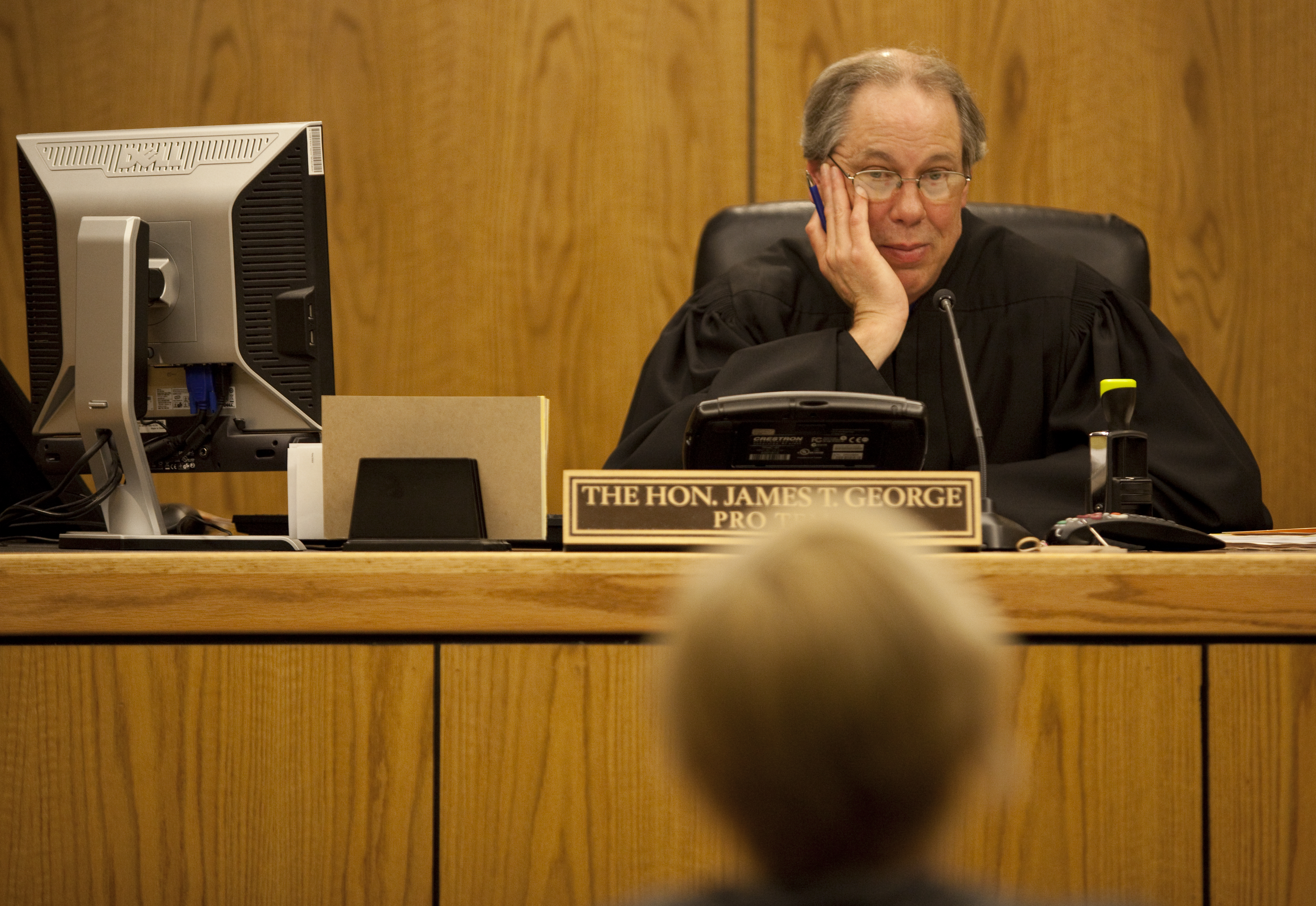
Judge Pro Tem James T. George listens to a plaintiff Thursday, May 5, 2011, in small claims court at the Douglas County Judicial and Law Enforcement Center.
The defendant’s word is no good.
That’s the marvelously uncomplicated legal argument being made in Douglas County District Court by litigator Marc Elster. He sits at the plaintiff’s table of the county’s smallest courtroom. Defendant Ryan Beck sits at the other table.
The oath already has been administered. The judge already has made the introductions. The case already has been called. Now, it is the time where good litigators shine. It’s speech-making time.
Elster never rises from his chair but does motion to the other side of the room. He describes a loan gone bad between what were supposed to be two friends. About $1,100 in total and countless text messages and phone call-promises of repayment that never were fulfilled.
The defendant, Elster says, simply promises one thing and does something quite another. The court should end that today.
Beck sits alone at the table. Not even the traditional legal props of an accordion file or a yellow notepad accompany him. Surprisingly, he looks rather unconcerned.
That’s the way it is here — almost always simple, but usually not lacking in surprise. This is the Small Claims Court of Douglas County, and perhaps the biggest surprise is who is not here: lawyers.
Elster, you see, is not an attorney. He’s the man who wants his $1,100. And Beck sits alone because those are the rules. Small Claims Court is perhaps the oddest place in the courthouse. It is a place you didn’t think existed. It’s the Land of No Lawyers.
“It stands logic on its head,” said Judge Pro Tem James T. George, who oversees the proceedings.
• • •
George has to make the announcement himself.
As a fidgety crowd of about a half dozen waits, he walks through the door behind the bench and simply says “All rise.” In this courtroom there is no bailiff, no court reporter or anybody else to make the proclamation for him. But it is one tradition that stands even in Small Claims Court.
Many others fall. That’s what makes the court, which meets every Thursday in the Judge Pro Tem’s courtroom at the Douglas County Judicial and Law Enforcement Center, unique.
You already know about the no lawyer rule. That one applies to everyone. Even if a company is sued and has a lawyer on staff, he or she is barred.
“Any employee could represent the company, as long as it is not the attorney,” George said.
The traditional rules of evidence take a particular beating here. There’s no need to know the procedures taught in a law school to present a case in Small Claims Court. Usually a case is as simple as you telling your story, and the other side telling theirs. One rule that is in effect is the hearsay rule. That means if you heard something, and you want the judge to hear it, you’ll have to get the person who said it to the courtroom. But as a litigator, you do have the power to subpoena a witness to testify.
One brave plaintiff last week actually subpoenaed a Lawrence police officer to testify in a dispute regarding the plaintiff’s car being towed from an apartment complex. It didn’t appear to be the highlight of the officer’s day, but the testimony did help the plaintiff win a $200 judgment against the complex.
• • •
There was a card game, your honor. Poker, actually, in a garage in Overland Park. Pretty much every Tuesday night.
Ah, here it is, the small claims surprise.
When Beck got his turn to talk — each side is allotted about 7.5 minutes — he very easily owns up to being a poker player.
You see, Beck claims the $1,100 was never a loan. Instead, Elster and he had met at this card game through a mutual friend. Beck soon learned that Elster had a practice of — he believes the phrase in the industry is — “staking” some players. In other words, Elster would provide the cash for an evening of play and be repaid — plus anywhere from 20 to 50 percent interest — with the winnings.
Theoretically.
“I can play the game OK,” Beck told the judge. “But I don’t win every time. It is about 50-50. He was rolling the dice.”
Elster’s rebuttal strategy probably has some fancy law school name, but it seemed to center around calling the defendant’s integrity into question.
“He’s lying through his teeth,” is how Elster would later describe Beck’s story.
Sure, Elster said, the two had played poker together. But he denies being a stakehorse for anybody. He loaned Beck the money to tide him over while he was looking for work. As for Beck’s version …
“That’s the first time,” Elster says to the judge, “that I’ve ever heard that story.”
Welcome to Small Claims Court.
• • •
Probably the biggest tradition that is broken in this court is the one of writing a big check to have justice done.
If you are looking to file a case where you would be awarded $500 or less, the filing fee is $49. If the amount of damages is over $500, the filing fee is $69. The time is pretty minimal, too.
Filing mainly involves filling out a form that lists your version of events, the defendant’s name and address, and the amount of damages you are seeking. The filing is done in the clerk’s office of the Douglas County District Court. The court’s website has a pamphlet that offers some pointers.
But, of course, there is a catch. You can’t seek more than $4,000 in damages, thus the “small” in Small Claims Court.
Sometimes it ends up being even smaller than people imagined. Just because you win a case in Small Claims Court doesn’t mean the court is going to get the defendant to give you the money.
“Believe me, winning a judgment and collecting a judgment are two different things,” George told the court crowd on at least three different occasions last week.
But winning a case does give you some legal leverage. At that point it becomes a legal debt that can be turned over to a collection agency or an attorney. The judge also can issue a bench warrant for a defendant, if the defendant continually refuses to pay.
“I think, eventually, most judgments get paid,” George said.
• • •
There would be no pay for Elster though.
The judge makes a ruling immediately after the case is presented. Sometimes he spends upwards of 5 minutes or so — while the crowd watches — reading documents related to the case and reviewing other evidence. In Elster’s case, though, there wasn’t any. There was no loan contract. No copies of the text messages promising to pay. Just two tales.
“There are obviously two different stories being told here,” George says as he invites the parties to the bench.
He warns everyone at the beginning of the proceeding that if he can’t tell who is telling the truth, the defendant wins. Kind of like the sandlot rule of all ties go to the runner.
That was the case here. He has both parties sign the decision, noting, “It doesn’t mean you agree with it, but it does mean that you were here.”
He sends both on their way with what appears to be the closest thing he has to a catch phrase — don’t expect a Judge Judy-style lecture.
“That’s all I’ve got,” he simply says as he places the documents in their hands.
Outside the courtroom, Elster is asked whether going through the process made him at least feel better. Let him get it off his chest, so to speak.
“Not really,” he says. “But it is better than not having an issue resolved, or resolving it in ways that will get you in trouble. Stay away from that. That will get in you in another type of court — criminal court.”
The surprises there can be a little tougher to swallow.
Public Safety

Lawrence Police Department announces 28-year-old officer’s death

KBI investigating deaths of 2 children reportedly shot by their young sibling
Man convicted of trying to kill his grandfather by shooting multiple rounds into his Lawrence home
Gang member who was acquitted in 2022 Douglas County shooting gets 5 years for machine-gun crimes

Car runs into storefront at Hillcrest Shopping Center