Summer bummer?
Burnout a concern with recent KSHSAA rule change

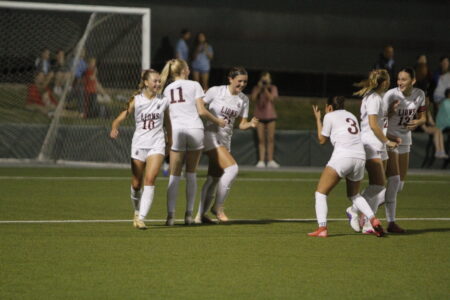
Lawrence High senior basketball players Marcus Ray and Haley Parker, shown above, from left to right, in winter, fall, summer and spring attire, have taken advantage of the opportunity to spend more time working with their high school coaches this summer thanks to a rule change adopted by the Kansas State High School Activities Association. The rule change eliminated the restrictions placed on summer contact.
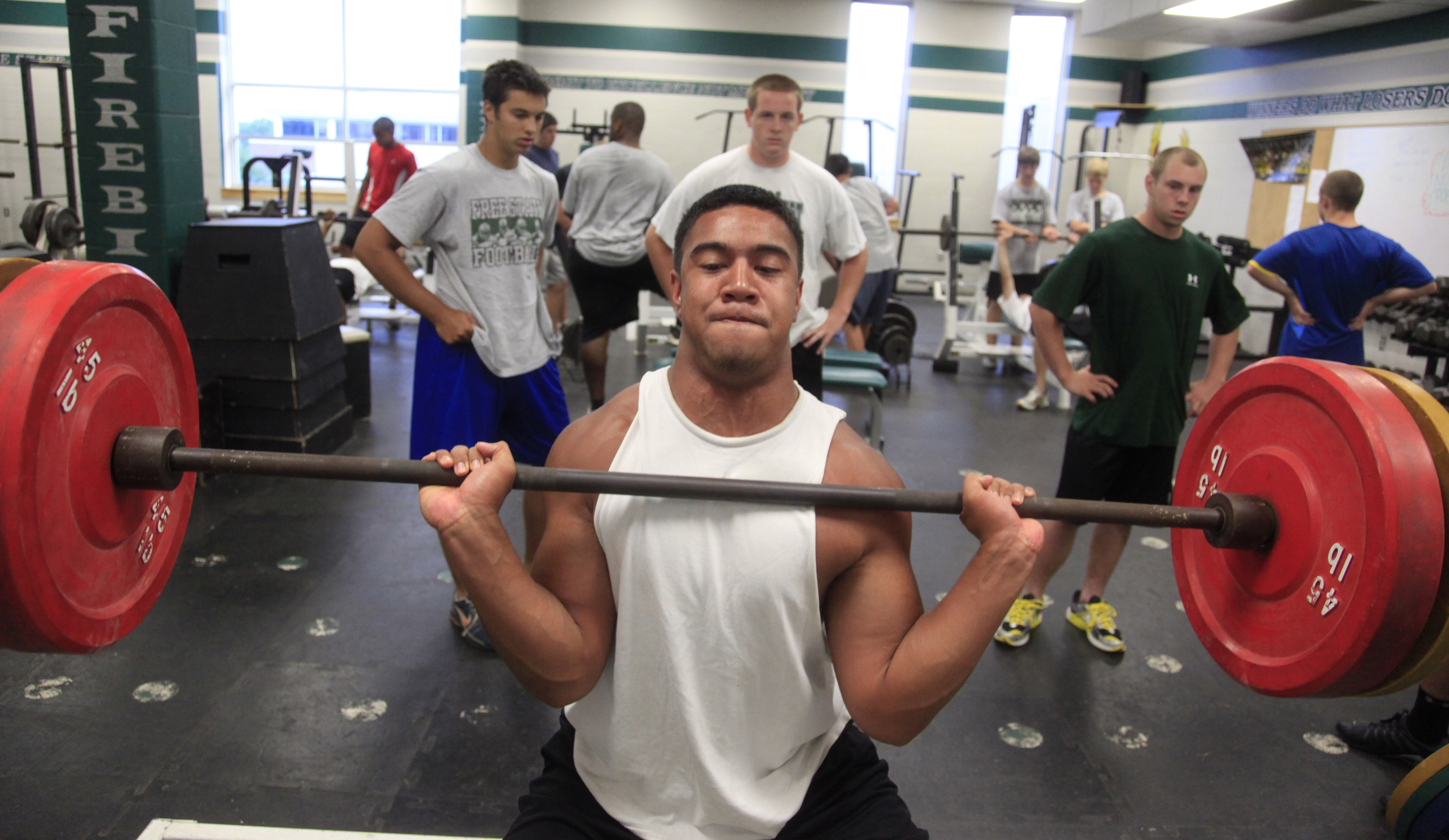
Free State football player Henry Veano lifts weights as the team works out on a recent morning at Free State High. A recent Kansas State High School Activities Association rule change allows coaches more contact with their players in the summer.
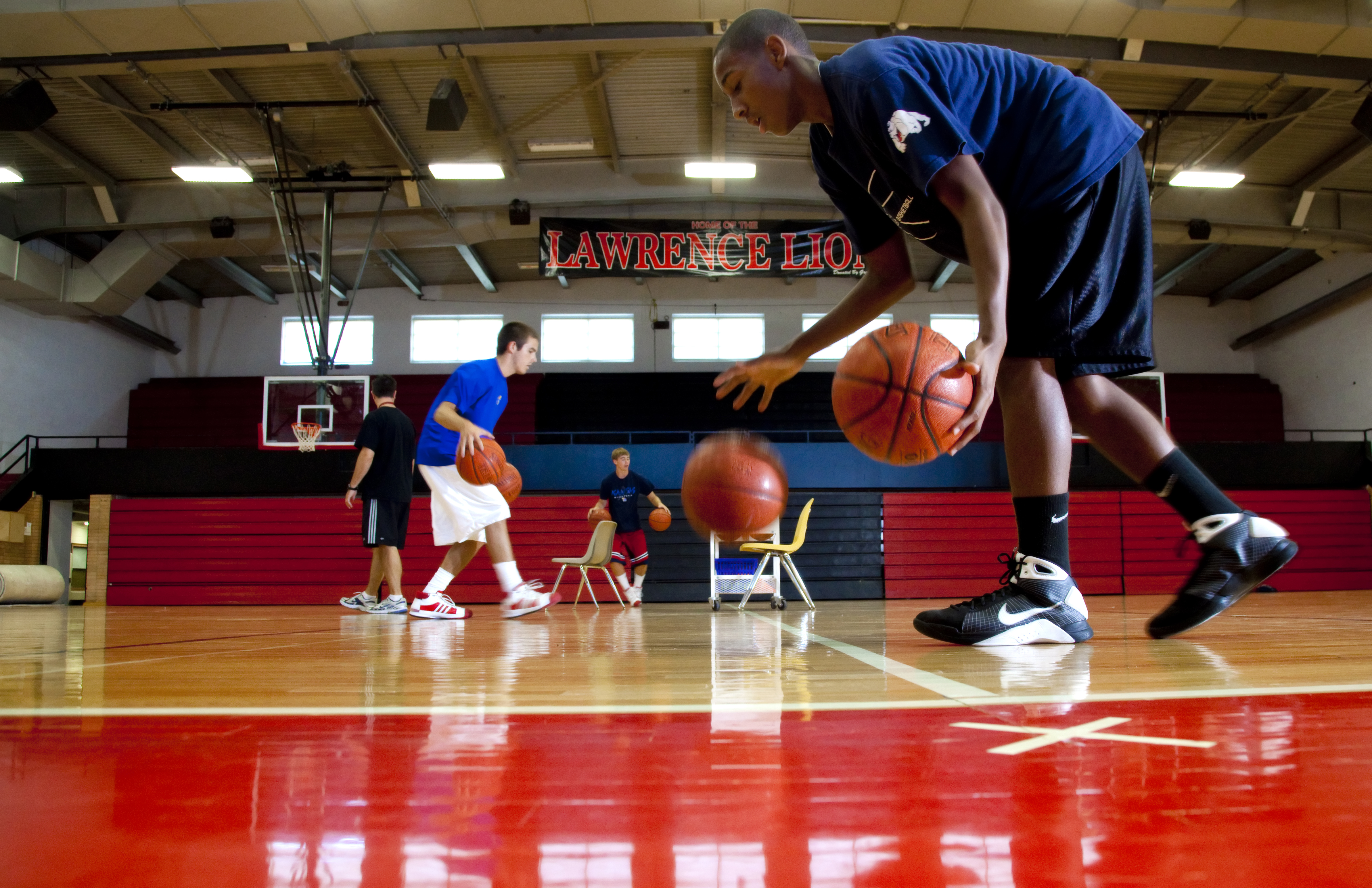
Lawrence High freshman Derrick Williams works through dribbling drills during summer workouts this month in the LHS gymnasium.

Lawrence High senior basketball players Marcus Ray and Haley Parker, shown above, from left to right, in winter, fall, summer and spring attire, have taken advantage of the opportunity to spend more time working with their high school coaches this summer thanks to a rule change adopted by the Kansas State High School Activities Association. The rule change eliminated the restrictions placed on summer contact.
The following is the second installment of a three-part series that examines the impact of a recent rule change by the Kansas State High School Activities Association regarding extended summer contact by coaches in basketball, football and volleyball.
Check Sunday’s Journal-World for Part III: College coaches weigh in on how the new rule could make Kansas athletes more heavily recruited.
Just about every June morning, Free State High senior Bo Schneider woke up early, hit the weights, ran through a couple of hours of football drills and camp work and then spent the rest of the day and evening playing basketball and baseball.
Somewhere in there the 6-foot-3, 175-pound wide receiver, middle infielder and small forward found time for lunch. Rarely in there did Schneider find time to enjoy what used to be called summer fun.
Because of a new set of rules put in place by the Kansas State High School Activities Association that has allowed for an increase in summer contact by high school coaches in volleyball, basketball and football, Schneider’s summer transformed from a time to regroup into more training time for his chosen sports.
“As soon as I heard about it, it was kind of like, ‘There goes my summer,'” Schneider said. “It was a mountain to climb.”
And it’s been steadily uphill ever since.
Red flag
In the past, coaches in the three sports affected by the recent rule change were limited in what they could do with their athletes in the summer. Restrictions were placed on the number of athletes they could work with and the time frame in which they could coach. Now, the gloves are off and the coaches have had free reign on their athletes for an eight-week period that ran from May 23 through today.
While the changes open up unlimited possibilities in terms of what can be accomplished in the summer sessions, they also create potential for a nightmare scenario for multi-sport athletes, players who are asked to juggle their commitments to accommodate all of their coaches and all of their sports.
That’s just one of a few red flags associated with an otherwise well-received rule change. And Schneider is one of a handful of what’s becoming the rarest breed of high school student: the three-sport athlete. They’re seen less and less at the Class 6A level these days, largely because of the increase in specialization among elite athletes.
With many coaches and parents continuing to encourage participation in multiple sports, the new rules make the summer months challenging for student-athletes such as Schneider, the kind of competitor each coach wants equal time with during the summer now that the opportunity is there.
Luckily for Schneider, and other Lawrence high school athletes like him, many of the city’s coaches were realistic when working their athletes this summer.
“Coaches are treading lightly in the first year because they don’t want to burn kids out,” FSHS boys basketball coach Chuck Law said. “It’s a fine line. I don’t want to go overboard. I don’t want to be blowing the whistle all the time.”
Summer schedules
The potential for exhaustion ranked No. 1 on the list when Lawrence’s high school coaches in the three sports affected by the rule changes were asked about their greatest concern for the new system.
“I’m very, very cautious of burnout,” said Lawrence High football coach Dirk Wedd. “The bottom line is kids need to be kids and summer’s the time for them to do that.”
With that in mind, coaches at Lawrence High and Free State High who “share” athletes have done their best to avoid pulling their players in too many different directions. While few actually sat down to map out a summer schedule that worked best, most chose to operate under the system of common courtesy.
“I don’t get on them if they don’t get there,” Law said. “I know they’ve got other things going on, whether that’s baseball or football or some other sport. And many of them have to work, too. When you go to football games, the most representative group of the Free State faculty there is the coaches. When you go to basketball games, the most representative group of the Free State faculty there is the coaches. We realize we’re all in this together. We have to cooperate, we have to share and we have to keep in mind an athlete like Bo Schneider who’s trying to do three sports.”
Added LHS volleyball coach Stephanie Magnuson, who shares a small portion of her roster with summer softball and basketball leagues: “I think about it a lot. What I’ve tried to do to combat that is make sure they don’t have near the consequences during the summer. They aren’t running sprints. We’re mostly just working on skills. The consequence is losing and that’s what I try to get in their heads because no one likes to lose.”
Magnuson shaped her summer practice schedule around a simple concept: Work hard during the week — she had open-gym sessions three days a week — and have fun at the end.
“We’re more laid back on Fridays,” she said. “We play games for two hours and they come out of it not even realizing that they’ve worked their butts off.”
Because of the way Lawrence’s coaches have tackled the first summer under the new rules, burnout has not been much of a problem. The coaches have been understanding, even lenient, and many of the city’s athletes have pushed themselves without entering the danger zone. In fact, although what they’ve been able to do has increased this summer, most athletes have not noticed much of a change in their summer workout schedule.
There’s a reason for that. James Findley, Sports Acceleration Director at Therapy Works, thinks he knows what that is.
“Most of these kids are training for (their sports) without coaches all year long anyway, whether it’s through camps or with trainers,” Findley said. “What (the new rules) are helping most is the mental edge. You don’t always think about athletics being a very conceptual activity, but there’s a huge mental aspect there, and the more you practice and the more you go through those drills and things, the better off you are mentally, which is huge.”
Other issues
The concern about the strain on high school athletes only scratches the surface of potential problems.
Other issues include: the potential push toward single-sport specialization created by the stress of trying to keep up with all sports; conflicts between AAU and club teams and the commitment to one’s high school team; and the unwritten rule that coaches keep themselves in check and not ask too much of their athletes.
“Like anybody, I’d love to have them thinking about football two hours every day,” Wedd said. “But I really think that it comes down to me wanting their motors running hot about LHS football in August and if you put huge demands on them in one specific sport, it’ll be hard for them to push that button and get going.”
Coaching concerns
While most concerns have the best interest of the athletes in mind, the one that most often gets overlooked is the burden the new set-up places on the coaches, who are now doing more work for no extra pay.
Although no one can require the coaches to ramp up their summer involvement, many of them feel they’d be doing their athletes, their programs and, ultimately, themselves a disservice by sitting on their hands. For most, money has never been a motivating factor in their chosen profession and they’re not about to allow it to become one now.
“I’ve been coaching for 35 years, if you don’t love it and don’t love being around kids, you’re in the wrong occupation,” Wedd said. “Really, it makes you feel young, but right now those 47 sophomores I’ve got are making my gray a little grayer. Besides that, it’s been a great summer.”
Added Law on the idea of coaches working themselves ragged: “I do think it’s a possibility, but ultimately it comes down to how much you enjoy what you’re doing and what you’re in it for. I enjoy teaching the game, I enjoy being around our guys, they’re a great group to be around.
“I think it’s probably too early to judge how much of an impact the new rules will have. I did coach our guys at a tournament a few weeks ago and I thought that was great. Summer time, in large part, is a time for them to figure out some things on their own. But at the same time, it was great to talk to them about the things they were seeing and experiencing. It’s good to be able to coach your kids in the summer time, where the stress level of winning and losing is a little less. It’s a little more relaxed and a little more teachable during this time. I think there can be a great benefit in that in terms of the relationships you can create and how you can scale it back and help your kids through the learning process.”
Free State
Photo Gallery: Free State falls 6-4 to Wichita Northwestern in regional softball action

Free State softball season ends in gut-wrenching regional semifinal loss to Wichita Northwest
Free State baseball advances to 8th straight state tournament with 15-0 win over Topeka/Cair Paravel
For the eighth straight time, Free State baseball is one of eight schools on its way to the state tournament. The ...
Shaw shuts down Liberal; Free State baseball to play in regional championship Tuesday
Free State’s Micah, Eli Ward become first siblings to win singles state tennis championship in same year