Bush makes surprise Iraq visit
President envisions troop cutback but gives no timetable
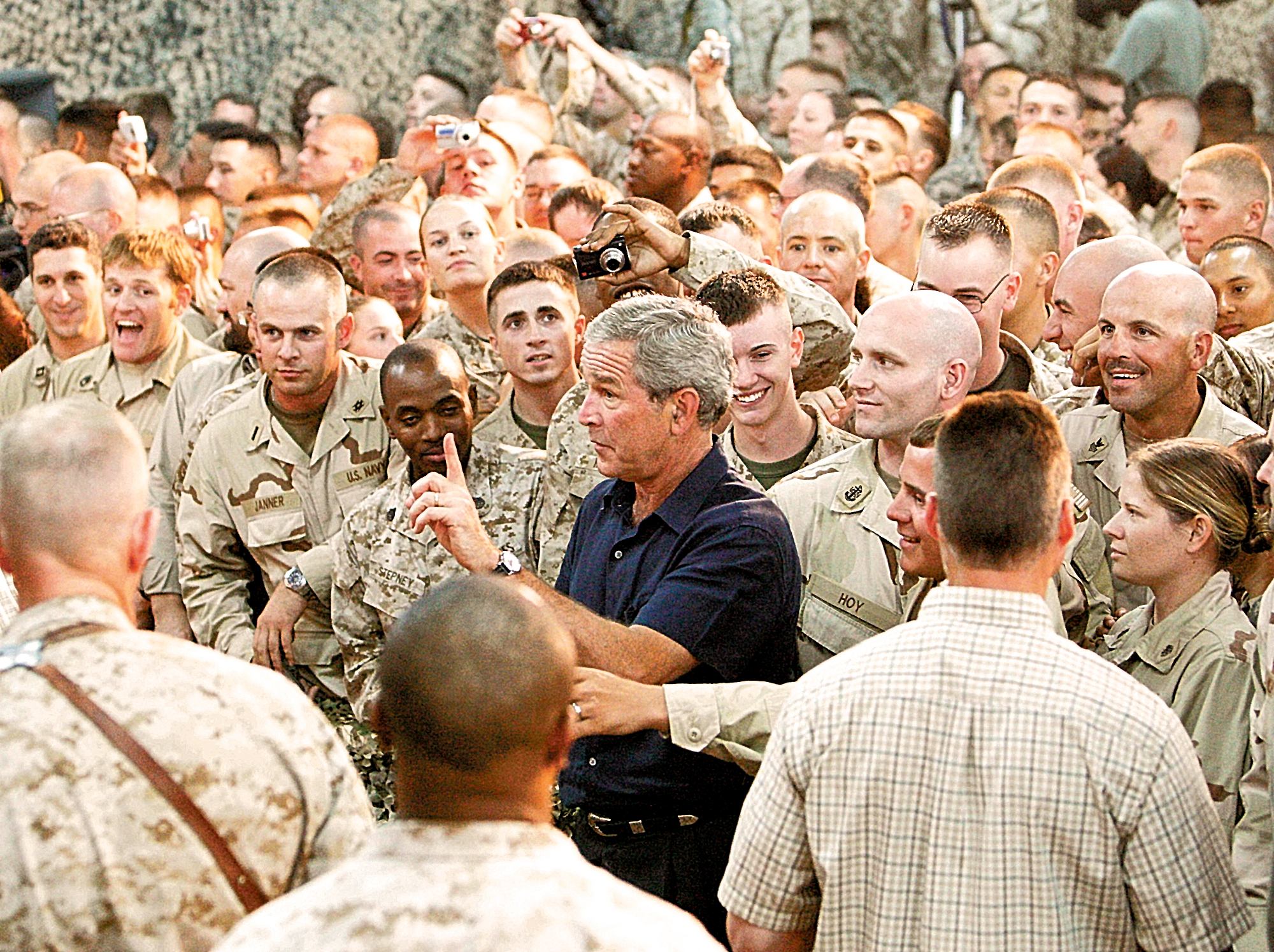
President Bush, center, greets troops Monday at Al-Asad Airbase in Anbar province, Iraq. The president made an unannounced visit to Iraq to meet with Gen. David Petraeus, commanding general of the multinational forces in Iraq; U.S. Ambassador to Iraq Ryan Crocker; Iraqi leaders; and U.S. troops. Read more about his visit on page 6A.
U.S. Deaths
As of Monday, at least 3,740 members of the U.S. military have died since the beginning of the Iraq war in March 2003, according to an Associated Press count.
Al-Asad Air Base, Iraq ? President Bush hinted at U.S. troop cutbacks in Iraq on Monday, saying security conditions are improving to the point “where I’m able to speculate on the hypothetical.”
Bush, in a surprise visit to Iraq, was cautious to hedge his comments and make them conditional on security conditions continuing to improve. But he knew he had piqued peoples’ interest by raising the prospect for Americans weary of a war now in its fifth year.
“Maybe I was intending to do that,” he told reporters as Air Force One carried him away from Iraq, after an eight-hour stop, toward Australia for meetings with Asia-Pacific leaders.
Bush did not say how large a troop withdrawal might be possible or whether it might occur before next spring, when the first of the additional 30,000 troops he ordered to Iraq this year are to start coming home anyway. He emphasized that any cut would depend upon progress.
The president was joined by his war cabinet and military commanders at an unprecedented meeting in Iraq over eight hours at this dusty military base in the heart of Anbar province, 120 miles west of Baghdad.
After talks with Gen. David Petraeus, the U.S. commander in Iraq, and Ambassador Ryan Crocker, Bush said they “tell me if the kind of success we are now seeing continues, it will be possible to maintain the same level of security with fewer American forces.”
Shrouded in secrecy, Bush’s trip was a dramatic move to steal the thunder from the Democratic Congress as it returns to Washington with fresh hopes of ending the war. Petraeus and Crocker will testify before lawmakers next week, and then Bush will announce how he intends to proceed in Iraq.
En route to Australia, Bush was asked by reporters about possible troop withdrawals.
“The main factor that will affect my decision on troop levels is: can we succeed,” the president said.
“If you look at my comments over the past eight months, it’s gone from a security situation in the sense that we’re either going to get out and there will be chaos, or more troops,” the president said. “Now the situation has changed where I’m able to speculate on the hypothetical.”
Still, Bush struck a defiant note about demands for bringing troops home.
Standing before troops cheering “hooah,” Bush said decisions on force levels “will be based on a calm assessment by our military commanders on the conditions on the ground – not a nervous reaction by Washington politicians to poll results in the media.
“In other words,” Bush said, “when we begin to draw down troops from Iraq, it will be from a position of strength and success, not from a position of fear and failure.”
Once the stronghold of the Sunni Arab insurgency, Anbar province now is cited as a model for the rest of Iraq. Violence abated after Sunni tribal leaders and former insurgents broke with al-Qaida and teamed up with U.S. troops to hunt down extremists.
“Anbar is a huge province,” Bush said. “It was once written off as lost. It is now one of the safest places in Iraq.”
Defense Secretary Robert Gates said it will take several months to assess whether security improvements across Iraq are sufficient to enable Bush to start withdrawing troops. He provided no details on Bush’s thinking about the timing and scope of any reductions.
“I am more optimistic than I have been at any time since I took this job,” said Gates.
Bush met with Iraqi Prime Minister Nouri al-Maliki and other top government officials from Baghdad. He urged the government to respond to progress in Anbar. He also met with Sunni tribal sheiks and members of Anbar’s governing body.
Bush spoke warmly about al-Maliki even while expressing frustration over the slow pace of political progress.
“My message to Maliki is: ‘You’ve got a lot of work to do and whatever decision is made in Washington, D.C., is all aimed at helping you achieve what is necessary to get the work done.'”
National
Backlash to Trump’s $1.8B settlement fund delays GOP immigration bill
Woman at center of sprawling Minnesota fraud gets nearly 42-year prison sentence
Officers who defended Capitol sue to block payouts from ‘anti-weaponization’ fund
Republicans mull dropping $1B request for the White House and Trump’s ballroom
US Rep. Thomas Massie loses Kentucky GOP primary in another victory for Trump
HEBRON, Ky. (AP) — Kentucky U.S. Rep. Thomas Massie lost his Republican House primary Tuesday in another test of ...