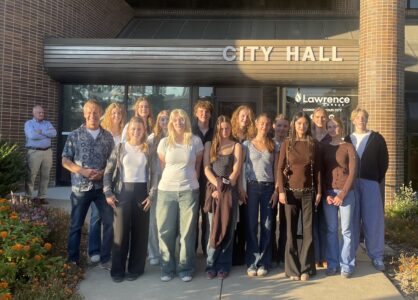
Bishop Seabury celebrating 10-year anniversary
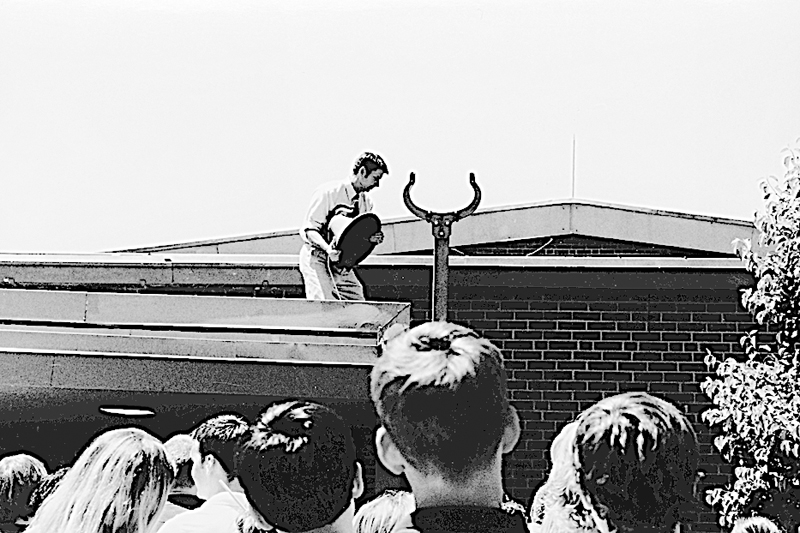
At the end of the 2002-2003 school year, Bishop Seabury Academy students gathered outside to watch Brian Clyne take down the bell in front of the school site, 1411 E. 1850 Road. The academy moved to 4120 Clinton Parkway in summer 2003 to accommodate its growing student body.

Students participate in an annual square dance at Bishop Seabury Academy when the school was still at 1411 E. 1850 Road. Even with the school's growth, there is still a priority on maintaining the culture that permeates the school.
Going to school at Bishop Seabury Academy is like going to school with members of your family, students say.
There are no locks on lockers, class sizes are kept small, and virtually every student and teacher knows everyone else by name.
Seabury celebrates its 10th anniversary this year and has seen tremendous growth in that time. It’s moved to a bigger building across town, and it has increased its enrollment from around 30 to 122, said Head of School Chris Carter.
But the school’s not yet satisfied with its current position. It continues to add five to 10 students per year and has plans for a new building to accommodate the fine arts and other specialized programs. Even with the school’s growth, there is still a priority on maintaining the culture that permeates the school.
“It’s certainly going where I expected it to be, in terms of community acceptance and involvement,” said Carter, who came to Seabury six years ago.
Back then, Carter could go out to get a haircut or shop and spend as much time explaining what Seabury was as actually explaining what it did. No one knew the school, which started with junior high school students before slowly adding high school grades. Carter and others say that’s no longer the case.
“Visibility in the community has increased tremendously with high school kids and the recognition they often receive,” he said.
Like Carter, many of the staff and faculty have joined Seabury in the years since it opened. Elisabeth Lee, a teacher of eighth- and 12th-graders, however, is one of the founding faculty members still at the school. She has nothing but good things to say about the family-style school she’s made her professional home.
“It’s been the most creative thing I’ve done in my professional life,” Lee said.
Lee said that no matter what has changed, the school has maintained as a central value the extent of what an education can be.
“You have kids who want to learn,” she said. “Kids feel free to be themselves without feeling pressure.”
It’s that attitude that attracted Mary Dillon, who enrolled the first of three sons, Jake, at Bishop Seabury eight years ago. Since then, Justin and Peter also have enrolled at Seabury, which Dillon credits as being a place where students aren’t allowed to slip through the cracks.
Dillon chose Seabury because she wanted her children to experience smaller class sizes and to be more challenged academically. She’s found that at Seabury and, even with a doubling of the size of the school and plans to grow at about 150 students over the next few years, she’s certain those same values won’t change.
Dillon said Justin, a senior who also is president of the school’s Student Senate, has made holding onto that culture a priority of student government.
“He wants to keep the school as a safe atmosphere. They don’t have locks on their lockers. It’s OK for a senior to be friends with an eighth-grader,” Dillon said.
This year’s senior class is the last group to have attended classes at the school’s old building.
Still, Lee and others acknowledge that Seabury has developed a certain reputation.
“We’re aware we have a reputation for being selective or elitist, but we’re not,” she said. “All children should have the kind of education we provide here.”
Meeting that goal is part of the reason behind Seabury’s drive to build a new building at the school’s Clinton Parkway campus. Expected to have facilities for the fine arts and athletics, the addition allows for more growth.
“We think that will be important for what that will represent in terms of our visibility and in meeting our program goals,” Carter said.
K-12 Education
Student-run coffee shop opens at Community Connections at Pinckney, teacher receives surprise $1,000 award
Perry-Lecompton voters to weigh new joint recreation system funded by property tax levy
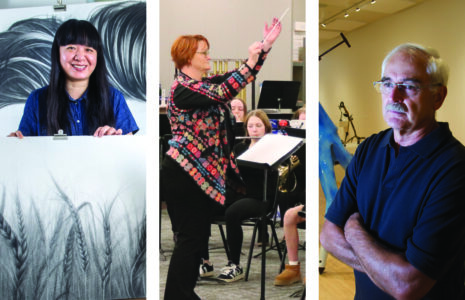
KU professors, middle school band director, radio personality among this year’s Phoenix Award honorees: ‘It’s a cool mix’
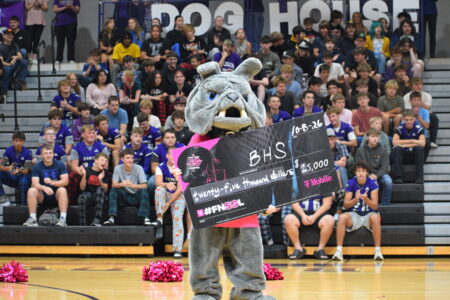
Baldwin High already has won $25K and is competing for $1M through national sports program
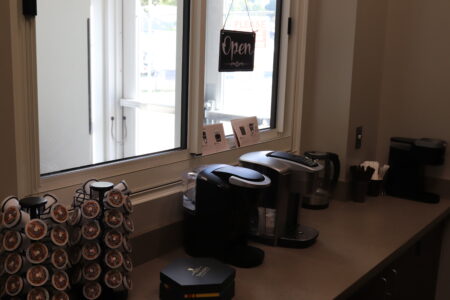
A student-run coffee shop will open at Community Connections at Pinckney next week