Winter canola growing in popularity
KIOWA ? For generations of farmers, winter wheat has sustained the economy of this parched Kansas hamlet where few other crops thrive in the summer’s searing heat.
But the development of winter canola – planted in the fall and harvested in spring like winter wheat – offers a promising alternative crop for fields depleted by decades of monoculture farming.
Farmers in the southern Great Plains planted an estimated 60,000 acres of winter canola this year, said Michael Stamm, a canola breeder at Kansas State University. That more than doubles the 25,000 acres planted in those states the season before. As many as 100,000 acres of winter canola is projected to be planted this fall.
Plans for a canola oil processing plant are in the works in Kiowa to process canola seed for oil. Kansas has a small biodiesel plant now in Burden.
“One of the biggest benefits is the benefit we get through crop rotation with monoculture wheat in the southern part of the state,” Stamm said. “Producers face a lot of disease and weed pressure when they grow wheat year after year.”
At stake is much more than the crop’s rotational benefits to farmers. Winter canola – bred to survive harsh Midwest winters and harvested before the onset of intense summer temperatures – promises a new industry for Kansas and other Plains states.
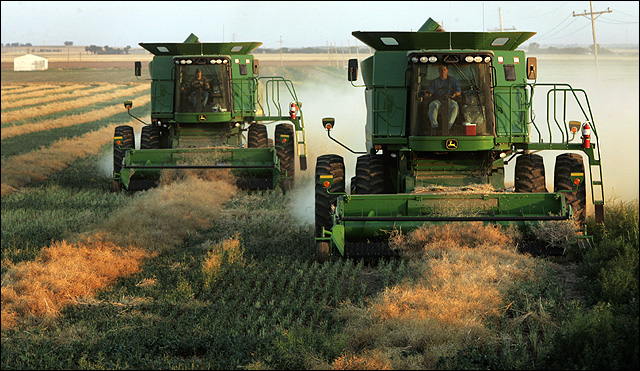
Bob Schrock, right, and Tyler Hiltner gather winter canola early this month in Schrock's field near Kiowa. An increasing number of farmers in southern Kansas, Oklahoma and Texas are growing the crop as an alternative to wheat.
The 400,000-bushel-capacity plant planned by OK Co-op Grain Co. in Kiowa would crush the tiny purple canola seeds to remove the oil, which then could be marketed as cooking oil or used for making biodiesel. The meal left behind by the process also makes a high-protein livestock feed.
The cooperative plans to invest $800,000 to build the Kiowa canola crushing plant and hire three employees to work in it, said Alan Meyers, general manager of OK Co-op Grain. It’s expected to be running by midwinter.
“We as a co-op see it as an opportunity for another source of revenue,” he said.
While canola is not a new crop – farmers in northern states have been growing spring canola for years – the newer varieties of winter canola have rekindled interest from hundreds of Southern Plains growers.

Seed pods of a winter canola plant are silhouetted against the setting sun in Bob Schrock's field near Kiowa.
A seminar last year on winter canola in Enid, Okla., drew about 400 farmers, Stamm said. More such meetings – coordinated by Kansas State University and Oklahoma State University – are planned later this summer in Dodge City in Kansas as well as Enid and Altus in Oklahoma.
Kiowa farmer Bob Schrock was enthralled by canola’s potential after attending a field day two years ago in Oklahoma.
“It just clicked – I never tried anything other than wheat,” Schrock said.
This year he grew 1,800 acres of canola, more than doubling his acreage after trying it for the first time a season ago. He plans to seed between 2,000 and 2,500 acres in canola this fall.
Schrock, 40, has watched the production of his third-generation farm dwindle after decades of his family growing winter wheat. But the usual spring-planted crops grown in Kansas – corn, soybeans and milo – often fail in places like Kiowa that get little summer rain.
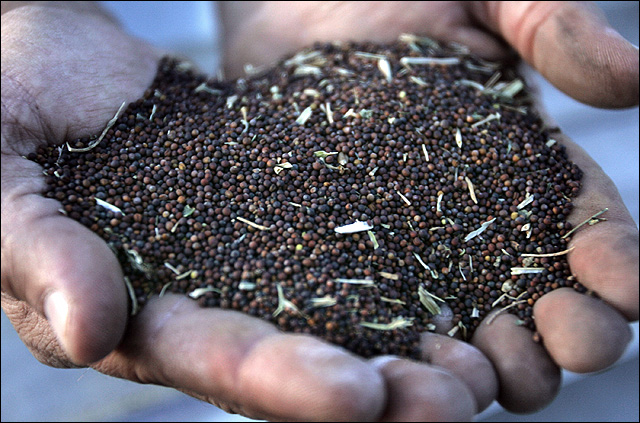
Bob Schrock holds a handful of tiny canola grains as he harvests his canola crop in early June. This year Schrock grew 1,800 acres of canola. He plans to seed between 2,000 and 2,500 acres of canola this fall.
In a season like this one – when both wheat and canola suffered during the winter and spring drought – Schrock got an opportunity to see its rotational benefits. The wheat he planted this season following those first acres of canola had higher yields than back-to-back wheat acres.
Kansas State University’s first winter canola variety was developed in 1998 for the region, and there have been three other varieties released since then, the latest in 2003, Stamm said. About 5,000 acres were planted into winter canola in Kansas this season, although it’s uncertain how many of those will be harvested due to drought and aphid losses.
While most of the Kansas crop has been grown in its southern counties, producers as far north as Salina have shown an interest. Researchers predict a time when as many as 100,000 to 300,000 acres of winter canola could be grown in Kansas.
“It wouldn’t probably ever get as large as wheat,” Stamm said. “But it can get as large as cotton or sunflowers in Kansas.”
State Government

Trump endorses Kansas Senate president in GOP campaign for governor
No Labels Kansas is no more as a political party
TOPEKA — Demise of the No Labels Kansas political party was inevitable after it neglected to fulfill the ...
Johnson County school districts plan to sue state over lack of special education funding
TOPEKA — Four Johnson County public school districts want to sue the state of Kansas for more than 15 years of ...

How to define diversity, equity, inclusion, critical race theory has become a $2M question at KU
Lawrence resident files for Secretary of State as third party candidate
A Lawrence resident has filed to run for Kansas Secretary of State as a third party candidate. Scott Morgan, who ...