Confucius Institute goes high-tech
Ni hao, class: Classes taught by videoconference
Teacher Yi Honggen slowly enunciated the Mandarin Chinese word for hello.
“Ni hao,” he said.
A chorus of high school students repeated after him, “Ni hao.”
Yi’s class, organized by Kansas University’s Confucius Institute, is bringing Mandarin Chinese instruction to more Kansas students.
“We are tripling the number of Kansas high school students learning Chinese with this course,” said Bill Tsutsui, the institute’s director.
And it’s doing so in nontraditional ways.
The interactive distance-learning class links students from across the state with Yi, who teaches from a room at KU.
“This technology is very advanced,” Yi said Tuesday, while sitting in a room surrounded by television screens. “There’s complete interaction between me and the students on the screen.”
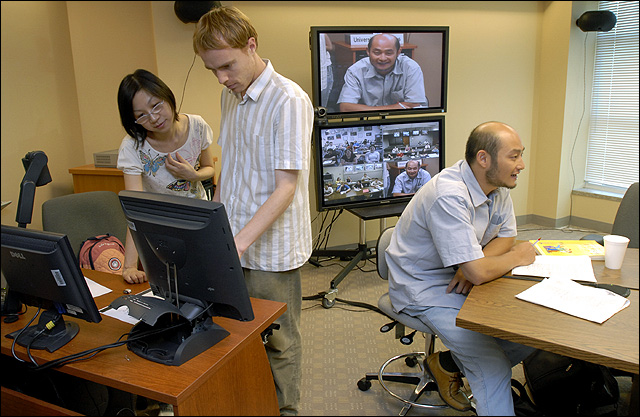
Teaching assistant Jing Shen, left, and Isa Kretschmer with Altec work on technical support as Kansas University visiting professor Yi Honggen broadcasts his language class on Mandarin Chinese to high school students across the state. Yi taught Tuesday from Joseph R. Pearson Hall.
KU this summer launched the institute in a partnership with the Chinese government. The institute’s mission is to help build a better understanding of culture and languages of the world’s most populous nation.
And organizers say the language and cultural programming will make Kansans better prepared to compete in the globalized world.
“China is going to take over the world in 10 years,” said Spencer Higginson, a Free State High School student taking the course. “I’m just sort of defending myself, I guess.”
More than 40 students from seven schools, including Free State, Holcomb and Winfield high schools, are participating. The yearlong class meets five days a week.
Yi, a visiting instructor at KU, is an associate professor at Central China Normal University.
The Free State students travel to KU’s campus for each class, but the others attend via videoconferencing from their respective schools.
“It really feels a little weird,” Yi said. “You can see each other very clearly, but actually you’re not in the same room.”
There are some technical kinks to smooth out.
It took a few minutes Tuesday to make sure the various off-site students could all hear one another and the teacher.
But organizers say it’s the best way to spread the Chinese language in a state where Chinese teachers are in short supply.
“It’s really a unique thing in the nation to be offering Chinese in this way,” Tsutsui said.
He said this year is the pilot run of the class, and the institute hopes to expand the program in the future. The institute also is offering Chinese language courses this fall for business professionals and the public.
More about the institute
City Government

Rising Rates: A three-part investigative series examines why Lawrence water and sewer bills have been soaring

Some leaders are now stating a new reason for why Lawrence’s utility rates are soaring: The city didn’t grow enough

Lawrence City Commission could start the process of finding a construction manager for new fire station

Lawrence is charging water, sewer customers a special tax not required by state or city law

Lawrence housing market strains residents as development fails to keep up, city’s affordable housing study finds