

Computer disk, DNA and messages helped lead police to BTK suspect
Wichita ? Dennis Rader came to his pastor in January with a floppy disk, saying he had the agenda of a church council meeting and needed to run off copies on a printer. The pastor obliged.
The head of Christ Lutheran Church inserted the disk into a computer, thinking it was nothing out of the ordinary. But that routine act may have cracked the BTK serial killer case.
Last Friday, four law enforcement officers came to Pastor Michael Clark’s church with a search warrant and asked who had access to the computer. An electronic imprint in a disk sent to a Wichita TV station by the BTK killer had been traced to the church.
A computer disk appears to be among the key pieces of evidence that led police to Rader, the 59-year-old church council president and former Cub Scout leader who was charged Tuesday with 10 murders in the BTK killings that terrorized this city over three decades.
Though police have been tightlipped about why they believe Rader is the BTK killer, some details of the evidence against him have emerged.
BTK resurfaces
Some of the biggest help to investigators may have been the messages and packages sent by the killer to police and the news media in the past year.
When the BTK killer resurfaced in March 2004 — the 30th anniversary of the first crimes — police took advantage of advances in technology to re-examine old evidence.
“Once he raised his head again and started gaming again, taunting the police — that’s a very positive development and breeds new life into this case,” said Gregg McCrary, a retired FBI profiler. “If he had been incommunicado and had not reached out, this case may have never been solved.”
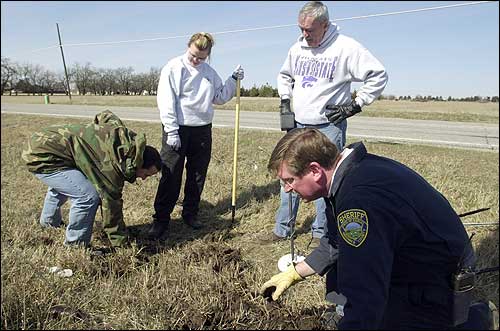
Members of the Sedgwick County Sheriff's Department search along a fence near East 61st Street North in Park City. They searched Tuesday for evidence in the BTK case using metal detectors and shovels.
Playing games
Former Wichita Police Chief Richard LaMunyon said he detected a distinct difference in tone between the messages the BTK killer sent in the ’70s and ’80s and those of the past year.
The early letters and poems “were laced with anger, with rage, with hurt,” he said.
But the messages of the past year, LaMunyon said, were far less harsh and were more of a puzzle. “The pattern at the end was to get himself identified and caught,” he said.
Among the materials BTK sent to the media were a cryptic word puzzle mailed to KAKE-TV in May that included dozens of hidden words, including a grouping of letters spelling “D. Rader.”
DNA evidence

 Computer disk, DNA and messages helped lead police to BTK suspect (03-04-05)
Police also had scientific evidence that was not available decades ago when the 17-year crime spree began.
DNA samples have linked Rader to the killings, according to Gov. Kathleen Sebelius. Police have said they obtained semen from the crime scenes, even though the killer did not sexually assault his victims.
The Wichita Eagle reported Thursday, citing unidentified sources, that investigators had obtained DNA before Rader’s arrest from a tissue sample that came from his 26-year-old daughter’s medical records. They took it without her knowledge, to keep Radar from discovering they were zeroing in on him, the newspaper said.
In the community
LaMunyon, the former police chief, said the thorough, dogged work of the police also helped solve the BTK killings.
“We ensured each of these cases was handled in a way that all the evidence was categorized, all the records were put into files, so if and when needed, the officers would be able to pick it up and move forward,” he said.
LaMunyon said he was not surprised the suspect was a long-standing resident of the area.
“We always thought he was someone in our community,” he said. “We never thought for a moment that he left.”
But LaMunyon said Rader still holds some of the pieces of this grisly puzzle.
“I don’t think until he sits down and explains it will we understand it.”
State Government
2 Douglas County District Court judges up for retention on November ballot
General Election Voter’s Guide

Two state senators vying to be Kansas governor

14 candidates for Kansas House of Representatives will appear across Douglas County ballots in November. See who they are.
Three candidates vying to become state’s chief election officer
There will be a new Secretary of State in Kansas after the incumbent decided not seek re-election to the post that ...
Voters Guide: Meet the candidates vying to become Kansas’ next Attorney General
Current Kansas Attorney General Kris Kobach is facing off against Democrat Chris Mann for the office. Again. The ...