Cowboys, modern horsemen begin trail ride to Dodge City
Bandera, Texas ? Dozens of cowboys and wannabes hitched up their horses and wagons in this Hill Country town on Monday and pointed them north along a historic route used by 19th-century cattle drovers to get their beef to market.
The hardy travelers plan to take seven weeks to cover the 650 miles from Bandera, the self-proclaimed Cowboy Capital of the World, to the famed Wild West outpost of Dodge City.
The ride will follow what was known as the Western Trail, along which millions of Texas longhorns were driven north to railheads during a two-decade span ending in 1893.
The effort is intended to raise money to pay for markers along the trail, which runs from the Rio Grande in South Texas to Ogallala, Neb.
“We’re losing our heritage,” said Suzie Knaggs Heywood, a former schoolteacher from Bandera mounted on a Tennessee walker named Dan. “We must save these things before they’re lost forever.”
Joe Howard, a retired sheet-metal worker from Red Oak, south of Dallas, has driven his wooden-wheeled wagon along parts of the Western Trail for each of the past 14 years. He says he enjoys the camaraderie of others who like horses and history.
“Every ride’s a little different,” said Howard, holding the reins gently as his two-horse team pulled the canvas-covered wagon on the shoulder of Texas Highway 173, “even when you’re doing the same trail.”
Heywood says the trail group includes participants from 15 states, many of them planning to cover the entire route. Others, she says, will ride for a week or two.
Karen Fletcher, an ex-social worker from Wichita Falls riding with Howard, says moving along at just a few miles an hour is good for the head.
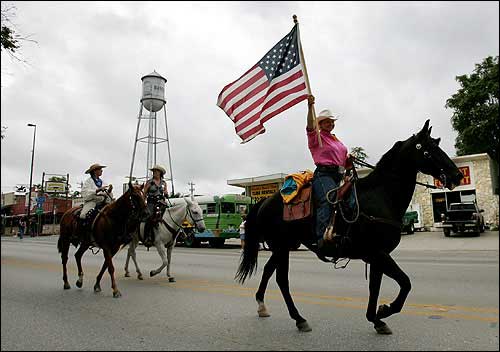
Carolyn Minsheu carries the American flag as she leads a trail ride from Bandera, Texas. The ride, scheduled to take seven weeks, will cover about 650 miles before reaching Dodge City.
“You get to slow down, escape civilization and all the pressure,” she said. “This is the best therapy in the world.”
John Yates, from Wagoner, Okla., agreed that the pace was a big attraction.
“In a car, you go too fast,” said Yates, riding on horseback with his wife, Mary.
Levi Barrett, a 13-year-old from Sherman, was in the back of Howard’s wagon, but just for the day. He was due back in school today, though it was clear he would rather stay with the riders.
“You get to see what it was like when (bygone cowboys) had to do it,” said Levi, dressed in replica clothing from the late 1800s. “School doesn’t let you re-enact things.”
A typical travel day covers 15 to 20 miles at about four miles an hour, and a handful of rest days will be mixed in. The riders will camp as a group, some in RVs and others in tents, away from towns where pasture is available for the horses.
The Western Trail — also known as the Dodge City Trail and the Fort Griffin Trail — was pioneered in 1874 by cattleman John Lytle, when he drove 3,500 longhorns from South Texas to Fort Robinson, Neb., according to the Handbook of Texas.
Within a few years the trail largely replaced the easterly and more famous Chisholm Trail and it soon was the main northbound route for the state’s growing cattle industry.
An estimated 3 million to 5 million head were herded up the trail before its use petered out in the early 1890s.
“This is how we rebuilt Texas after the Civil War,” said Heywood, whose grandfather made several trips to drive cattle along the Western Trail.
The trail covers about 370 miles in rural Texas before crossing the Red River in Oklahoma. It will continue another 235 miles before finishing at Dodge City in southwestern Kansas.
State Government
Trump endorses Kansas Senate president in GOP campaign for governor
No Labels Kansas is no more as a political party
TOPEKA — Demise of the No Labels Kansas political party was inevitable after it neglected to fulfill the ...
Johnson County school districts plan to sue state over lack of special education funding
TOPEKA — Four Johnson County public school districts want to sue the state of Kansas for more than 15 years of ...
How to define diversity, equity, inclusion, critical race theory has become a $2M question at KU
Lawrence resident files for Secretary of State as third party candidate
A Lawrence resident has filed to run for Kansas Secretary of State as a third party candidate. Scott Morgan, who ...