Collectors hip with poker chips
Poker has become the hot game of the year.
Poker tournaments are featured on several TV networks, and ratings are high. This might be the time to collect poker memorabilia.
There are many theories about the origins of the game. Some say it is based on a Chinese game invented about 900 A.D. Others think it is a revision of an 18th-century game called poque, played by French settlers in New Orleans. Or the name of the game might have come from the term “hocus-pocus.”
By 1843, poker was a well-known game played on Mississippi riverboats. By then, an observer had already written about the rules of the game, which he called the “cheating game.” Poker tables were soon in most towns in the West.
Poker rules changed through the years. The draw and the straight became popular during the Civil War, and the joker as a wild card came into use about 1875. Poker chips are a popular collectible. Modern casinos usually have chips with designs featuring the name of the casino or important events or people. Early chips were made from colored plastic, wood or “clay” (clay and composite material). Today, collectors pay from a few dollars to $100 for unusual old chips. The large, round, revolving holders for chips and cards were popular by the 1930s. Holders are made of plastic or wood today, but before 1950 most were wood. Collectors also want cards, tables, rule books, ads for casinos and poker events, even table covers. Value rises if the memorabilia can be associated with an important person or a famous, long-gone casino.
We inherited a writing desk that my parents purchased in the 1960s from the Carl Forslund Furniture Co. in Grand Rapids, Mich. I think it was called a “Jenny Lind writing desk.” Can you tell me anything about the company?
Carl Forslund Sr., who had been a salesman for Stickley Bros., established his own furniture business, Carl V. Forslund Inc., in 1935. He sold furniture at his retail store and by mail order. Carl’s three sons joined the business in the 1940s and ’50s. Forslund’s manufacturing plant closed in 1991, and its retail stores a year later. The company specialized in manufacturing oak, walnut and cherry furniture in Early American styles. Forslund marketed its furniture in a folksy way and often named pieces for famous people. Jenny Lind (1820-1887), nicknamed the Swedish Nightingale, was a world-renowned opera singer in the 1850s.
Q: I have been a collector for years and find that dealers and even collectors will give me only about one-third of what I paid for some items, including my Shelley china. This is disappointing because I invested money for my later years. Can you explain?
A: We have always said to buy what you like or want to use — not for investment. Whether or not your antiques and collectibles appreciate in value is often a matter of luck or changing tastes. We’ve made our own share of “bad investments,” including 18th-century English porcelains, but we still enjoy them. Many china sets of dishes were made in huge quantities.
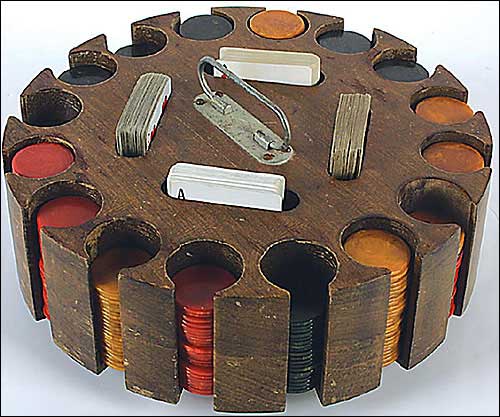
President Harry Truman used this worn poker chip and card holder. His initials are on the boom. It sold for ,537 at a Slater's Americana Auction in Indianapolis.
Q: I am trying to identify my unusual eating utensil. It has a four-tonged fork at one end and a wooden handle at the other. The center section between the handle and fork forms a curved and sharp knife blade. The utensil has its own leather-covered case.
A: Combination knife-forks similar to yours are made today for people who have the use of only one hand. The curved knife blade can be rocked back and forth to cut food. Some older combinations might have been used by the military; it’s easier for a soldier to keep track of one all-purpose eating utensil.
Q: Do you have any information on glassware designed by Frank Maietta? I have a set of black drinking glasses decorated with large flowers and a few bumblebees. The name Frank Maietta is in script on the side of each glass. My aunt gave me the glasses in 1972, but she said she had bought them years before.
A: Check the bottom of your glasses. You might find a mark that looks like an F in a shield, the mark of the Federal Glass Co. of Columbus, Ohio. Your glasses also came in pastel colors, including yellow, pink and light blue, all with gold flowers and bees. The flower petals are striking because they’re all decorated in different gingham patterns. Federal Glass Co. was in business from 1900 until 1980 and made glass tumblers and pitchers in many different patterns. Your glasses probably date from the late 1960s. A set of four sells for about $10.
Tip
Do not display silver on unsealed wood, felt, wool or velvet. They all contain sulfides that will tarnish the silver.
¢
The Kovels answer as many questions as possible through the column. By sending a letter with a question, you give full permission for its use in the column or any other Kovel forum. Names and addresses will not be published. We cannot guarantee the return of any photograph, but if a stamped envelope is included, we will try. The volume of mail makes personal answers or appraisals impossible. Write to Kovels, (name of your newspaper), King Features Syndicate, 888 Seventh Ave., New York, NY 10019.
| Current prices are recorded from antiques shows, flea markets, sales and auctions throughout the United States. Prices vary in different locations because of local economic conditions.Doc Holiday Wild West board game, Transogram, box, 1960, $30.Plains Indian pipe, buffalo shape, wood and stone, 1900, 25 inches, $55.Corn King sugar bowl, No. 78, Shawnee, $80.Quaker State Oil sign, white lettering, dark-green ground, tin, 9 3/4 x 13 3/4 inches, $145.Fostoria pitcher, Colony pattern, ice lip, 3-pint, 8 1/2 inches, $310.Pilgrim-style settee, turned arms and uprights, ladder-back splats, splint seat, signed “Stickley, Fayetteville, Syracuse,” 42 inches, $420.Cranberry glass tumbler, amber base, enameled gold women, urn and flowers, 1850s, 5 inches, $435.Staffordshire historical plate, Landing of the Pilgrims, ships in medallions, Enoch Wood, 10 1/4 inches, $500.McCoy turkey cookie jar, green and brown, 1945, 11 1/2 inches, $565.American Indian doll, composition head, sculpted facial features, side-glancing eyes, black mohair braids, straw-filled body, blanket-wrapped, marked “Skookum, Bully Good Indian,” c. 1935, 27 inches, $1,345. |
Arts and Entertainment

In collaborative show ‘Breeders,’ Lawrence artists capture the chaos and the fun of parenthood

Final Friday Art Walk, theater, markets, Kansas Union 100th Birthday Party and more
University Theatre’s final show of the season, ‘The Laramie Project,’ is important story of queer history, director says

Hear about the bizarre side of biology with acclaimed author Mary Roach at Liberty Hall

Lawrence groups will blend soccer and signature events for free World Cup watch parties