District fields a dream?
Support varies, funds lacking for city sports complex
Facilities for sports, particularly football, remains an issue as sensitive as fingertips in a community still adjusting to life as a two-high school town.
Lawrence High is comfortable with its setup, but Free State High lives one year at a time, longing for stability.
This school year, in particular, has been a bullhorn — not screaming for the problems to be fixed, but hollering for attention, nonetheless. Free State officials and parents, with crisis after crisis becoming public regarding venues, are pleading for something to be done, while Lawrence High officials look the other way.
One solution is a sports complex. Such facilities exist in multi-school districts surrounding Lawrence, including Shawnee Mission, Olathe and the newest, swankiest addition to the mix — Hummer Sports Park in Topeka, a $17.5 million dollar jewel that opened last fall.
With budget woes cutting teachers and placing other projects on hold, academic-minded Lawrence citizens merely chuckle at the thought of spending millions for a similar venue.
Meanwhile, the Free State camp continues to deal with hot-button issues — its tenuous relationship with Kansas University’s new administration, the deterioration of home fields on its own campus and the inability to emulate the tradition of which its rivals across town are so proud.
“I get the question all the time,” Free State athletic director Steve Grant said, “especially when we were dealing with the rocky start at KU this year. They ask, ‘Why don’t we have a district stadium?'”
KU relationship
Free State’s woes started after KU agreed prior to the change in athletic administrations to allow the Firebirds to play their five home football games at Memorial Stadium.
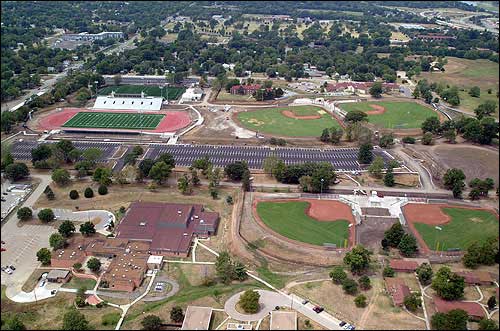
Hummer Sports Park in Topeka features a 6,000-seat football stadium, a 2,000-seat soccer stadium, two baseball fields, two softball fields and a natatorium with an Olympic-size swimming pool. While a case could be made that Lawrence needs a similar facility, a lack of overwhelming support and funding for the project may be too tough to overcome.
New athletic director Lew Perkins stated in August he had concerns about Free State playing there, citing a risk to his scholarship players if the artificial surface incurred wear and tear from high school games.
Eventually, the two sides settled, and Free State was allowed to play at Memorial Stadium for a $3,700 per-game fee.
More tension arose, however, Sept. 19 when Free State played host to Shawnee Mission West. Upon arriving at the stadium, FSHS football coach Bob Lisher learned the visitors’ locker room would not be available to his team because Jacksonville State, KU’s opponent the next day, had moved in its equipment. The home locker room already had been declared off-limits.
While both Lisher and Grant were told ahead of time there was a chance the locker rooms would be closed, they didn’t know for sure until just before kickoff. After a story appeared in the Journal-World, KU apologized and waived its fee for that game.
Since then, Grant said the relationship between his school and KU has improved, and Free State will play at Memorial Stadium again this fall. But to call the arrangement a long-term solution would be a stretch.
“We don’t want to be the answer to everyone’s facility needs,” said Sean Lester, a KU associate athletic director.
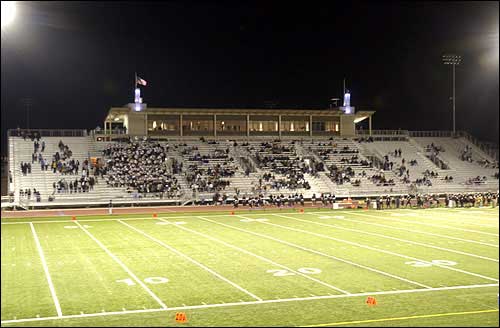
Topeka's Hummer sports park features a spacious press box for the football and soccer stadiums.
Soccer, baseball woes
Other issues involving Free State’s facilities surfaced this spring. Bare spots and divots popped up on the soccer field — products of overuse, a harsh winter and what soccer coach Jason Pendleton called maintenance neglect.
Free State’s baseball field had similar turf woes, in addition to the fact it has no permanent seating, restrooms or concessions.
Both the baseball and soccer fields were made playable through private fund-raising efforts, but the lack of support — and funds — seems to have caught up with them.
“People have been very generous,” FSHS baseball coach Mike Hill said. “But there’s only so much you can do.”
School districts like Topeka and Olathe have complexes with football, baseball and soccer fields. Generally, the fields are for game-use only, so deterioration is less of an issue.
“It makes you wonder why our athletes aren’t as appreciated as much as other athletes in other cities,” Pendleton said. “Why isn’t there a greater value placed on those sorts of issues here in Lawrence? Are our kids not worthy of the same things that Topeka kids or Olathe kids are worthy of?”
Rick Gammill, director of special operations for the Lawrence school district, agrees with the need for centralized facilities.
“My personal feeling is that an ideal solution would certainly be a district complex,” Gammill said. “However, I know and understand that there is a long-standing tradition with Haskell Stadium and Lawrence High football.”
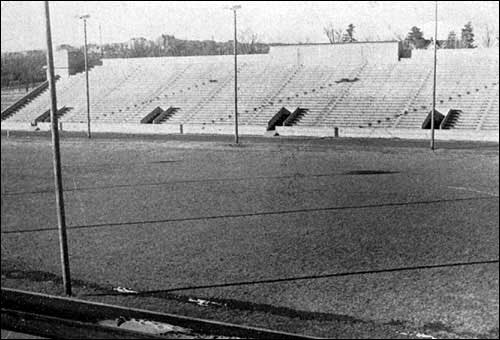
A photo of Haskell stadium from a 1939 Liberty Memorial High yearbook shows the field with the light towers inside the track instead of outside the stadium.
Football does add complexity to the issue, particularly in a town steeped in high school tradition.
Lawrence High football
A 1939 yearbook from when the school was called Liberty Memorial High, sits in cobwebs in an upstairs room at LHS. The annual contains several pictures of the football Lions, who finished 6-2-1 under the leadership of coach Elmer Schaake that year.
One of the photos was of an old football stadium on the east side of town, where the Lions played in front of large crowds that saw, as the yearbook describes, “eleven men plod down the field to slow but telling touchdowns.” The cutline to the photo simply read “HASKELL STADIUM”
The yearbook described the stadium as more than just a home field for the Lions, but “a symbol of the friendship and cooperation shown to LMHS by Haskell Institute.”
While Free State has called both Haskell Stadium and Memorial Stadium home since it opened in 1997, Lawrence High long has been proud of its football tradition, and that includes playing it home games at aging Haskell Stadium.
The Lions started playing regularly at Haskell 74 years ago, and since then, have earned 27 state championships, 21 undefeated seasons and a record of 541-159-12 (a .773 winning percentage).
Even Lisher, a proponent for a district stadium, realizes the mystique surrounding Haskell. As an assistant at Lawrence High, he had a hand in seven state titles while the Lions called Haskell home.
“I can certainly understand,” Lisher said. “Lawrence High has played there forever.”
The thought of abandoning Haskell, and the ghosts of all the greats who played there, doesn’t sit well with many on the south side of town.
“Haskell Stadium has been a big part of Lawrence High for a long time,” football coach Dirk Wedd said. “We feel strongly about it, and the way Haskell treats us as a partner in that field is unbelievable.”
Deteriorating turf
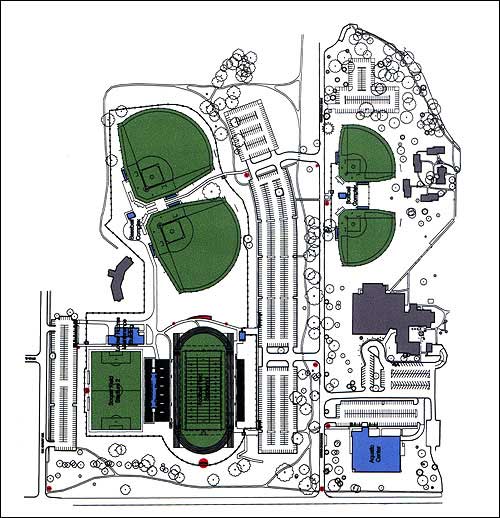
These are the site plans for Hummer Sports Park in Topeka.
When both Free State and Lawrence High play at Haskell, which might be required should KU deny use of Memorial Stadium in the future, new issues arise with the delicacy of the turf at Haskell.
In 2002, Free State moved three games to Memorial Stadium, and Lawrence High even moved a game to KU, because the field at Haskell was too torn up to handle all the football being played there.
Wedd said an investment far smaller than that of a district stadium could be made to put a grass-like artificial surface at Haskell, so that it could support the wear and tear of three teams’ home games.
Regardless, Wedd and LHS athletic director Ron Commons are adamant there is no other place for Lawrence High football to call home. Both played football for the Lions in the 1960s.
“Haskell is one of the first things you associate the tradition with,” said Commons, who recalled playing at Haskell back when the light towers were located inside the track, instead of outside the stadium.
Lawrence High’s football tradition seems too grand to ignore, but other towns have managed to avoid the issue. In Lee’s Summit, Mo., for example, a second high school was completed in 1995. With the building of Lee’s Summit North, a district complex was built, too, complete with two baseball fields, a soccer field and a football stadium with a track around it.
The complex was built with a no-tax-increase bond issue that voters passed in 1993, though what they voted on wasn’t exactly what they received.
“The intent was that there would be one football stadium built and both schools would play there,” said Darwin Rold, athletic coordinator for the Lee’s Summit school district.
However, during construction, Lee’s Summit High decided to keep its home football games at its on-site field, which had become a staple of the ever-growing community. The school uses the new district complex for soccer, track and baseball, however.
Everywhere else
Both Lisher and Wedd are impressed with Topeka’s new digs.
“It’s an absolutely beautiful facility,” Lisher said. “The Topeka school district did it right. They didn’t cut any corners.”
In April of 2001, Topeka voters put a long-discussed plan into motion, approving a $24.5 million bond issue that built, among other things, Hummer Sports Park.
What came of it was a true spectacle for high school sports in Kansas. The park came complete with a 6,000-seat football stadium, AstroPlay surface for the football field, a 2,000-seat soccer stadium, a spacious press box for both football and soccer, four baseball and softball fields and a natatorium with an Olympic-size swimming pool.
Hummer is home to Topeka High, Topeka West and Highland Park athletics, as well as two state championship games last fall, and many more surely to come.
“I’ll be real honest,” Grant said. “I’m kind of jealous that they’re able to pull that off. From the landscaping to the seating to the fan accommodations … everything was great.”
It’s not the first district sports complex in Kansas, though it just might be the best.
More than a decade ago, Olathe built the Olathe District Activities Center, complete with football, soccer, baseball and softball fields. The Olathe school district’s satisfaction with ODAC made the building of a new complex, the College Boulevard Activities Center, a no-brainer when a fourth high school, Olathe Northwest, opened this year.
While ODAC generally sticks to high school sports, it has hosted a few NAIA championships over the years, which brings in even more revenue.
“I think it’s been very positive,” said Jim Ater, athletic facilitator for the Olathe school district. “We’re very pleased with what we have.”
What they have is what Lawrence doesn’t have. However, ODAC wasn’t built until Olathe East was completed in 1992, giving Olathe three high schools. Hummer Sports Park plays host to three schools, as well.
Lawrence, of course, has just two.
Is it even feasible?
At a time when budget crunches put every cost on a tight leash, a district sports complex, assuming it even is wanted in Lawrence, would have to wait in line.
Topeka’s complex, a luxurious park with some amenities Lawrence wouldn’t need, cost $17.5 million. Lawrence doesn’t have that kind of money, and with the issue as divisive as it appears to be, it would be awfully tough to pass the proposal if it would require an increase in taxes.
Currently, the school district spends tens of thousands of dollars every year renting facilities from KU, Haskell and the city. Haskell Stadium costs $3,000 every time the facility is used, which usually includes five or six football games and the annual fall sports jamboree. KU charged $3,700 per game for use of Memorial Stadium last fall, and will charge the same price this fall.
The Lawrence Indoor Aquatic Center, adjacent to Free State High, is owned by the city which charges the school $50 per hour to use as its home pool. Lawrence High’s Knox Natatorium is owned jointly by the school district and the city as is the Lawrence Tennis Center located on the LHS site.
At least Free State has its own soccer, baseball and softball venues. Lawrence High doesn’t. The Lions play soccer and baseball at the city’s Holcom Complex, although at no cost because of a trade-out that enables the city to use school gymnasiums for youth and adult recreation.
However, the school district does have to pay rent in order for the Lions to play soccer at Youth Sports Inc. fields.
Buying would be better
“Common sense dictates that you’d buy a house rather than rent one,” FSHS soccer coach Pendleton said, “because in the long term, it’s cheaper.”
Not in the short term, though. A steep down payment is required before you can buy, and the school district would no doubt need help.
“It would need to go in the hands of the voters,” said Commons, who added that he felt a district football field would be unnecessary, but a stadium for soccer and track could be useful. “Let the community decide. Obviously, I can’t write a check for however many millions of dollars. I don’t think our school board can, either.”
Until then, business will continue as usual for high school sports in Lawrence, with two attitudes — satisfaction with how things are, or jealousy of how things are elsewhere.
“I am in favor of Lawrence kids playing on top-notch facilities,” Firebirds baseball coach Hill said. “Whether that’s a district stadium or where we’re currently at, I don’t know. I do think there are an awful lot of issues that need to be worked out before we get to a district stadium.”
That, it seems, is the one thing everybody can agree on.
Free State
Free State baseball takes advantage of erratic pitching in 7-1 win against Shawnee Mission East
Journal-World Athletes of the Week: AJ Kimzey and Ginny Besson
The spring sports season continued throughout the week as more sports and more local athletes got started with ...

LHS, Free State see good things, room for improvement at swim, dive meet

Free State softball bats go cold in season-opening loss to Olathe Northwest
Free State baseball ready to repeat as league, state champions ahead of Sunflower League play