Sun sets on Bazaar cowboy
Cottonwood Falls ? Frank Gaddie looked overdressed in his casket.
He was wearing a dark suit with his hands folded just so below a wide, blue and white necktie. The funeral home had done a good job making the 94-year-old horse trader look “natural,” but it’s doubtful Gaddie would’ve appreciated the powder and the makeup, or, for that matter, the suit.
No real cowboy would.
Gaddie was a cowboy from way back.
It was Monday night in the Brown-Bennett-Alexander Funeral Home in Cottonwood Falls. Gaddie’s wife, Virginia, along with family members were exchanging handshakes, hugs and a few tears with old friends who dropped by to pay their respects the night before the funeral. Gaddie’s open casket was at the edge of the crowd, against a wall.
A couple of weeks earlier Gaddie had spent the better part of a morning talking about his life and his family, homesteaders in Bazaar in the 1870s. Bazaar is about seven miles south of Cottonwood Falls, just off Kansas Highway 177.
Gaddie’s father, “FM” they called him, built and ran a grocery store and a livery barn, and his mother, Roanna, ran a boarding house. The youngest of five children, Gaddie lost a brother and sister to the flu epidemic that took many lives in 1918.
“We had the funeral at home on the same day they died, and we buried them on my 8th birthday,” he recalled. “Couldn’t have the service in the funeral parlor because they thought the bodies would spread the bad flu.”
He said he sat in his father’s lap on the front porch after they returned from the cemetery.
“My dad told me, ‘Your brother’s gone, and you’re all I got left … you gotta stay with me ’til I die,’ and I did,” he said with misty eyes.
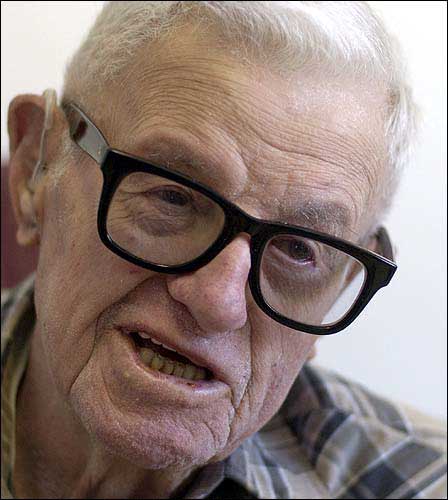
Frank Gaddie, 94, a longtime horse trader and breeder, died last week in Chase County. He lived in Bazaar, 7 miles south of Cottonwood Falls, his entire life.
Gaddie got his first horse and started cowboying when he was 12.
“Me and the Norton boys would leave early in the morning and come back with cattle late in the afternoon to ship on the Santa Fe, and we’d get $3 a day,” he recalled. “Everybody had to work in them days.”
He talked about the frustrations and sweat involved in trying to gather an out-of-control herd of “Brahmas with horns as wide as your pickup.”
“They was wild and was spread out over 2,200 acres west of Bazaar,” Gaddie said. “They’d run right through a barbed-wire fence, and we didn’t get ’em slowed down until we got to the third fence. … They would quit runnin’ when they was tired and not a minute sooner.”
Gaddie’s legacy was breeding and selling quarter horses — and also speaking his mind, when he wasn’t trying to sell you a horse.
“Now I know you live in Lawrence. But do you know what I didn’t like about KU when I was a kid?” he asked with a mischievous grin. “Your folks had to have so damned much money for that tuition that poor kids like us went up to Manhattan.”
He played freshman football at Kansas State in the 1920s. He still had his jersey.
Gaddie believed selling horses out of his barn was harder than selling them at a sale and that there was no dishonor in persuading a buyer to pay more than he could afford.
“You don’t try to beat nobody. … If you sell a horse to a guy for more than he thinks he can pay, that ain’t beatin’ a guy,” he said, looking serious.
Monday night, the arched, iron Bazaar Cemetery sign stood out against a dark blue sky, illuminated by a nearly full moon. A half-dozen American flags, already in place along the cemetery’s fence, were popping in the strong, steady winds. Gaddie, who died at lunch Friday, was buried there Tuesday after a funeral service in the old Bazaar School across the road from the cemetery and about a half-mile from his house.
That was one of his wishes.
State Government
Candidate’s campaign manager created website with documents used to attack rival
TOPEKA — Kansas U.S. Senate candidate Patrick Schmidt’s campaign manager left his digital footprint on ...
GOP secretary of state files to run for governor

9 nominees vying to fill vacancy created by Judge Pokorny’s retirement

As filing deadline nears for 2026 elections, some Douglas County races feature just one candidate
State lawmakers extend emergency declaration over hantavirus exposure
TOPEKA — Kansas legislative leaders on Tuesday approved the governor’s request to extend an emergency ...