Specter of mad cow haunts cattle auction
Prices down, grim humor up at Overbrook sale barn
Overbrook ? A 1,500-pound cow was pushed into the small ring before a crowd of prospective buyers Monday at the Overbrook Livestock Sale Barn and immediately turned cranky.
It pawed the ground menacingly. It mooed angrily. And it refused to exit the ring until a man on horseback forced it out.
“Now that,” said one man outside the ring, “is a mad cow.”
Nervous jokes were common Monday, the first livestock auction day in Overbrook since news of a U.S. case of mad cow disease was announced in late December.
Cattle auctions were canceled across the state last week, as cattle prices fell and buyers and sellers decided to wait out the mad cow scare. As in Overbrook, most planned to reopen this week.
The crowd at the barn about 25 miles southwest of Lawrence was smaller and the prices fetched were lower than they had been before the mad cow scare.
“It’s like everybody was on strike from selling cows,” said Gary Carbonneau, a rancher from Grantville. He sold a bull for 54 cents a pound Monday; he had expected a price of more than 60 cents per pound.
“We were here three weeks ago, and it was going 20 cents higher,” said Ava Carbonneau, Gary’s wife.
The auction, which often takes as long as four hours to finish, wrapped up in less than an hour Monday.
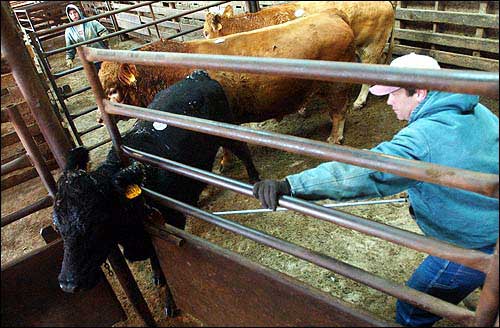
Ron Neilson, Lyndon, tries to block a calf's exit while separating cattle for auction at the Overbrook Livestock Sale Barn. Monday's auction had considerably fewer cattle than usual, with some farmers concerned about lower prices because of the effect of the mad cow case on the U.S. beef market.
Several of the ranchers and buyers in attendance had nothing to sell or buy, in fact — they were on hand to see how the prices would shake out after the mad cow news.
“We don’t have that big a sale this week,” said Joyce Dillon, co-owner of the sale barn. “John (Dillon, her husband and co-owner) told everybody to wait a week and see what happens to beef prices in the U.S.A.”
Federal officials say the first U.S. case of mad cow disease, discovered in a cow slaughtered Dec. 9, poses no threat to public safety.
Humans who eat brain or spinal matter from an infected cow can develop a brain-wasting illness, variant Creutzfeldt-Jakob disease. During a mad cow outbreak in the 1980s in Britain, about 150 people died of the disease.
As the nation’s No. 2 beef state behind Texas, Kansas stands to lose billions of dollars if concern over mad cow spreads to the dining table.
Beef futures were up the limit Monday at the Chicago Mercantile Exchange, increasing 1.5 cents to 75.30 cents a pound for live cattle delivered in February, and to 81.52 cents a pound for March. Despite the increases, prices still are down significantly from the 90.67 cents per pound being paid Dec. 23, the day the mad cow case became public.
Ava Carbonneau said if representatives from countries where U.S. beef has been banned would visit Kansas feedlots and ranches, they would like what they saw.

 Governor’s proclamation aims to beef up consumption
 6News video: Mad cow disease detected (12-24-03)
“We think people in Kansas raise better cattle,” she said. “We take pride in what we raise.”
Joyce Dillon said she was optimistic beef prices would rebound.
“We’re going to get back to where we were,” she said. “Prices will be stronger than ever.”
| Washington — U.S. agriculture officials have decided to kill 450 calves in a Washington state herd that includes an offspring of the cow diagnosed with mad cow disease.Ron DeHaven, the Agriculture Department’s chief veterinarian, said Monday that the month-old calves would be slaughtered this week at an undisclosed facility that is not being used.The herd that is to be destroyed is one of three under quarantine in Washington state because of ties to the diseased Holstein. The other herds contain cows that probably are from the same Alberta, Canada, farm as the 6 1/2-year-old Holstein, but DNA tests to confirm the cow’s origins are not complete.Officials decided to kill all month-old calves in the Sunnyside, Wash., herd because they cannot determine which one was born to the infected cow. Officials cannot rule out transmission of the disease from mother to calf. |
City Government
In Riverfront lawsuit settlement, city commissioners see a ‘once-in-a-generation opportunity’ for downtown Lawrence
Lawrence City Commission approves earlier public comments once a month, civility resolution for commissioners
Lawrence City Commission approves Industrial Revenue Bonds to help manufacturer Amarr buy its current facility
19th Street expected to fully reopen in first week of June
Lawrence City Commission to consider earlier public comment period once a month, new civility standards for commissioners