Honor guard helps preserve Fort Riley’s history
Fort Riley ? Fifteen soldiers at Fort Riley might feel right at home if they were transported to frontier times at the post. They form Fort Riley’s ceremonial mounted honor guard that helps preserve the post’s cavalry heritage.
Of course, the mounted skills and fighting tactics they strive to perfect won’t be tested against bands of Indians. Instead, the modern-day cavalrymen demonstrate their skills and the life of a frontier soldier for audiences at public and post events ranging from parades to formal military ceremonies for new commanders to setting up a military encampment at public events.
Today’s Fort Riley cavalrymen enjoy some luxuries their counterparts of old didn’t — comfortable, air-conditioned trucks and horse trailers to transport their mounts long distances, for example. But much of the day’s tasks for frontier cavalrymen still must be performed today — including shoveling manure and mucking stalls (changing the stall bedding) every day.
Sgt. 1st Class Greg Sutton serves as “top kick” for the honor guard. The Scurry, Texas, soldier normally drives the Army’s biggest transport vehicles, but he has been driving honor guard performances for the past two years.
Sutton’s cavalrymen are generally volunteers from units based at Fort Riley — seven from the 1st Brigade, 1st Infantry Division; seven from the 3rd Brigade, 1st Armored Division; and one from the 937th Engineer Group.
They usually stay with the honor guard their entire time at Fort Riley, 12 to 18 months, Sutton said. Members of the current honor guard hail from Iowa, Texas, Oklahoma, North and South Dakota, North Carolina and Georgia. Some never rode a horse before joining the honor guard. Others had a lot of riding experience, Sutton said.
Despite previous experience, by the end of Trooper School — the first 30 days in the honor guard — the soldier will know what a cavalryman had to know on the frontier: Work days for today’s cavalrymen at Fort Riley are similar to those of the past. The soldiers rise early — stable call is 6 a.m. After removing manure and scrap hay from the stalls and changing the cedar chip bedding, the soldiers report for modern-day physical training (PT).
After PT, the soldiers have an hour to clean up in the stable area and eat breakfast at the nearby dining hall.
Work call is 8:30 a.m., and the rest of the day, when no performances or ceremonies are planned, is spent training in whatever skills need to be improved; maintaining the trucks, tractors and cavalry tack; beautifying the grounds; and repairing buildings.
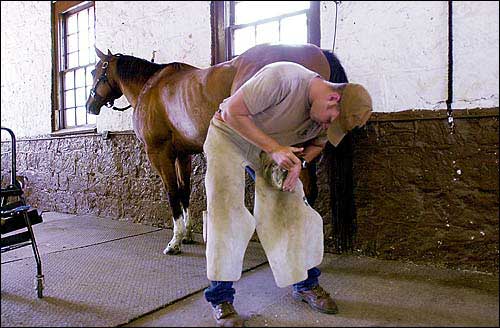
Sgt. Ryan Thomas of Moville, Iowa, works on shoeing the hoof of Stonewall, one of the Fort Riley Honor Guard mounts. The honor guard showcases the cavalry heritage Fort Riley cultivated as a frontier outpost in the 1800s.
“We have about 60 acres of the post and five buildings to maintain,” Sutton said.
Honor guard soldiers spend only about one hour riding for about 12 hours of other work they must do.
Everyone has additional duties assigned because the honor guard has no authorized manning — people assigned to do designated missions. Some of the cavalrymen are responsible for building repair, others for getting needed supplies. Still others repair the vehicles, Sutton said.
| Fort Riley turned 150 years old June 27. In honor of the post’s 150 years of consecutive service to the nation, the Institute for Military History and Twentieth Century Studies at Kansas State University is having a sesquicentennial symposium Sept. 11-12 on the college’s campus.The symposium will address “Perspectives on Fort Riley’s Place in U.S. National Defense and American Life and Times.”For information on the symposium, call (785) 532-6730 or 532-7004. |
State Government
Candidate’s campaign manager created website with documents used to attack rival
TOPEKA — Kansas U.S. Senate candidate Patrick Schmidt’s campaign manager left his digital footprint on ...
GOP secretary of state files to run for governor

9 nominees vying to fill vacancy created by Judge Pokorny’s retirement

As filing deadline nears for 2026 elections, some Douglas County races feature just one candidate
State lawmakers extend emergency declaration over hantavirus exposure
TOPEKA — Kansas legislative leaders on Tuesday approved the governor’s request to extend an emergency ...