Barbecue lovers propose museum
Kansas City hall of fame would honor American culinary style
Kansas City, Mo ? A shrine of slabs and sausages. A palace of pulled pork. A veritable cathedral for carnivores.
Such is the sauce-splattered vision of a consortium of barbecue enthusiasts and civic promoters, who want to establish the American Barbecue Hall of Fame and Museum here to honor one of America’s most beloved — and most debated — culinary styles.
“I wouldn’t call myself a barbecue fanatic by any means,” said George Vesel, a specialty-foods broker and restaurant partner who serves as the group’s president. “My main motivation is that I feel it would be a great thing for Kansas City. It’s a natural for a location here.”
The area does have impeccable barbecue credentials.
“Kansas City has the largest barbecue organization, the greatest concentration of barbecue contests and certified barbecue judges, and the greatest concentration of cooking teams,” said Carolyn Wells, executive director of the Kansas City Barbeque Society, which boasts more than 5,000 members worldwide.
The city boasts the annual American Royal Barbecue Contest, one of the nation’s largest alongside Memphis in May and the Houston Livestock Show and Barbecue.
Its roster of barbecue restaurants numbers in the dozens and includes Arthur Bryant’s, lauded by writer Calvin Trillin in The New Yorker and a favorite of presidents and Hollywood stars. Then there’s the K.C. Masterpiece line of sauces, now owned by Kingsford but launched in its namesake city by Dr. Rich Davis.
Regional loyalty
Still, any barbecue-capital claim emerging from Kansas City might be fighting words to lovers of vinegary Carolina pork, wet-rubbed Memphis ribs or mesquite-smoked Texas brisket.
Few things spark as much regional loyalty — and passion — as barbecue. Aficionados even spar over the spelling — “barbecue,” “barbeque” — even “Bar-B-Q” or the even more truncated “BBQ.”
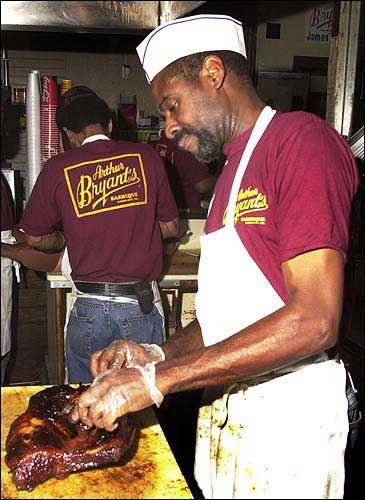
Ray Echols cuts a piece of brisket at Arthur Bryant's in Kansas City, Mo. A consortium of barbecue enthusiasts and civic promoters want to establish the American Barbecue Hall of Fame and Museum in Kansas City, Mo. Arthur Bryant's is one of the city's many well-known barbecue restaurants.
“Barbecue is a very provincial food,” said John T. Edge, director of the Southern Foodways Alliance at the University of Mississippi’s Center for the Study of Southern Culture. “It is the idea that one man’s sustenance is another man’s pestilence — what you were raised on is true barbecue, and all other is mere imitation.”
Museum backers, though, say they will focus on far more than Kansas City’s hickory-smoked, South-by-Southwest fusion style. They envision a national board of directors, and a wide-ranging nomination process.
“Our intent is to honor everyone across the country who’s made a significant contribution to barbecue,” Vesel said.
That’s an ambitious goal, Edge said — but one that museum backers must achieve to truly represent American barbecue.
“As long as that museum, that hall of fame, throws up a big enough tent under which every pit master can gather — sure, they can do it,” he said.
Collection content
Vesel’s group is not affiliated with the Kansas City Barbeque Society, but Wells said the society would be willing to contribute part of its collection.
“We’ve got pictures from contests, 300 to 400 T-shirts and aprons,” she said. “One of our members gave us a vintage grill from the 1950s that has hardly ever been used. It’s sitting in our garage waiting for a place that will honor it.”
Edge, the food historian, said the proposed museum must go beyond the world of barbecue competition to the cuisine’s founders — mostly poor, almost uniformly Southern, largely black.
“For the longest time, the job of barbecuing was assigned to people of lower economic rank and victims of the Jim Crow system,” Edge said. “It is sweaty, hot, messy work that has been elevated to a sport, a weekend endeavor.
“The grand old men and women of barbecue were not out there doing it for the glory of the Food Network.”
The Kansas City group hopes to open the museum by Memorial Day weekend in 2005 but does not have a definitive price tag on the project or a location for it.
“An extremely ballpark guess would be half a million,” Vesel said. “It could be a lot less. I don’t see it being more than that.”
Kansas City also is home to the Negro Leagues Museum and the American Jazz Museum in the historic 18th and Vine district. That would seem to be a natural fit, but the area doesn’t draw the foot traffic Vesel would like to see.
Among the proposed museum’s highlights would be a working barbecue pit, where visitors could see up close the differences between true barbecuing and the backyard grilling so many think of as barbecue.
“I think it will be an awful lot of fun,” said John F. Head, an executive with the Denver-based Culinary Institute of Smoke Cooking. “I can think of a lot of places around the country that aren’t going to be as much fun or taste as good as this.”
State Government

Regents approve new policy for what constitutes DEI-related content in KU, other university classes

Regents approve 5% tuition and fee increase for KU for upcoming school year
Girod said latest controversy with Texas Tech is stark reminder of why college athletics needs federal help

Over 100,000 Kansans yet to receive state tax refunds; Department of Revenue says staffing issues contribute to delays
‘If it ain’t broke, don’t fix it’: Retired Judge Sally Pokorny tells residents why she opposes electing Supreme Court justices