

Prosthetic craftsman makes artificial eyes look real
Wichita ? When Margaret Chipman told a friend about making an eye appointment recently, he automatically assumed she was having her vision checked.
His jaw dropped to the floor when she corrected him, saying she was having her eye polished. Though they’d known each other for years, he hadn’t realized until then that her right eye was a prosthesis.
For that, credit ocularist Jim Henthorn, who has been handcrafting prosthetic eyes, noses and cheeks in Wichita since April 15, 1987.
Henthorn said about 1 in 200 people — 0.5 percent of the population — need his services. He has about 500 patients, whose homes stretch from McCook, Neb., to Ponca City, Okla. Though another man in Wichita also works with patients who need artificial eyes, Henthorn is the only ocularist, making them himself.
“An Eye for an Eye” proclaims a brochure explaining his services.
In addition to making artificial eyes, he does expansion therapy, on children born without eyes, to “make the body go in and think it’s got an eye growing.” Beginning at birth, a clear shaper is placed in the child’s eye socket to help it grow so it will accommodate an artificial eye of the right size. By age 2, the child usually can be fitted with a prosthesis.
Henthorn also makes scleral shells, which are very thin, natural-looking eye “shells” that can be placed over a disfigured or blind eye to make it look natural.
And he makes orbital prosthetics, for those who have lost the area around the eye as well as the eye itself. That can include eyelids and lashes as well as eyeballs and skin.
Patient services
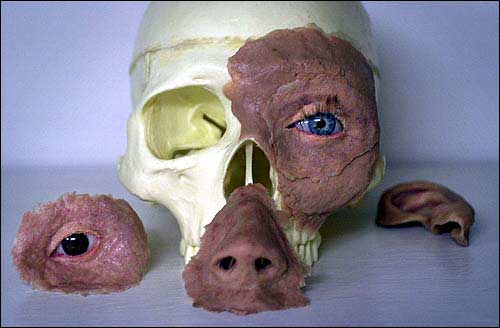
Wichita ocularist Jim Henthorn made these orbital and facial prosthetics. Creating an artificial eye is an all-day endeavor for Henthorn and the patient.
All this happens in an office on South Hillside, where Henthorn uses acrylics and other dental materials to re-create nature.
He has been working with Chipman for years. Chipman, now 68, lost her eye in an auto accident in 1949, when she was a freshman in high school in Ohio. Her dad was driving the car; it hit ice and crashed into a bridge.
Chipman had the fortune to go to a doctor who took into consideration the muscle behind her eyeball as he constructed her prosthetic. That’s done routinely now, but it was rare in the late ’40s.
The doctor inserts an implant — “It’s called an implant, but it’s essentially a marble,” Henthorn said — in the eye socket. The muscle grows or is sewn around the implant, holding it in place.
Then the patient has an impression made, much like a dental impression is made for a crown or dentures.
“He squirts this stuff in the socket,” Chipman said.
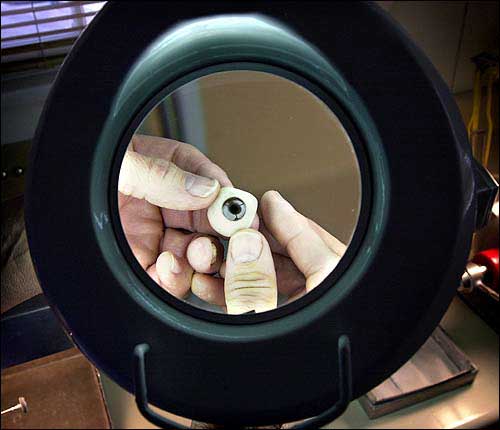
Ocularist Jim Henthorn examines patient Margaret Chipman's prosthetc eye after cleaning and polishing it.
“It sets up like pudding,” Henthorn added. “It takes about three minutes.”
From the impression, Henthorn creates a wax model, then makes a mold from it that is used to create the acrylic prosthetic.
Personal attention
Creating an artificial eye is an all-day process, and Henthorn sees only one patient a day when he’s doing that. The first two hours are spent creating the wax mold; after a break, Henthorn is back at work, painting, processing, readjusting. He begins at 8:30 a.m. He has been done as early as 2 p.m. and as late as 7.
Each eye has an “alignment peg” that gives it a custom fit over the implant and muscle in the eye socket. Because the eyes work together, that allows the prosthetic to follow the real eye as the patient looks to the right or left, up or down.
Chipman says she can’t look too far to the right without running into bone. And she has difficulty looking very far up. But if you are carrying on a conversation or stare straight into her eyes, you can’t tell which is the real one if you don’t already know.
Her first artificial eye after the accident was the equivalent of an over-the-counter model. She remembers thinking, “oh, my word” as the doctor opened artists’ drawers full of eyes, trying to find the best match for size and color.
The only over-the-counter part of Henthorn’s eyes are the “iris buttons,” which look like clear thumbtacks with a black spot on the head, for the pupil of the prosthetic eye.
Though he starts with white acrylic, Henthorn adds layers of color to a prosthetic eye, not only to create blue eyes or brown, but also to shade the whites. “If anything, I want an artificial eye a little on the dark side,” he said, because natural vision is drawn to white — much like a wedding audience focuses on the bride rather than the groom.
“Getting the cosmetics is the side effect of what I do,” he said. Making sure the eye closes right and the tear ducts work are the more important parts of the process — Chipman still cries with her right eye as well as her left.
Upkeep
An artificial eye will last seven to 10 years on average. As with other parts of the body, the eye socket changes with age and weight gain or loss, so the fit of the prosthesis changes. And over time, the body’s chemistry begins to work on the acrylic, crazing it with microscopic lines that then begin to turn the eye yellow.
“Her eye’s a little over 10 years old, so we’ve already discussed replacing it,” Henthorn said, referring to Chipman.
Chipman wears her eye 24 hours a day. Henthorn said patients used to take their prosthetic out weekly, to clean it, but that caused more problems than it prevented.
Chipman flushes her eye daily with saline or artificial tears. Wind is the artificial eye’s worst enemy, Henthorn said, because it dries out the eye and introduces foreign matter.
A prosthetic eye costs $1,950, Henthorn said, which includes a one-year follow-up. Insurance usually picks up the cost.
After that, a patient has the eye polished once a year, as Chipman recently had done.
Henthorn reinserted Chipman’s prosthetic, then flushed it with a solution.
“Wow,” she joked as he pulled his hands away. “I can see.”
State Government
No Labels Kansas is no more as a political party
TOPEKA — Demise of the No Labels Kansas political party was inevitable after it neglected to fulfill the ...
Johnson County school districts plan to sue state over lack of special education funding
TOPEKA — Four Johnson County public school districts want to sue the state of Kansas for more than 15 years of ...
How to define diversity, equity, inclusion, critical race theory has become a $2M question at KU
Lawrence resident files for Secretary of State as third party candidate
A Lawrence resident has filed to run for Kansas Secretary of State as a third party candidate. Scott Morgan, who ...
Douglas County Judge Carl Folsom chosen as a finalist for Kansas Supreme Court seat
