Restored vision offers insight into seeing
Patient was blind 43 years
After 43 years of blindness, Michael May can see again.
He can play soccer with his sons, enjoy movies and, for the first time, gaze on the Sierra Nevada slopes he has expertly skied — sightless — since the late 1970s.
But May can’t recognize his sons, Carson, 11, and Wyndham, 9, by their faces alone. The same goes for identifying Jennifer, his wife of 15 years.
People “can’t fathom that,” said May, who owns a company in Davis, Calif., that makes navigational software for the blind.
Three years after surgery restored sight to May’s right eye, researchers say May’s case shows how vision is more than just eye function. Blindness has long-term effects on how the brain processes information and constructs one’s view of the world.
May lost his sight after a chemical explosion when he was 3 1/2 years old. He eventually lost his left eye and remained blind in his right until the surgery in 2000.
But testing since that surgery has showed that May’s ability to interpret what he sees through his good eye is decidedly mixed, said Ione Fine, lead author of a study appearing in the September issue of the journal Nature Neuroscience.
May can identify simple shapes and colors. He can interpret objects in motion. He can spy faraway peaks. He marvels at the vibrancy of plants and flowers unseen since he lost his vision.
But three-dimensional perception and the ability to recognize complex objects such as the faces of family and friends remain severely impaired. He strains to tell the difference between a man and a woman. He describes a cube as a square with extra lines.
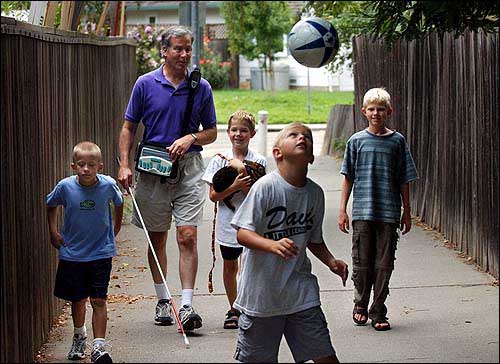
Michael May, second from left, walks with his children and their friends to a park near his home in Davis, Calif. Seen from left are Ben Smithers, 8, Carson May, 11, Wyndham May, 9, and Aaron Hills. May has been blind since the age of 3 but has been able to gain some of his sight back after corneal surgery.
Rare case
Written history mentions perhaps 30 people who reacquired vision after protracted periods of blindness, said Fine, a neuroscientist at the University of California, San Diego. She and her colleagues leapt at the chance to study May and began testing him just months after his cornea- and stem cell-implant surgery. The stem cells formed a protective layer over his new cornea to prevent clouding.
“There has always been this question: What would happen if a blind man got his vision back? Is it something innate or is it something we learn from first principles?” Fine asked. “Is it something that happens or is it something we learn, like language?”
Repeatedly, the researchers combined vision tests with scans of May’s brain activity to study how blindness had affected him.
Complex results
When asked to identify a cube illustrated on a two-dimensional computer screen, for example, May failed. But once Fine commanded the cube to rotate, simulating motion in three dimensions, he immediately recognized it.
“It was really weird to have a three-dimensional sense of something on a flat surface, because it was such a foreign experience to someone dominated by a tactile ability,” May said.
Scans of the region of May’s brain associated with the processing of complex forms revealed patchy responses when he was shown the still cube.
But once the cube moved, his motion-processing region came ablaze with activity, Fine said. That suggests the region was fully developed when May lost his sight, Fine said.
Since May’s ability to recognize complex forms showed such impairment, it suggested that region is much slower to mature, Fine said. Once deprived of visual experience, it likely ceases to develop and languishes, she added.
Since humans constantly encounter novel objects and new faces — and aging in familiar faces — the processing region in the brain must remain flexible, Fine said.
Health
More children’s hospitals turn to furry caregivers to help kids heal
Sometimes ‘baby blues’ is actually something darker
Moments after Jenna Carberg gave birth to her daughter, doctors put the baby on her chest. “I felt a disconnect ...

Moving to music offers all kinds of benefits as you age
Conflicting mamogram advice leads to confusion
WASHINGTON — Deciding when to get routine mammograms is confusing. Some health groups recommend women begin at ...

A mop, a broom and a calmer mind: Why some find mental health benefits in everyday tasks