Plains cathedral opens its doors to interstate travelers, tourists
Victoria ? Weary travelers may have a hard time believing their eyes when they approach this small western Kansas town from Interstate 70.
On the horizon, the twin towers of St. Fidelis Catholic Church rise from the wheat fields about a mile south of the heavily trafficked highway.
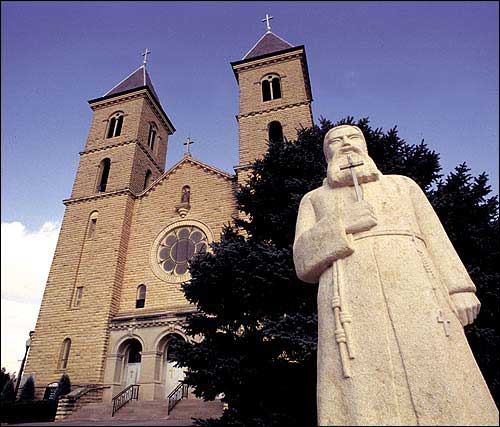
A limestone statue of a Capuchin friar stands in front of the twin towers of St. Fidelis Catholic Church at Victoria. The landmark, also known as the Cathedral of the Plains, draws about 16,000 tourists a year from nearby Interstate 70.
No, it isn’t a mirage.
A brown highway sign near the I-70 Victoria exit designates the church as the historic Cathedral of the Plains, answering any immediate questions motorists may have about what they are seeing.
Most travelers, trying to get to their destination as quickly as possible, continue going at a steady 70 mph or more.
But a surprising number do turn off at Victoria, a community of 1,214 with deep German-Catholic roots.
Many, no doubt, feel drawn to the cathedral, wondering just how big it actually is, and what it holds for those who visit.
“We have about 16,000 tourists a year here,” said Ethel Younger, who works in the church’s parish office, across the street from the massive cathedral. “And the number seems to be growing.”
On a mid-morning weekday visit last spring to the Cathedral of the Plains, whose address is 900 Cathedral, there were no other visitors.
But by summer, a steady stream of people are flowing in and out of the cathedral, every day of the week. The church, about 10 miles east of Hays, is made of 17 million pounds of native fencepost limestone. It was built between 1908 and 1911, with much of the construction done by parishioners.
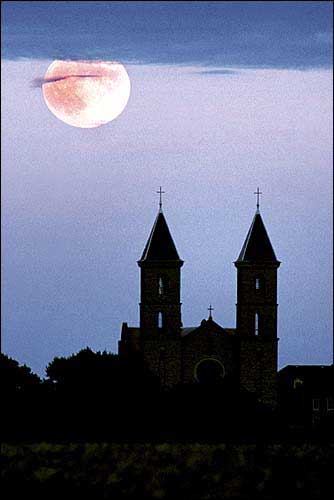
The twin towers of St. Fidelis Catholic Church rise above the town of Victoria, as a full moon rises in the distance.
The breathtaking sanctuary, which is open during daylight hours, includes an altar and pulpit from Italy, stained glass windows from Germany and intricately carved shrines from other areas of the world.
It has a Roman basilica design, with two rows of seven pillars 14 in all made of Vermont granite, supporting a windowed clerestory. Two transepts give the building the shape of a cross.
The building is 220 feet long and 110 feet wide at the transepts. The outer walls rise 27 feet, and the peak of the roof is 75 feet.
Facing the west, the twin towers are 141 feet high, and each is topped with a 12-foot cross.
To the south of the church is a two-story friary, completed in 1905, which is attached to the sacristy. It is for the Capuchin friars who work in St. Fidelis and neighboring parishes.
Those who see all of this and more are glad they took the time to stop, Younger said.
“I have a lot of tourists stop and say they tour churches in Germany and all over the world,” she said, “and this would absolutely be their No. 1 choice.”
Other visitors have found spiritual aid from their stop at the Cathedral of the Plains, she said. Many notes have come to the church office over the years to that effect, from travelers who have found comfort there in an hour of need.
Younger said the church was glad to open its doors to travelers.
“We invite them,” she said. “We’ve been so fortunate we’ve never had any vandalism where people steal anything. So far, we’ve never been forced to lock the doors.”
While individuals get a lot out of visiting the Cathedral of the Plains, it is what they take with them that matters most, Younger said.
“You’re taking the Lord with you,” she said.
State Government
Thousands of Kansas residents to receive notice saying they need to repay mistaken unemployment payments from pandemic

Interviews for Kansas Supreme Court vacancy scheduled for May 21; public can submit written comments until week prior
Kansas policymakers lag on updating school funding formula
TOPEKA — A Kansas task force is running out of time to craft a new public school funding formula, which the ...
State forecast shows falling tax collections and budget shortfalls
TOPEKA — Kansas revenue forecasters expect income tax collections to fall below previous predictions for this ...

Seeking to take on both Republicans and Democrats, pair of smaller Kansas political parties merge