

OrthoKansas clinic now has more space, high-tech equipment
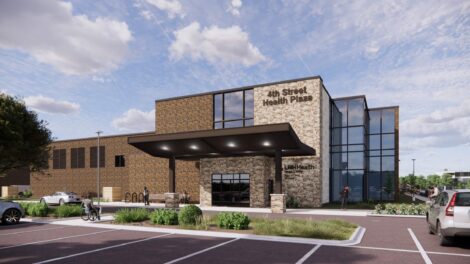
With the opening of the new LMH Health West Campus, the OrthoKansas clinic now has a lot more space and more equipment to help people recovering from injuries or orthopedic surgery.
One new feature of the 16,000-square-foot facility has LMH’s sports medicine staff particularly excited: an isokinetic testing device. This machine can precisely evaluate joint function following injury or surgery, specifically for the knee, shoulder and ankle. It is commonly used for strength training and rehabilitation from a sports injury or other joint injury.
Dan Lorenz, director of sports medicine at LMH Health, said it makes sense for a new facility to have this kind of state-of-the-art equipment.
“We should have data-driven outcomes and evaluation/testing procedures for our patients,” he said. “With the isokinetic machine, there is not a better modality to do exactly this in the physical rehabilitation realm.”
Lorenz said it’s a luxury to have this machine on hand. There are only a few isokinetic machines in the state of Kansas.
“We want to provide the best care for our patients and the community,” he said. “This service will be offered to our therapy patients, but anyone can use it. We have a self-pay option for this that is available through MDsave.com.”
Lorenz said that patients may want to try the isokinetic machine out if they had an injury years ago and something still doesn’t feel quite right. The isokinetic machine will pick up the deficits.
“This machine allows people to know their status,” he said. “Rather than thinking or feeling like they aren’t at their full capacity, this will allow them to know for certain what level they are at and what areas need some further attention.
“We are also able to do accurate baseline testing,” he added. “If you have an injury that will need surgery, we can test your good limb to make sure after surgery (that) we can do our best to get your injured limb up to your fullest potential again.”
The isokinetic machine is just one of the new technologies offered at the LMH Health West Campus. Jaye Cole, senior director for physical therapy and rehab, said the new space offers a lot more options for her department.
“We can see patients using new equipment like our HydroWorx water therapy, our growing motion analysis lab and have the agility space to work with our sports medicine patients in an environment that feels more real to them,” she said. “We are also now able to work with our Women’s Center and create an environment that is a one-stop-shop for our patients, along with assisting in their pelvic floor rehab and breast center post-op rehab as well.”
Cole said that the new equipment at the West Campus can serve anyone, from top-level athletes to ordinary people who just want to work on gaining more mobility.
“With the new HydroWorx water therapy we can make patients weightless, taking all stress off of their joints,” she said. “We can go up to an 8 mph speed with the underwater treadmill to challenge our athletes if they’d like.
“We are also focusing on our runners with our motion analysis lab,” she said. “We want to be able to help runners improve their efficiency and see where their deficiencies are to decrease the likeliness of an injury.”
The West Campus also includes a space for athletes where they can kick, throw and move as they would in a real game.
Cole said that anyone can seek treatment at the new facility by self-referring to a physical therapist. However, if a patient is not progressing toward documented treatment goals that are objective, measurable or provide functional improvement within 10 visits or 15 business days of the initial treatment visit, the physical therapist will obtain a referral from an appropriate licensed health care practitioner.
“Before treatment, we make sure our patient knows that a physical therapy diagnosis is not a medical diagnosis by a physician,” Cole said. “Therefore, we can focus on the reason for the referral — say, hip pain — rather than a known medical diagnosis that would come from a physician, like hip bursitis.”
Dr. Stephan Prô, an orthopedic surgeon with OrthoKansas, said the move for the OrthoKansas team to the West Campus has allowed for a bigger space and a greater focus on patients.
“In my opinion, the physical therapy space is perhaps the highlight of the entire clinic,” Prô said. “This enables our orthopedic specialty-trained therapists to perform the highest level of rehabilitation for both surgical and nonsurgical care.”
The state-of-the-art technology was funded in part by donor contributions. Donors gave more than $5.5 million to support the West Campus project, including a $1 million gift for orthopedics made by Rodger and Sheryl Henry through the company H & S Holdings.
Prô said that the OrthoKansas team hopes to continue developing tools and diagnostics to help the West Campus become a single stop for all outpatient needs, including imaging, labs, surgery and more.
“In the future, we hope to expand our offerings to include the possibility of same-day follow-up after imaging as well as digital check-in kiosks for patient appointments,” he said.
After three years of the West facility being in the works, Prô said the team is happy to finally be settled in and taking care of patients.
“This new environment allows us the ability to continue to grow as a practice,” he said. “We want to fulfill the needs of our patients and fulfill the future needs of the greater Douglas County community.”
— Jessica Brewer is the social media and digital communications specialist at LMH Health, which is a major sponsor of the Journal-World’s health section.
Health
Infant mortality rate hits all-time low mark for US
NEW YORK — Infant mortality in the U.S. dropped to a new all-time low in 2025, according to preliminary ...
Heart Center renovation aims to get services beating as one
Missouri judge finds state laws restricting abortion violate voter-approved constitutional amendment
A Missouri judge this week struck down a series of restrictions on abortion, finding they violated a constitutional ...

ER visits for tick bites on the rise throughout the Midwest
FDA OKs first new sunscreen ingredient in over 25 years
WASHINGTON — Federal health regulators last week signed off on the first new sunscreen ingredient for the U.S. ...
OB-GYN group makes its 1st vaccine recommendations
A prominent OB-GYN group announced vaccine recommendations on Wednesday that differ from what the U.S. ...