Why the long wait? Understanding Emergency Department boarding
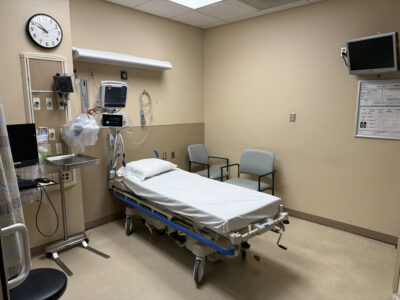
photo by: Autumn Bishop, LMH Health
A patient room is seen at the LMH Health emergency department.
When inpatient resources are at capacity – whether it’s because of a lack of physical beds or a patient volume exceeds the number of staff available to care for patients in those beds – patients may find themselves waiting in the Emergency Department (ED) long after they’ve been admitted to the hospital.
This practice, known as boarding, occurs when a patient spends four or more hours in the ED after being admitted. Boarding affects hospitals across the country – it isn’t a problem unique to LMH Health. In fact, many hospitals in the area have experienced an uptick in boarding over the past several months.
“When we board patients in the ED, we’re holding patients who have been admitted to the hospital in the ED until an inpatient bed becomes available,” said Jan Wiebe, LMH Health’s chief nursing officer. “We start all the orders and care for them, just as if they’d been admitted to an inpatient unit. It becomes challenging because those rooms are no longer available to care for patients in the ED.”
Hospitals typically expect to have a lower census — the number of patients admitted to the hospital – during the summer months. This year, LMH experienced something different – an 18% increase in admissions.
“It’s hard to pinpoint a reason for the increase,” Wiebe said. “Our ED volumes were similar to the summer before, but the number of people we needed to admit to the hospital was higher.”
Winter generally brings a higher number of admissions during a time when illnesses such as flu and RSV are at their peak.
The summer surge strained resources.
“When the demand overwhelms your resources and capacity, the only place to keep admitted patients is in the Emergency Department,” Wiebe explained.
Let’s go back…what happens when I go to the ED?
Let’s be clear: Seeking care in the Emergency Department is vital when you’re experiencing a life-threatening illness or injury. If there’s a bed available when you arrive, great! We’ll take you back and the ED team will assess your condition.
When the ED is at capacity, you’ll speak with a triage nurse. They’ll take your vital signs and ask questions about your symptoms or injury so they can understand your condition.
“The triage nurse will decide how urgently you need care and the resources we anticipate it will take,” said Jen Behmer, Emergency Department director. “Think of it as a scale with the most critical patients at the top and the least urgent at the bottom. Patients with life-threatening issues are seen immediately, while those with less severe problems may wait longer.”
(Spoiler alert: If the nurse rushes you back without hesitation and has a look of panic on their face, you might be at the top of that scale. And that’s not great.)
But if the hospital happens to be boarding patients? That may lead to longer wait times in the ED.
“We have limited space in the ED with 24 monitored beds for medical patients. If we have 12 people boarding in the department, that means that decreases our overall capacity by 12 rooms,” Wiebe explained. “And that means that we aren’t able to get patients in our waiting room back to be seen as quickly.”
LMH Health is working to relieve the pressure on the ED by undertaking a throughput project. This means we’re looking at every step of your visit, from the moment you walk in the door until the time you leave, to make sure care moves as smoothly and quickly as possible.
Teams are working to increase available spaces to care for patients, including additional progressive beds in the ED. The good news is that the throughput project seems to be making an impact. One of the metrics that LMH Health monitors is the left without being seen rate. At its peak, that rate was close to 6%. Now it’s under 2%.
“It’s hard to be in the waiting room. You don’t feel well, you’re hurt and you just want to be taken care of. We get that,” Wiebe said. “For the most part, the time you spend from door to doc – when you come into our waiting room until the time you see a doctor – is less than 20 minutes.”
The hospital has also opened additional inpatient space to house patients four days a week, from Monday morning through Thursday night.
“We’re hopeful with the throughput project and opening additional space that we will decrease the number of people boarding in the ED,” Wiebe said. “This is just one step in a larger process because it isn’t just an ED problem. It’s one we all have a part in.”
If you happen to check into the ED during the same hour as ten other patients, and that volume continues for three hours, you still may have to wait to be seen. Overall, Wiebe said the throughput project has made a difference.
“No one wants their loved one to spend more time in the ED than needed,” she said. “Boarding isn’t just a problem that affects one area at LMH Health, it impacts everyone. We’re continually working with teams across the health system to improve the experience for our patients.”
Autumn Bishop is the marketing manager and content strategist at LMH Health, which is a sponsor of the Lawrence Journal-World health section.
Health

Doctor discusses trends in early-onset colorectal cancer
Tips for cutting back on social media before it devours life
Social media addiction has been compared to casinos, opioids and cigarettes. While there’s some debate among ...

Olympic doctors offer wellness tips for weekend athletes

As legislators target illicit e-cigarettes, a health official says they’re already a problem in Lawrence
Expert urology care, close to home at LMH Health