Recently disclosed letter from 2016 shows Regents agreeing to Gray-Little’s $510K salary as ‘expression of our gratitude’
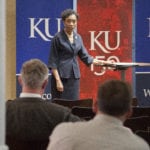
In this file photo from Feb. 6, 2016, University of Kansas Chancellor Bernadette Gray-Little answers questions during an informal forum at The Commons in Spooner Hall.
The Kansas Board of Regents has released a document outlining the terms of former University of Kansas Chancellor Bernadette Gray-Little’s continued employment with KU, shedding some light on her role as the university’s “special advisor” — and mentioning that an “expression of gratitude” played a role in her receiving more than half a million dollars in salary and other compensation.
Last week, after news broke that Gray-Little was being paid more than $510,000 to serve as a special adviser at KU, the Journal-World filed an open-records request for a document listing the terms of her employment. The Board of Regents responded with a letter written by Regents president and CEO Blake Flanders.
In the letter, dated Sept. 16, 2016, Flanders writes on behalf of the entire Board of Regents to express “our appreciation for the unfailing leadership and service” they say Gray-Little had provided in her then eight years as chancellor. Flanders writes in his letter that “the Board of Regents, the University of Kansas, and important friends of the University are committed to providing the support that will ease the transition for a new leader in that challenging position.”
In return, and “as an expression of our gratitude,” Flanders wrote, the Board of Regents gladly offered to pay Gray-Little’s new salary as a “consultant to the new Chancellor,” among other items. That salary, the Journal-World reported last week, is the same payment — $510,041 — she received in her final year as chancellor.
Public funds are paying 55 percent of Gray-Little’s post-chancellor salary, with private funds covering the other 45 percent.
“This role will consist of helping the new Chancellor, at her or his request, become acquainted with the University’s unique programs, its several campuses, and other areas,” Flanders wrote in his letter, which was sent to her less than a week before Gray-Little officially announced her decision to step down.
Gray-Little’s successor, current Chancellor Douglas Girod, would not be announced until May 2017. At the time, he was serving as executive vice chancellor of the KU Medical Center in Kansas City, Kan., a position he had held since 2013. Girod first joined the KU Medical Center faculty in 1994.
In his letter to Gray-Little, Flanders said he and other Regents were “pleased that you are willing, when called upon and subject to your calendar,” to help in Girod’s transition to chancellor.
“We understand that you will not maintain a campus presence during this time, but will make yourself available as needed,” the letter said. Gray-Little maintains an office at KU’s Hall Center for the Humanities, though it is unclear if that office was established at the time of Flanders’ letter.
“For the period of your consulting work, fiscal year 2018, you will remain on the University payroll, except for the $25,000 deferred compensation, and you shall receive the same gross salary that you receive during fiscal year 2017,” the letter said. “In addition, you shall receive the same salary-associated fringe benefits that you presently receive.
“Further, you shall receive the same retirement, health, dental, and disability benefits that you presently receive,” the letter continued. “The services, compensation and benefits provided for in this paragraph shall cease should you accept and begin other full time employment during this period of time.”
Flanders also said the deferred compensation had already been credited to Gray-Little in an agreement from June 2010, and was provided through private funding within KU Endowment. The letter said that compensation would be paid within 30 days of Gray-Little’s conclusion of her chancellor role.
The letter also said Gray-Little would receive reimbursement for moving costs related to her office and residence as chancellor.
The letter was signed by both Flanders and Gray-Little in agreement of the employment terms. Neither the Board of Regents nor Gray-Little herself has provided details about her job responsibilities as “special advisor,” though KU Endowment president Dale Seuferling later told the Journal-World much of it would involve donor outreach, serving on volunteer and advisory groups and attending events.
The Journal-World has sent follow-up questions to the Board of Regents, including what fringe benefits Gray-Little is getting and why the board felt a monetary expression of gratitude was necessary, and will provide updates as details become available.
Gray-Little has declined to comment on her continued employment at KU, referring all questions to KU and the Board of Regents. When Gray-Little stepped down as chancellor last summer she indicated to a Journal-World reporter that she would remain a KU employee “for several months” but did not disclose that she would be on the payroll at her full salary and benefits for another year.
“I will have no role in running the university,” she said at the time.
Gray-Little also said at that time that she did not have a retirement compensation package or any contract buyout compensation coming.
City Government
Lawrence City Commission to weigh whether Costco should be included in STAR bond district
As they approve bikes plan, Lawrence city leaders ask about data collection, Kentucky and Tennessee streets
Lawrence city leaders want to toughen tobacco licensing rules ‘sooner than later’
Algerian government invites Mayor Brad Finkeldei, Lawrence delegation for a visit
Construction on Wakarusa Drive to resume; city manager says KDOT’s secretary has apologized for delay