Railroad project’s felled trees along scenic road prompt concern in Lecompton
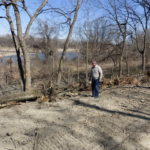
Paul Bahnmaier, president of the Lecompton Historical Society, surveys the damage done from a Burlington Northern Santa Fe Railroad project on a scenic road along the Kansas River. The railroad has agreed to clean up the site after a roadway meeting that included a congressional aide, State Sen. Marci Francisco and Douglas County Public Works staffers.
It’s rare that anything about Lecompton’s history or setting embarrasses Paul Bahnmaier.
But that was the case Friday when an Ohio couple visited the Territorial Capital Museum in Lecompton after picking up a brochure on the town in Colby.
“They were going to stop at Fort Hays and Abilene, but they drove straight through to get here before we close,” said Bahnmaier, the president of the Lecompton Historical Society. “I was embarrassed to tell them if they took the scenic route listed on the brochure, it would look a lot different than it did a few weeks ago.”
The different look to the road that overlooks the Kansas River to the north and timbered hills and bluffs to the south was the result of what Bahnmaier called a “butchering” of trees on the north side of North 2050 Road for about a half-mile west of East 850 Road. The trees were reduced to twisted sticks to make room for four power poles that will carry an electrical line to serve a switching box for the Burlington Northern Santa Fe Railroad, which runs parallel to the road to the north.
Bahnmaier was not the only Lecompton area resident upset about the work. Keith Noe, Lecompton Township treasurer, said the township was particularly displeased with how the worksite was left after the trees were felled, and for not being informed of the project.
“A bunch of people who drive that road complained about the mess,” he said. “In my opinion, it was a mess. You can’t even use it for firewood, because it’s just a bunch of broken-up trees that are not even stacked.”
His other concern was that the steep dropoff to the road’s north side was left barren from construction traffic, causing erosion concerns, Noe said.
The township was able to arrange a meeting Friday at the scene with BNSF representative Mark Hunter. Through the efforts of Bahnmaier, an aide for U.S. Representative Lynn Jenkins, State Sen. Marci Francisco, and Douglas County Public Works staffers Chad Voigt and Mike Kelly attended the roadside meeting.
“Paul brought the weight in,” Noe said. “If a catering truck had been there, they would have made some money.”
Noe said the meeting went well. Hunter pledged the site would be cleaned by the end of March, and received local contacts from Voigt to help with the reseeding of the slope. The meeting served its purpose, he said, adding he doubted the railroad would have agreed to cleanup and seeding through phone calls.
“Everything came out well,” he said. “In my opinion, it turned out very well.”
Bahnmaier said he was pleased with the result, but not with the process that led to the felling of the trees. He noted that when an electrical utility notified the city some years ago it intended to install overhead lines in the Lecompton cemetery, the city and community successfully lobbied to have the lines buried.
He also was concerned the removal of trees would increase the danger of any vehicle skidding off the roadway to the north and down the now unblocked 20-foot slope, Bahnmaier said. He noted school buses travel the road twice a day.
Bahnmaier, who can point out from the road the sites of the territorial town of Douglas and the estate of Territorial Gov. William Shannon, said the indifferent approach to the character of the scenic road was bothersome in a county in which the governing body gives great support to the Douglas County Heritage Conservation Council and Freedom Frontiers National Heritage Area.
“Unbeknownst to any governing jurisdiction, the railroad and the electrical company butchered 150 years of history and natural beauty,” he said. “It’s great that they are going to clean it up, but who’s to say this can’t happen again without them notifying anyone?”
City Government
Opinion: Don’t give up on trying to use Costco to take tens of millions of dollars from the state of Kansas
Abandoned housing pilot program, data center rules, funding clawback for Bert Nash project on City Commission’s agenda

KU professors, middle school band director, radio personality among this year’s Phoenix Award honorees: ‘It’s a cool mix’
Housing Stabilization Collaborative’s request for city trust fund aid won’t be considered because it was filed late
On sister city visit, delegates from Hiratsuka, Japan, see Lawrence’s friendship firsthand