

Minor party candidates look to make gains in Kansas in 2016
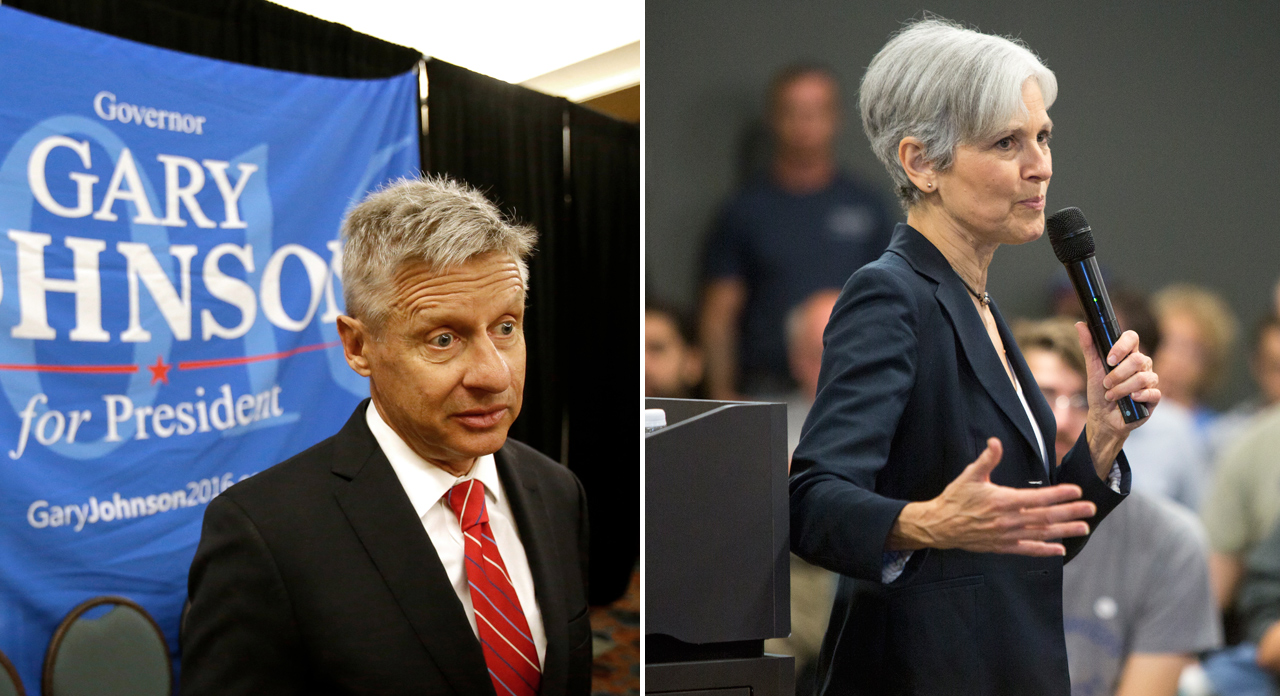
Libertarian presidential candidate Gary Johnson, left, and Green Party candidate Jill Stein, right, speak on the campaign trail in these file photos from summer 2016.
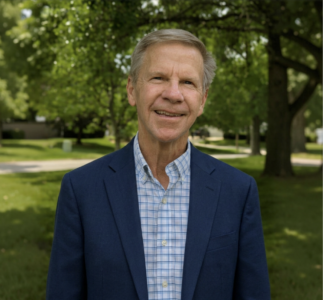
Topeka ? Caleb Christopher answered his home phone in the middle of the day this week. That by itself is unusual for someone who both works full time and is running for a seat in the Kansas Legislature.
But while his job as an IT manager keeps him very busy, the Basehor resident said he’s not putting too much energy into his legislative race.
“I’m mainly just providing an option for people,” Christopher said this week. “I’m a really busy guy. But I’ll be happy to serve if I get to that point.”
Christopher, who lives in Basehor, is one of 15 candidates whose names will appear on Kansas ballots for federal, state and local races this year under the Libertarian Party ticket, a party that has only been organized in Kansas since 1992.
And while he’s not actively raising money or spending a lot of time knocking on doors, campaigning for people’s votes, Christopher thinks he and other Libertarian Party candidates could make significant showings this year by tapping into what many observers say is widespread frustration with the current state of politics and government in the United States.
“Generally, the people that I talk to, both those that are voting for the two major parties and those that are voting for Libertarians in particular, tend to agree that spending is out of control, government always grows no matter who’s in power, and that’s the wrong direction,” he said.
Unusual election year
Christopher says he has good reason to be hopeful. In 2014, he ran as the Libertarian for that same seat and got nearly 10 percent of the vote without actively campaigning.
This year, though, even many political experts are saying Libertarians and other minor-party candidates could attract a significant number of votes by giving an alternative to people who are strongly dissatisfied with the two major party candidates.
Leading the Libertarian Party ticket this year is presidential candidate Gary Johnson, a former Republican governor of Arizona, who has been showing up as high as 8 and 9 percent in some recent national polls.
“I think Kansas is ripe for a big Johnson vote, for a couple of reasons,” said Washburn University political scientist Bob Beatty.
“One reason is the seeming distaste for (Republican Donald) Trump, not just among moderate Republicans but also the signals coming from (Gov. Sam) Brownback, (Sen. Jerry) Moran or (Rep. Lynn) Jenkins who say they support Trump, but its hidden somewhere in a three-paragraph statement,” he said.
“The second reason is, the idea of (Democrat Hillary) Clinton winning Kansas is not really thinkable, so Republicans who don’t like Trump can vote for Johnson and be confident Kansas will still vote Republican,” Beatty said.
But University of Kansas political scientist Burdett Loomis said he is more cautious about his expectations for third party candidates.
“Traditionally when people are unhappy with the major candidates, third party candidates look pretty good. And certainly if ever there were a year for that, this is the year,” Loomis said. “But the conventional wisdom is, as you get closer to the election, third parties fade. They’re really not that significant … except when they are.”
Third parties in Kansas
It has been more than 100 years since any parties other than the Democrats and Republicans have exerted significant influence in Kansas. But when they did, they were a dominant force for most of the decade.
That was during the populist movement of the 1890s, when the Populist Party — also known as the People’s Party, or the Farmers Alliance — became a driving force in both state and national politics.
The populist movement was especially strong in rural states where farmers experienced a series of setbacks in the late 1880s when droughts and crop failures forced many farms into bank foreclosures.
According to the Kansas Historical Society, the Populists believed that railroads, banks and other businesses held too much influence over government. They pushed for government action to raise commodity prices, reform the currency, and to reign in the power of railroads and corporate monopolies, among other things.
From 1890 to 1898, according to state election records, the Populist Party in Kansas elected 13 different congressmen, two U.S. senators, two governors and at various times held control of both chambers of the Kansas Legislature.
And in the presidential election of 1892, Kansas delivered its 10 electoral votes to Populist Party candidate James B. Weaver, who got 50.3 percent of the vote in Kansas over Democrat Grover Cleveland, who won the race, and incumbent Republican President Benjamin Harrison.
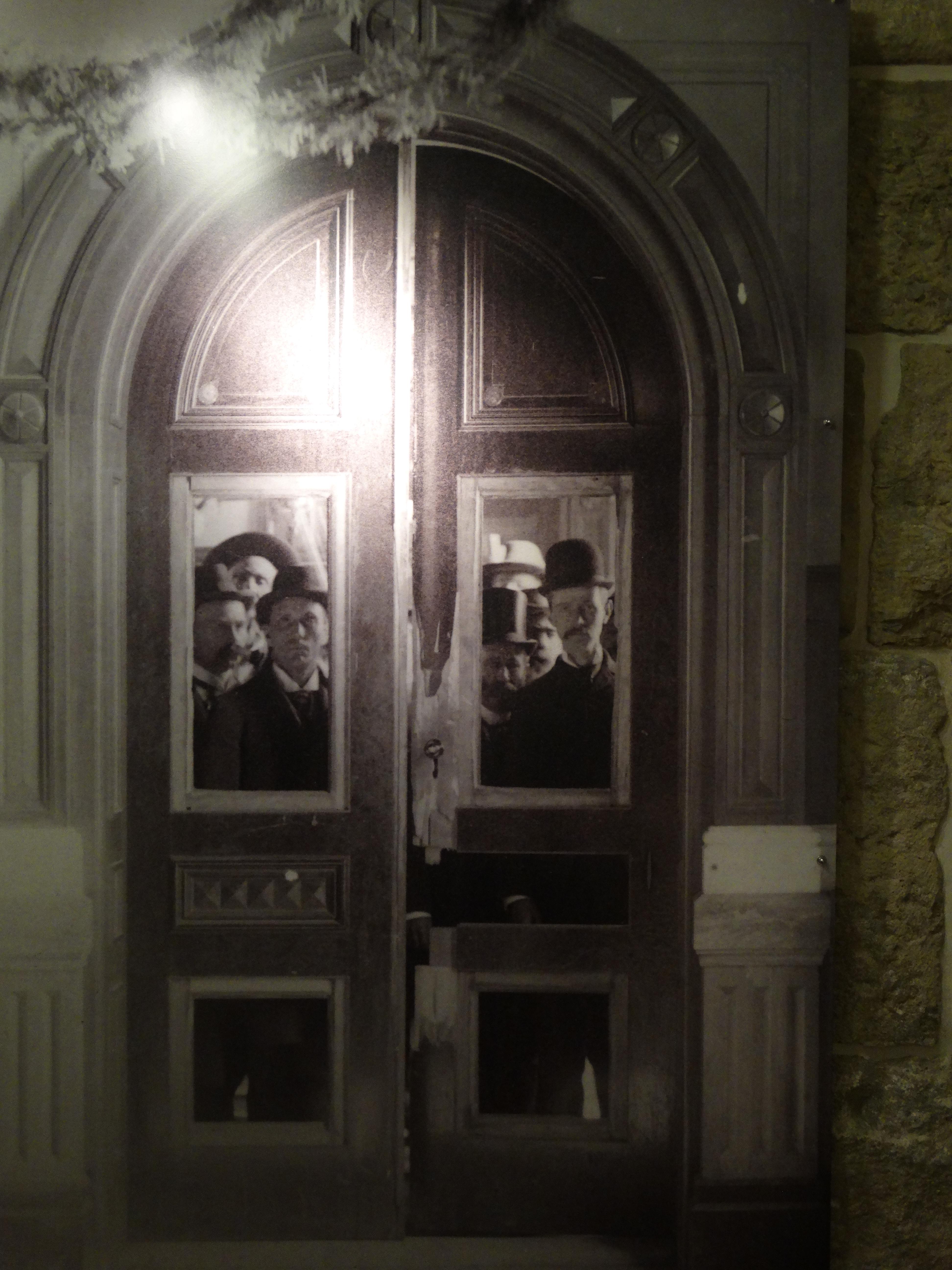
This life-size photograph on display in the Kansas Statehouse depicts the Legislative War of 1893, when contested elections between the Populist and Republican parties led to an armed standoff in the House chamber. The Kansas Supreme Court decided the conflict by ruling in favor of the Republicans, but the Populist Party remained a strong force in Kansas politics through the end of the 19th century.
That same election, the Populist Party claimed to have won a majority of seats in the Kansas House. But Republicans alleged widespread voter fraud and refused to surrender their seats when the Legislature convened in January.
That led to one of the most infamous moments in Kansas Statehouse history known as the Legislative War of 1893, an armed standoff between the two camps, each of which elected their own Speaker of the House and tried to hold sessions.
The event is chronicled in photos and artifacts now on display in the Statehouse, including a sledge hammer that Republicans used to break down the door of the House chamber where the Populists had barricaded themselves inside.
Gov. Lorenzo Lewelling, himself a Populist, negotiated a settlement in which the Populists were forced to relent. Eventually the Kansas Supreme Court, which was controlled by Republicans, ruled in favor of the Republicans.
Modern-era candidates
The populist movement faded away in the early years of the 20th century, and the state has not elected anyone other than a Republican or Democrat to any major statewide or federal office since then. But a number of minor-party and independent candidates have influenced elections since then.
One of those was Dr. John Brinkley, popularly known as the Goat Gland Doctor, who launched one of the first radio stations in Kansas and used it to peddle his medical treatment using goat glands to enhance male virility.
Brinkley ran for governor as a write-in candidate in 1930 and got 30 percent of the vote while the Democratic and Republican candidates nearly tied at 34 percent each. Brinkley later claimed he was robbed of the election through fraud, and KU’s Loomis says there may be some valid evidence of that.
But Brinkley never returned to political life. He died in 1942 shortly after being sued by the federal government for malpractice and mail fraud.
More recently, Texas billionaire H. Ross Perot got 27 percent of the vote in Kansas running as the newly-organized Reform Party’s candidate in 1992. That was one of the best showings Perot had in any state that year, boosting his confidence that the Reform Party could become a long-term movement.
But when he ran again in 1996, he got only 8.6 percent of the vote in Kansas, and soon after that the Reform Party lost its status as an officially recognized party.
In 2000 and 2004, consumer advocate Ralph Nader ran as the Green Party candidate. But because the Green Party is not recognized in Kansas, he was listed on the ballot as an independent.
Nader got 3.4 percent of the vote in 2000, and fell to just 0.7 percent in 2004.
This year, Jill Stein of Massachusetts is running as the Green Party candidate, but again is listed on the Kansas ballot as an independent. She also ran in 2012, but received only 714 votes in Kansas.
2016 prospects
Christopher — the Libertarian candidate/IT manager — is a classic example of what often happens with third-party candidates in Kansas, according to Washburn University’s Beatty. They don’t actively campaign.
“When I say Kansas is ripe, that doesn’t mean it’s going to happen,” Beatty said. “Where is Gary Johnson? He should have been in Kansas already. He should have been campaigning.”
“The biggest problem for Libertarians is their candidates,” Beatty said. “If they had better candidates, they could have a Ross Perot. It doesn’t take a lot of money to travel around the country and get a lot of press attention this year.”
But Loomis said the 2016 election cycle has been so different from any other in recent years, he’s still not ready to count Johnson or the other Libertarians out.
“Usually when you get closer to the election and you see there might be a real implication for your vote, then people tend to go back home,” he said. “But I think Trump has made it so hard for some people to go back home.”
The key for Libertarians, Loomis said, will be getting above 15 percent in the polls because that’s the threshold at which he would automatically be eligible to take part in the presidential debates.
“If Johnson got 15 percent and ended up in one of the debates, that would be fascinating because I don’t think anybody knows what the repercussions of that would be,” Loomis said.
State Government
Marshall camp settles unpaid bakery bill after 6 years
HUTCHINSON — The owner of a south-central Kansas bakery did not expect a Facebook post she made last Thursday to ...
Opinion: Lawrence deserved more from its Congressman at Saturday’s candidate forum
Candidates for ‘The Big First’ Congressional district talk affordability, immigration, Iran in Lawrence forum
US Rep. Sharice Davids introduces healthcare reform package
TOPEKA — U.S. Rep. Sharice Davids introduced healthcare legislation intended to benefit families grappling with ...
Opinion: The Lawrence man seeking to break the power of Republican, Democratic parties this election
State tax receipts top estimate by $147M for quarter
TOPEKA — The state of Kansas collected $147 million more in taxes than anticipated during the first quarter of ...