Prosecutors cite ‘mounds’ of evidence in Franklin County quadruple murder trial; defense calls case circumstantial

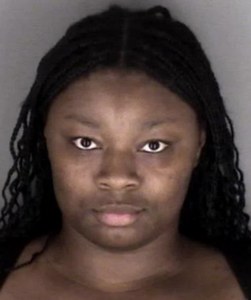
Kyle Flack, accused in a 2013 quadruple homicide in Franklin County, listens to defense attorney Tim Frieden during a hearing on Friday, Aug. 29, 2014.
Ottawa — Franklin County Attorney Stephen Hunting began his opening statements Monday in a quadruple murder trial describing how the body of one victim, an 18-month-old girl, was eventually found in a suitcase in the Tequa Creek in Osage County.
“In just a few hours, it would be Mother’s Day, May 11, 2013,” said Hunting to a packed courtroom, describing how a group of officers stood on a bridge in the gathering darkness as a dive team walked through the stream to collect the black suitcase.
The defendant, Kyle Trevor Flack, 30, is on trial for his life in the death-penalty case that is expected to continue for a month.
Flack is charged with capital murder in the deaths of the toddler, Lana Bailey, and her mother, Kaylie Bailey, 21, of Olathe, and with sexual battery of the mother.
He also is charged with two counts of first-degree murder in the deaths of Andrew Stout, 30, and Steve White, 31, who lived with Stout. Stout was Bailey’s boyfriend.
The killings took place over several days from about April 20 to May 1, 2013. All the victims were shot with a 12-gauge shotgun at a farmhouse owned by Stout’s relatives 8 miles west of Ottawa on Georgia Road.
Numerous law enforcement agencies, including the Franklin County Sheriff’s Office, the Ottawa and Emporia police departments, the Kansas Highway Patrol, the Johnson County Sheriff’s Criminalistics Laboratory, and the FBI have been involved in the investigation.
Hunting told the jury the state has “mounds and mounds of evidence” that will show that “the defendant and the defendant alone committed each and every one of these murders.”
Maban Wright, one of Flack’s defense attorneys, told the jury that the state plans to provide testimony from dozens of witnesses, crime analysts and law enforcement officers from across the state, as well as hundreds of pictures and exhibits.
But she said the state’s case is only circumstantial.
No one actually saw Flack commit the homicides, Wright said.
“There is no direct evidence that Kyle Flack killed them,” she said. “They will ask you to infer that Kyle Flack is guilty … you need to think critically.”
After Flack’s arrest, he gave statements to police over a nine-hour period that have been contested by his attorneys because they maintain Flack had asked for an attorney before he made the statements. Although a judge ruled the statements can be presented to the jury, it’s unclear how much will be. Hunting made reference to the statements on Monday but did not give details.
The statements, however, have been discussed in prior hearings leading up to the trial.
Flack told detectives he blamed the killings on “Omar and Chewy,” two men he said he met in prison, prosecutors told a Franklin County judge last year. But authorities determined that “Omar and Chewy” don’t exist, Victor Braden, a Kansas deputy attorney general who is working with the Franklin County prosecutor on the case, said during one hearing last year.
It’s also unclear whether Flack’s prior criminal history will be allowed in the testimony.
Flack has a criminal history that includes a second-degree attempted murder case in 2005 for shooting a man multiple times in Franklin County. He pleaded no contest and served less than four years in prison.
During Hunting’s opening statement, the prosecutor did not provide a motive for the killings.
But he said Flack was friends with all three adult victims, especially with Stout.
The case received a large amount of publicity after Bailey and her child went missing and the search for them intensified. During a period from about April 28 to May 6, when the first body was found, friends, family and law enforcement officials became increasingly concerned for the well-being of the missing victims, Hunting told the jury.
Hunting said according to the evidence and forensic analysis, the killings occurred in this order:
• White was killed first on or about April 20. A friend searching for the missing people on May 6 had gotten into a large outbuilding on the farm owned by Stout’s family. The friend walked over to a large pile of rubble, including bicycles, tools, trash and cinder blocks, that was covered by a blue tarp. On the edge of the pile was a solitary cinder block. The friend peered into the hole in the block and saw a decaying face. White had been shot twice, once in the face and once in the chest, Hunting said.
• Even as White’s body was decomposing in the outbuilding, Flack continued to act normal, Hunting said. On April 28, Flack was seen with Stout on convenience store videos in Emporia, Ottawa and Pomona. That evening they went bowling and sometime that night, Stout was shot four times, once in the face, once in the chest and twice in the back. An autopsy shows that he also received several blows to the head, possibly with the shotgun barrel, before he was shot in the face, Hunting said.
Stout’s body was discovered on May 6 in the corner of the farmhouse’s master bedroom hidden under a mound of clothing as high as the dresser, Hunting said.
• The morning of May 1, Kaylie Bailey decided to take her daughter and go see Stout before she had to go to work as a security guard that night, Hunting said. Before leaving Olathe, she withdrew $30 from the bank, and in Ottawa she stopped at a Burger King and bought three meals before driving to the farmhouse.
Hunting said when her body was found, Bailey’s hands were tied behind her with black zip-ties. She was naked from the waist down, and it’s believed she was forced to kneel down with her head on the floor. She was killed by a single shotgun blast to the back of her head, Hunting said. She too was then buried under a huge pile of clothing in the master bedroom.
• Lana Bailey, who Hunting said had been alive only 542 days, was killed last with a single shot to her back at close range, Hunting said. Her body was found May 11 in the Tequa Creek in Osage County after a law enforcement officer declared he was going to search under every bridge in the area until they located her. The officer spotted some trash near the creek, and he noticed some shredded papers had the name “Bailey” on them. The subsequent search then led them to the toddler’s body in the suitcase.
During this period Flack continued to live at the farmhouse, Hunting said. Flack’s stepfather stopped by and gave him some Hot Pockets, Doritos and two bottles of Coke. Flack appeared to be sleeping on the couch.
On May 3, Flack took Kaylie Bailey’s car and drove to his friends’ apartment in Emporia, Hunting said, and asked to stay for a few days. The friends agreed. Flack then got a new cellphone.
On May 7 — the day after the bodies were discovered — video at Cambridge Apartments, located several miles from where he was staying in Emporia, showed him parking Bailey’s car in the parking lot, Hunting said. A black bag he was carrying when he got out of the car — later found in the complex dumpster — contained Lana Bailey’s purple blanket, kids clothes and two black zip-ties similar to the ones used to bind Kaylie Bailey’s hands, Hunting said. The dumpster was out of video camera range.
Not long after that discovery, men working at the Emporia trash transfer station found a shotgun without the barrel. Testing of shells fired from the shotgun found that it was the same one that was used in the killings, Hunting said.
On May 8, Flack was arrested.
The trial continues Tuesday morning.
Public Safety
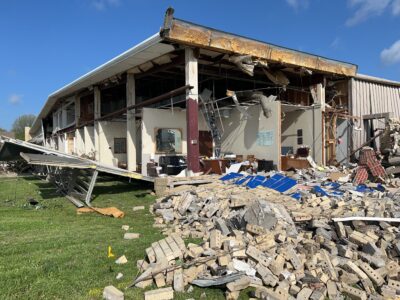
Minor injuries, significant damage in Ottawa after tornado; forecasters warn of more severe weather in region
Police arrest man suspected of spray-painting dozens of buildings in downtown Lawrence
Case of repeat DUI felon accused in fatal hit-and-run of KU student delayed another 7 weeks
Storm takes out power, damages buildings in Ottawa, but city says no injuries reported Monday night
The National Weather Service and the weather departments of multiple area television stations are reporting that a ...
Speech pathologist pleads not guilty to molesting kids at Lawrence elementary school; trial scheduled for January 2027