The politics of being president: Richard Norton Smith reflects on White House successes, failures
Success as president has eluded some very honorable men — William Howard Taft and Herbert Hoover — because they were politically inept once they took over the most political job in the world.

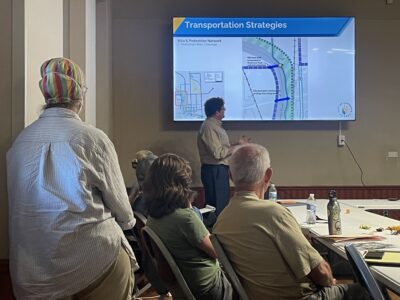
Richard Norton Smith speaks to the crowd at the Dole Institute of Politics on Sunday. Smith spoke about what separates successful presidents from those deemed failures. The lecture was the first of the 2012 Presidential Lecture Series.
“First and foremost, in every face on Mount Rushmore is the face of a great politician,” historian Richard Norton Smith told an audience of about 300 people Sunday at the Dole Institute of Politics. “That includes George Washington, whose genius was to convince everyone, beginning with himself, that he was no politician.”
Historians of both the right and left can differ on criteria for judging presidents, and there’s no hard-and-fast rule, he said during the first session in the 2012 Presidential Lecture Series on “Why Presidents Succeed. Why They Fail.”
“Also in some ways, it’s a trick question because there are presidents that are both successes and failures,” said Smith, the Dole Institute’s first permanent director who now teaches courses on the presidency at George Mason University.
Still, with the nature of the job, all presidents are measured against Lincoln, whom Smith called “the greatest politician who ever lived in the White House,” just ahead of Franklin Roosevelt.
Lincoln never stopped growing politically, especially on his concepts on race and slavery and often combined pragmatism with a vision during the Civil War era. Lincoln’s presidency contrasts with his successor Andrew Johnson, who was impeached.
“What (Johnson) didn’t understand was it was one thing to reunite the sections, but if you didn’t reunite the races at the same time, then you were only doing half the job,” Smith said.
Traditionally, not winning a second term can be counted against a president, but, Smith said, James K. Polk became one of the country’s most successful unsung presidents, including a victory in the Mexican-American War. Polk said up front he would only serve one term.
“He laid out four big things he was going to do, did them all, went home to Tennessee and died three months later,” Smith said. “If he’s largely forgotten today, it’s undeservedly.”
The country and electorate also changed over decades. Harry Truman, because of his style — bourbon and poker, loud Hawaiian shirts and angry letters to music critics — might not be able to get elected today, said Smith, who wrote a book on Thomas Dewey, a Truman political rival.
“What we actually sentimentalize today as evidence of (Truman’s) authenticity, I guarantee you in the hands of the 24/7 news cycle would be fatal,” he said, “which is worrisome because it suggests how trivial we have allowed our politics to become.”
Smith also touched on each president from Kennedy to Clinton.
John F. Kennedy
“I would argue that Kennedy is, in fact, a much more significant president than the length of his presidency suggests. It was an incredibly concentrated period when history was almost sped up, and change in this country accelerated in a way that I can’t think of than another period, except maybe the early 1930s.”
Lyndon Johnson
“I’ll bet you there are folks in this room who recoil at the phrase ‘The Great Society.’ For many people it’s become synonymous with overreaching government, but if you step back, … I think there are lots of folks who might take a fresh look at just how much Johnson changed our lives, for which he gets very little credit.”
Richard Nixon
“It is just possible that 50 years from now, if this in fact turns out to be the Chinese century, that Nixon’s historical obituary will no longer read ‘the only president to resign the office in disgrace.’ That will be the second sentence after the man who opened up China to the world.”
Gerald Ford
“Ford turned out to be a hinge historically. He’s much less a coda to the Nixon years than he is a forerunner. He’s the president who started economic deregulation.”
Jimmy Carter
“Arguably Carter never would have been elected president in any set of circumstances other than the ones that occurred in 1976. Of course, I can say the same thing about Reagan four years later. People were willing to take a chance on an outsider.”
Ronald Reagan
“Ronald Reagan transformed his party and indeed American conservatism in a way that not all of those who claim to be his heirs would recognize. It was inclusive. Ronald Reagan practiced the politics of multiplication rather than division.”
George H.W. Bush
“When he left office (after one term), I think people felt that there weren’t a lot of people asking for a recount. There was a sense that he had performed his historical mission differently in 20 years since. More and more people have come to a greater appreciation of just how great that mission was, how challenging it was, how difficult it was peacefully managing the end of the Cold War, and how much credit Bush deserves for that.”
Bill Clinton
“Clinton pre-empted the middle of the road. And I don’t care. You can sit in front of Fox all day. You can sit in front of MSNBC all night. The fact of the matter is that’s where the majority of Americans remain to this day. That’s where this (year’s) election will be won. Whether a critical mass of those people believe not only that the economy is getting better but that the next four years will be better and somehow different than the last four years, those are deciding factors.”
City Government

Developer seeks incentive from City of Lawrence to build 131 units of housing near Wakarusa and Queens

Lawrence city leaders will consider whether to keep Community Building open, make 2 other rec centers free to access
A STAR Bond application raises questions for city leaders about Costco and housing west of the SLT
Soccer gear honoring Lawrence history’s all-star team is now on sale as part of city’s public art exhibition
To honor public servants, Lawrence’s July 4 celebration will have a whole gallery of their photos on display; submissions open now