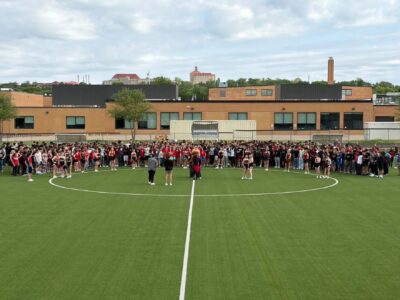
Group assessing function of community schools
Existing schools. Older schools. Neighborhood schools.
Now a new term is emerging for such educational institutions considered essential both for youngsters’ learning and the overall health of a wider population: community schools.
“A school community is more than a building,” said Brad Finkeldei, a member of a subcommittee working to define neighborhood schools as part of the Lawrence school district’s Elementary School Facility Vision Task Force. “The neighborhood doesn’t create the school community. The community creates the school community.”
Such discussions are part of the focus for the subcommittee, whose members are charged with evaluating what it means to be a neighborhood school and how that definition fits within the district’s educational fabric.
Once the subcommittee’s work begins to take shape — possibly as early as next week — the information will be forwarded to the larger task force, whose members are studying other aspects and implications of elementary education: efficiency, building conditions, best practices and optimal operations.
With districts statewide continuing to face budget cuts, and the potential for even more financial pressure from the upcoming Kansas Legislature, such larger discussions could be expected to shape local decisions about how the district’s 15 elementary schools operate going forward.
Looking ahead
The task force’s work started once the Lawrence school board decided to move the district’s sixth grades into middle schools, offering officials a chance to reassess investments, schedules, programs and everything else.
Just what a “neighborhood” school might be, in the future, could hang in the balance.
“It’s important to have schools in neighborhoods, but we want to keep people focusing on keeping the school community together,” said Finkeldei, a member of the Lawrence-Douglas County Planning Commission. “It’s a different way to look at that.”
An example: While Hillcrest School, 1045 Hilltop Drive, operates within an established residential area between Iowa Street and the Kansas University campus, its student population reaches far beyond. Three out of four children live more than a half-mile away, Finkeldei said, given the school’s designation as an English as a Second Language site.
Perhaps even more interesting: Once students learn enough English to test out of the program, the large majority petition to stay at Hillcrest, preserving the strong community bonds they’ve built.
Boog Highberger, a former Lawrence mayor, acknowledges that there are instances within the district where students and families interacts with their schools in such a manner. But that doesn’t mean the idea of a “neighborhood school” should get lost in the shuffle.
“We all consider walkability a pretty key component of what comprises a neighborhood school, or a community school,” said Highberger, another member of the subcommittee. “This is potentially a critical issue for the task force.”
That’s because preserving existing schools or planning new ones such that a large percentage of students have the opportunity to walk to school would need to be considered alongside the amount of money the district has available to provide such services.
February deadline
Another subcommittee is crunching its own sets of numbers, and others will be contributing their own thoughts before a final task force report is due back to the school board by February.
“Economics will be the ultimate issue driving this,” Highberger said.
Rich Minder, another member of the subcommittee, acknowledges that walkability remains an important concept for elementary schools now and in the future. But it goes beyond what students and families can achieve on foot.
“In school, there are networks of relationships that have value,” Minder said. “At Hillcrest, they aren’t so much based on the geographic place, where in other schools it really has to do with the place, and being within walking distance. One isn’t more valuable than the other, but they have value because they’re relationships.
“People really value the sense of community in their schools. We want to be sure that whatever systems we design going forward, that we don’t disrupt that sense of relationship to the point that it breaks down.”
K-12 Education
Lawrence school district names interim principal of Lawrence High School and leader of early childhood programs
Lawrence school district reveals first details of new flexible curriculum for Centennial Choice Campus

Lawrence school board members to consider increases to school meal prices for 2026-2027

Federal judge orders Lawrence school district to pay attorney fees to students in Gaggle case

Lawrence school district’s spokesperson departing after less than a year