Lawrence resident helps church investigate abuse
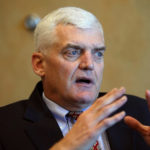
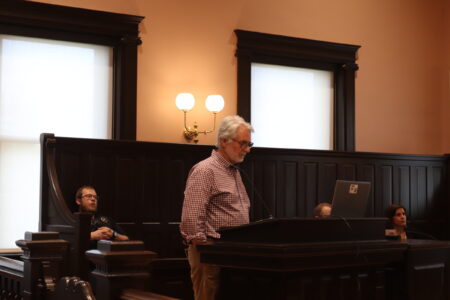
Wint Winter, president of Peoples Bank and head of an independent review board for the Capuchin Franciscan Order of the Catholic Church, which investigates claims of sexual abuse within the church, talks about the investigation process. Winter has served on the board for five years, in which time he has investigated about ten alleged cases of abuse.
Wint Winter, a former Kansas state senator and current People’s Bank president, performs a vital function in the Catholic Church’s reform efforts to address sexual abuse.
Winter is chairman of the church’s Capuchin sexual abuse review board and, along with four others, conducts investigations into allegations of sexual abuse by clergy.
“Ours is a search for truth,” Winter said.
The board that Winter chairs is one of many across the country mandated by church reforms. It’s a form of detective work, and determining whether abuse occurred — sometimes decades ago — can be a challenge.
“Often, Person A says this happened. Person B says this didn’t happen. And there’s no corroborating evidence,” he said.
Winter’s board investigates abuse committed by clergy from the Capuchin order, a division of the church based in Denver and separate from Kansas’ four Catholic dioceses. Capuchins may serve in a diocese, but abuse cases involving them are handled by the order, while each of Kansas’ four dioceses has its own review board.
The board uses a lower burden of proof than a criminal court, and it will substantiate a case if “based on what we hear there is some good reason to believe that this may have happened,” Winter said. New reforms in the church adopted in 2002 also mandate that officials report all allegations of sexual abuse to police.
Winter, along with the other board members, is appointed by the Capuchins, which have had priests serving at St. John’s in Lawrence since 1986. Winter said he was selected because of his Catholic background and experience as a lawyer.
Charles Polifka, provincial minister of the Capuchins, appointed Winter and said he feels confident in his abilities and motivations.
“It is his way, I believe, of trying to help get this mess cleared up in the church,” said Polifka, who served at St. John’s from 1995 to 2004. “He is a good man for the job and has the interests of the victims at heart.”
In his six years chairing the board, Winter said he has investigated about 10 cases and that “in many cases, we do find that they’re (the allegations) true.”
Winter’s experience is consistent with numbers regarding church investigations of abuse nationwide. Since the inception of the reforms eight years ago, an independent auditing firm hired by the church found that between 88 percent and 94 percent of cases investigated by review boards have been substantiated; that is, deemed credible by the various review boards, according to documents published by the Church.
The investigative process is one that fosters openness and encourages victims to come forward, in what is often not motivated by a potential financial settlement, Winter said.
“Often the victims are not looking for big dollars,” he said. “They’re looking for a group of people who believe them.”
If the board substantiates the allegation, it makes a recommendation to the church about how to handle the alleged abuser, as well as for victim compensation. In some cases, the clergy member is removed from the church. Other times, it makes more sense for the clergy member to be kept in custodial care by the church — stripped of his duties — with a safety plan in place to prevent future abuse, Winter said.
“We’ve got more control of them if they’re still a member of the clergy,” he said.
Winter said the entire investigative process is a necessary step for the church if it is to move forward.
“It’s important for me to know that people who commit these horrible acts are brought to justice and stopped,” he said.
City Government
Developer seeks incentive from City of Lawrence to build 131 units of housing near Wakarusa and Queens

Lawrence city leaders will consider whether to keep Community Building open, make 2 other rec centers free to access
A STAR Bond application raises questions for city leaders about Costco and housing west of the SLT
Soccer gear honoring Lawrence history’s all-star team is now on sale as part of city’s public art exhibition
To honor public servants, Lawrence’s July 4 celebration will have a whole gallery of their photos on display; submissions open now