Administration defends budget plans
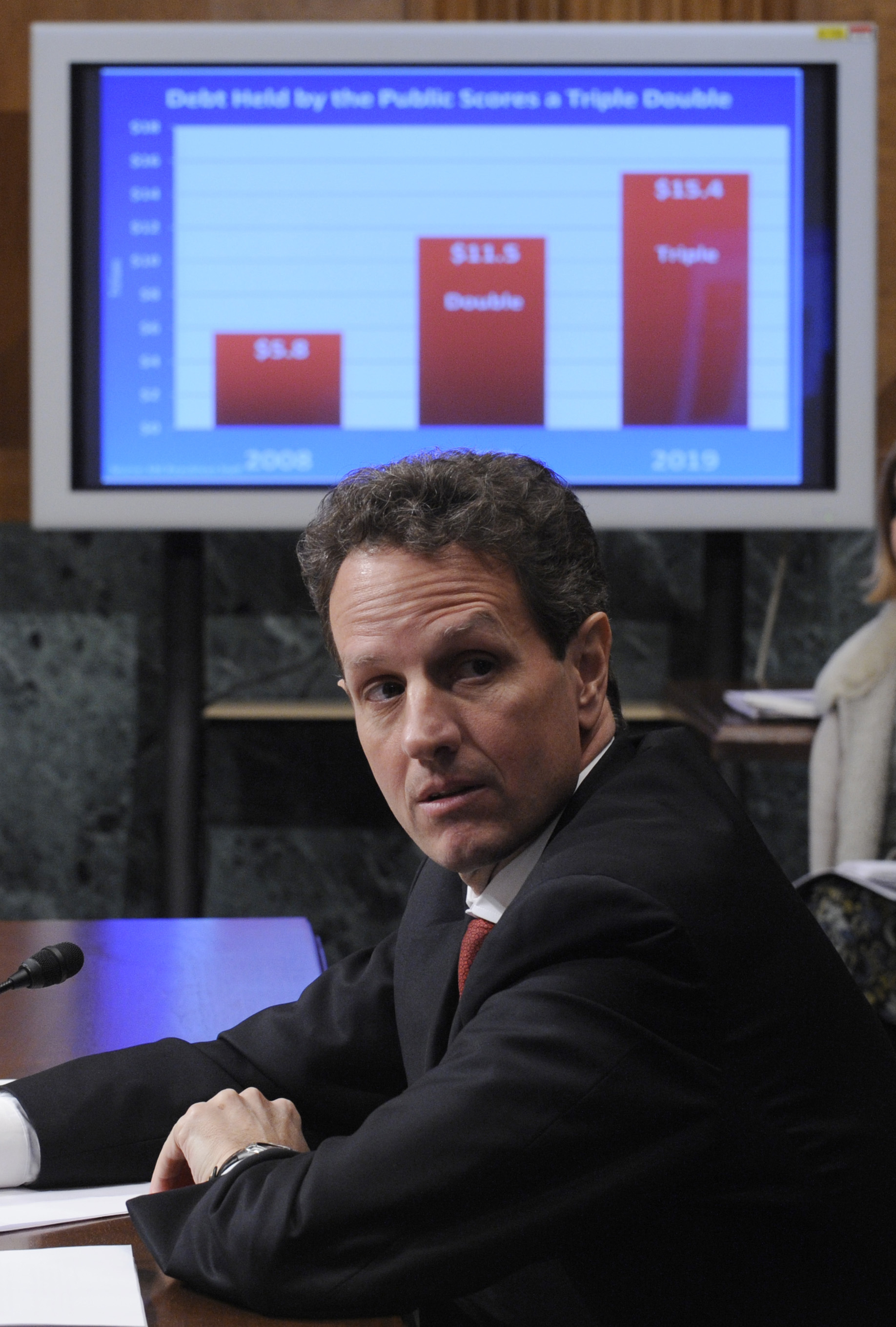
Treasury Secretary Timothy Geithner testifies Thursday on Capitol Hill in Washington before the Senate Budget Committee hearing on the economy.
Washington, D.C. ? Confronting misgivings, even in his own party, President Barack Obama mounted a stout defense of his blueprint to overhaul the economy Thursday, declaring the national crisis is “not as bad as we think” and his plans will speed recovery.
Challenged to provide encouragement as the nation’s “confidence builder in chief,” Obama said Americans shouldn’t be whipsawed by bursts of either bad or good news and he was “highly optimistic” about the long term.
The president’s proposals for major health care, energy and education changes in the midst of economic hard times faced skepticism from both Democrats and Republicans on Capitol Hill, as senators questioned his budget outlook and the deficits it envisions. But Obama, speaking to top executives of the Business Roundtable, expressed an optimistic vision and called for patience.
‘A real pause’
But in Congress, Obama’s budget plans were meeting resistance. Sen. Kent Conrad, the chairman of the Budget Committee called the track of future deficits “unsustainable” and singled out Obama’s proposal for adding $634 billion in health care spending over the next 10 years.
“Some of us have a real pause about the notion of putting substantially more money into the health care system when we’ve already got a bloated system,” said Conrad, D-N.D.
Treasury Secretary Timothy Geithner, testifying before Conrad’s committee, encountered questions about plans for shoring up the nation’s banks. He reiterated the goal to lay out a private-public partnership to make up to $1 trillion in financing available to help banks clear their books of toxic, mortgage-related assets.
Geithner hinted more money might be required beyond the $700 billion financial rescue fund. “We certainly can start with the resources we have,” he said.
Meanwhile, House Speaker Nancy Pelosi, D-Calif., played down talk that Democrats would consider a second economic stimulus bill. “I really would like to see this stimulus package play out,” Pelosi said.
Financial flurry
The comments illustrated the complicated moving parts confronting Washington as the economy continues to decline, credit remains clogged and a new president advances broad and expensive initiatives. The money set aside to address those needs so far has been staggering — $787 billion for an economic stimulus designed to save and create jobs, the $700 billion approved by Congress for the financial rescue package and hundreds of billions more through programs from the Federal Reserve Bank.
On top of that, Obama wants to overhaul health care, reduce greenhouse-gas pollution and undertake major changes in energy policy.
He’s projecting a federal deficit of $1.75 trillion this year, by far the largest in history, but says he can get it down to $533 billion by 2013.
“I am not choosing to address these additional challenges just because I feel like it, or because I’m a glutton for punishment,” Obama told the Business Roundtable. “I am doing so because they are fundamental to our economic growth, and to ensuring that we don’t have more crises like this.”
Obama said his health and energy changes would build a foundation for lasting recovery, arguing that the current economic crisis was precipitated by an “illusion of prosperity.”
Critics of Obama’s budget, such as Sen. Judd Gregg, R-N.H., complained that the spending blueprint does not tackle the rising costs of Social Security and Medicare.
Geithner said the administration intends to confront higher health care costs with changes that will lower Medicare spending.
Geithner is at the center of Obama’s economic policy, advocating for its budget proposals and tax policies, as well as the rescue program for the financial sector.
He faced questions on all those fronts before heading to London for talks today and Saturday with finance officials from the Group of 20 nations.
Obama’s budget would raise taxes, starting in 2011, on individuals earning more than $200,000 and on households earning more than $250,000. Geithner said the increases would kick in after the economy was expected to be in recovery.
National

Man pleads guilty to killing a top Minnesota Democrat and her husband

New tornadoes outside Chicago as severe storms pummel the Midwest
Feds won’t seek death penalty in plea deal with man accused of killing top Minnesota Democrat

NASA unveils astronauts to test tech for future moon landing
Social Security’ fund faces shortfall one year earlier than expected
WASHINGTON (AP) — Social Security 's retirement trust fund is projected to face a funding shortfall in 2032, a ...