Mark’s on the Move: Curveballs create angst for the novice, challenge for the expert
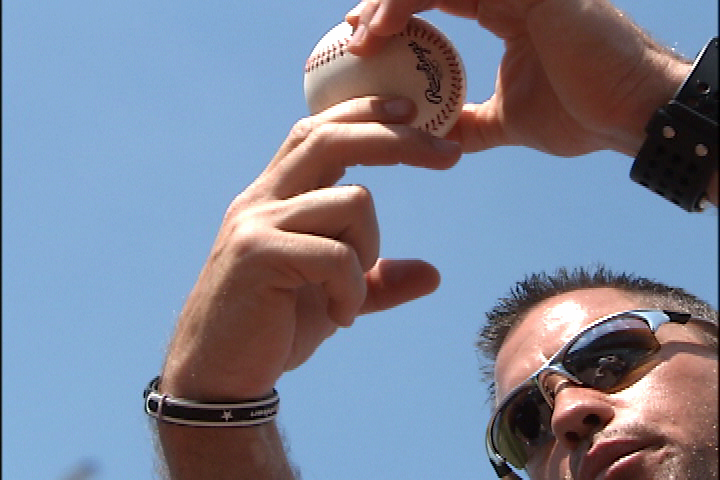
T-Bones Coach Tim Doherty explains how a curveball is thrown.
Editor’s note
Reporter Mark Boyle takes us behind the scenes of news stories in the area. This week, he catches up with the current Northern League Champion Kansas City T-Bones baseball team. The instant Mark stepped onto the diamond he learned that off-speed pitching is a key to success in the Northern League. Every batter must be able to hit breaking balls and recognize when they might be thrown.
Kansas City, Kan. ? “Deuce.” “Hammer.” “Hook.” The curveball goes by myriad names, but regardless of what you choose to call it, the curveball is a tough pitch to hit.
“Very difficult,” said Tim Doherty, the T-Bones’ hitting coach. “The thing about a curveball, the good curveball, is the guys that change speeds with them.”
Doherty noted Kansas City Royals pitcher Zack Greinke as being one of those with an outstanding curveball.
Ryan Fox is an outfielder for the T-Bones who has also been a pitcher. Fox says that he has been on both sides of a game-changing situation involving a curveball.
“A lot of people sit in the stands and it doesn’t look like that tough of a pitch to lay off or that tough of a pitch to hit, but one that’s sharp and has tight spin on it is extremely tough to distinguish,” Fox said.
The delivery of a curveball as it rolls out of the pitcher’s hand is a batter’s first indication of what to expect over the plate. Doherty says good hitters should have a pitcher’s tendencies figured out well before they get to the batter’s box.
“A fastball will come out of a pitcher’s hand in a downward motion,” said Doherty. “A curveball, you’re going to see a slight tilt of the wrist and an exit out of the hand upward. The key is to be able to read the release point and how the ball exits out of the hand.”
A curveball may be a thing of beauty, but not if the beholder is in the batter’s box. That is certainly the case for T-Bones outfielder Eric Scriven.
“The curveball for me is a pitch that I try to avoid hitting unless I have to,” he said.
My own experience at the plate was a mixed bag of both great success and failure. Doherty got me swinging on several curveballs that began at my hands and dropped out of the hitting zone. But I also found one hanging and drove it to the left field wall.
The curveball is effective. It is a very useful pitch in a hurler’s arsenal.
If you encounter one, just hope it’s not with two strikes in the count as mine were.
City Government

Developer seeks incentive from City of Lawrence to build 131 units of housing near Wakarusa and Queens

Lawrence city leaders will consider whether to keep Community Building open, make 2 other rec centers free to access

A STAR Bond application raises questions for city leaders about Costco and housing west of the SLT

Soccer gear honoring Lawrence history’s all-star team is now on sale as part of city’s public art exhibition
To honor public servants, Lawrence’s July 4 celebration will have a whole gallery of their photos on display; submissions open now