House Democrats muzzle GOP on sensitive issues
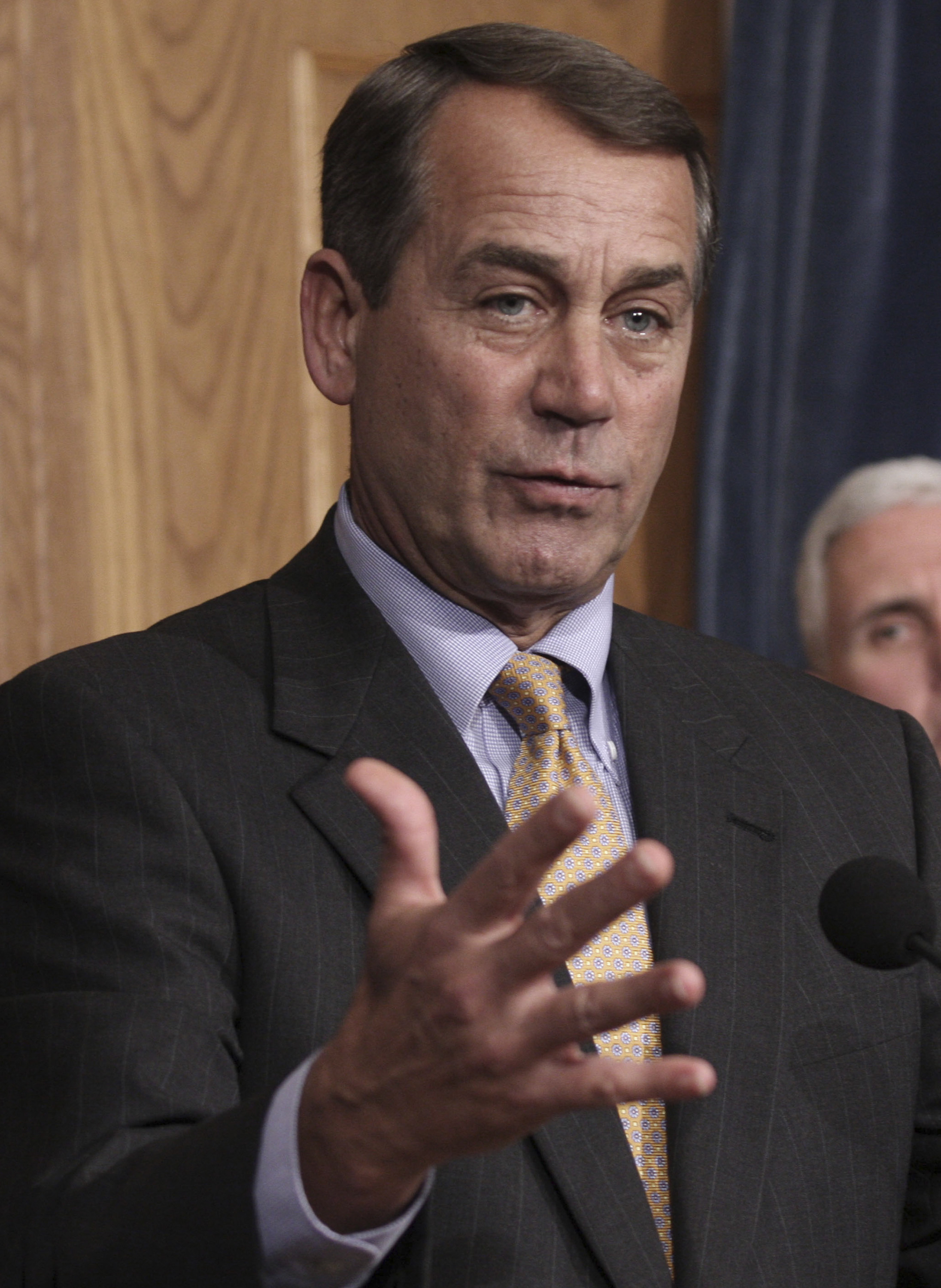
House Minority Leader John Boehner, R-Ohio, talks with reporters on Capitol Hill in Washington in this Feb. 13 file photo. In their zeal to protect their members from politically hazardous votes on issues such as gun control and gay marriage, Democrats in the House of Representatives are taking steps to muzzle Republicans in debates on spending bills this summer.
Washington ? In their zeal to protect their members from politically hazardous votes on issues such as gay marriage and gun control, Democrats running the House of Representatives are taking extraordinary steps to muzzle Republicans in this summer’s debates on spending bills.
On Thursday, for example, Republicans had hoped to force debates on abortion, school vouchers and medical marijuana, as well as gay marriage and gun control, as part of House consideration of the federal government’s contribution to the District of Columbia’s city budget.
No way, Democrats said.
At issue are 12 bills totaling more than $1.2 trillion in annual appropriations bills for funding most government programs — usually low-profile legislation that typically dominates the work of the House in June and July. For decades, those bills have come to the floor under an open process that allows any member to try to amend them. Often those amendments are an effort to change government policy by adding or subtracting money for carrying it out.
The tradition has often meant laborious debates. But it has allowed lawmakers with little seniority to have their say on doling out the one-third of the federal budget passed by Congress each year. It was a right the Democrats zealously defended when they were the minority party from 1995 through 2006.
House Appropriations Committee Chairman David Obey, D-Wis., insists the clampdown is to prevent debates from dragging on and on. Republicans, however, have agreed to limit the amount of time debating the bills.
Majority Leader Steny Hoyer, D-Md., acknowledged in a brief interview that one reason for restricting amendments is to save members of his party from having to cast politically painful votes.
So instead of debating an attempt backed by House Republican Leader John Boehner of Ohio to allow more children living in Washington to receive school vouchers, the House voted on a Quixotic attempt to eliminate the President’s Council of Economic Advisers.
“What they want to do is they want to avoid tough votes on appropriations bills,” said Rep. David Dreier of California, senior Republican on the Rules Committee.
Even some Democrats are chaffing at the heavy-handed clampdown on debate. Abortion opponent Rep. Bart Stupak, D-Mich., on Thursday lashed out at his party’s leaders for denying him and others a chance to vote on restoring a long-standing directive by Congress blocking taxpayer-funded abortions in Washington, D.C.
Democrats effectively reversed that stance while the bill was still being considered by the Appropriations Committee. Stupak said the Democratic leadership’s new policy on floor debates “muzzles the voices of pro-life members.”
As a result, the measure barely cleared a procedural hurdle Thursday afternoon before passing later by a 219-208 vote.
The process has become so relentlessly efficient that Democrats were actually forced to drag out action into today on a $33 billion measure funding energy programs and water projects. The reason? They need to stretch the workweek into today to force lawmakers to remain in Washington for committee work on health care and other spending bills.
Republicans complain that unless a member of their party is one of the 60 members of the Appropriations Committee, he is essentially blocked from having any say in shaping the budget.
“That simply disenfranchises most of the members of this body,” said Rep. Jeff Flake, R-Ariz.
National

Man pleads guilty to killing a top Minnesota Democrat and her husband

New tornadoes outside Chicago as severe storms pummel the Midwest

Feds won’t seek death penalty in plea deal with man accused of killing top Minnesota Democrat

NASA unveils astronauts to test tech for future moon landing
Social Security’ fund faces shortfall one year earlier than expected
WASHINGTON (AP) — Social Security 's retirement trust fund is projected to face a funding shortfall in 2032, a ...