Corliss sees pluses, minuses in city’s balance sheet
Next budget to reflect changes wrought by poor economy
More information
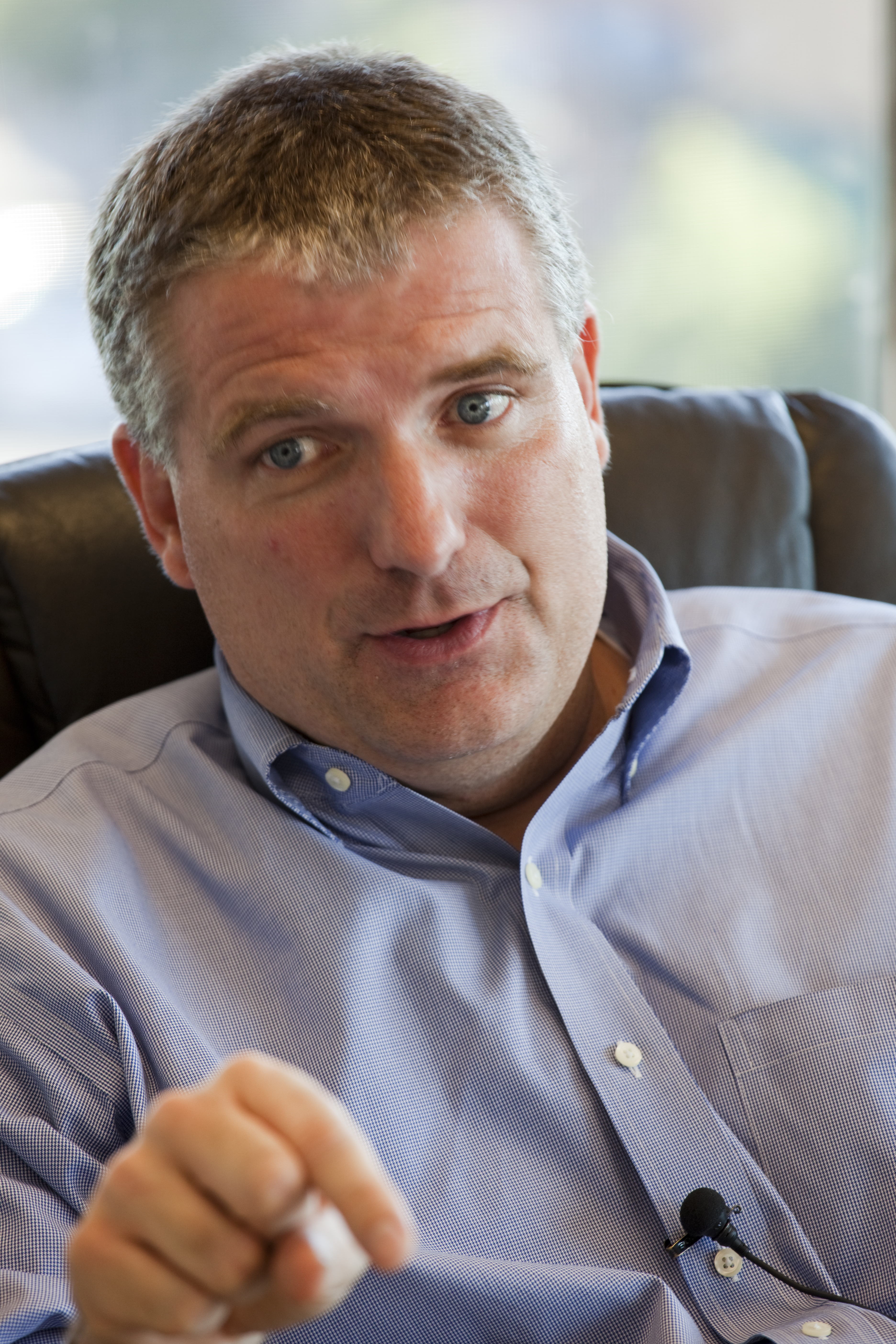
City Manager David Corliss.
From his fourth-floor office at City Hall, City Manager David Corliss has a good view of what hangs over the city.
During his first 32 months as the city’s top executive, what he’s noticed is an attitude that hasn’t always been healthy for the community.
“We have not hustled,” Corliss said. “When you look at what other communities have been doing, what they have been investing in, we have not been hungry.”
Corliss, in a lengthy interview with the Journal-World and 6News, said the community’s appetite is showing definite signs of increasing — he’s still praising voters for soundly approving a trio of new sales taxes that took effect in April. But he also said such efforts are more of a beginning than an end.
“There’s a lot of things that we’ve moved ourselves on, but I don’t think we’re at a point to spend a day congratulating ourselves,” Corliss said.
As the city prepares its budget for next year, and also looks for a path through a turbulent economy, here’s what Corliss had to say on several broad issues facing the city.
At last count, Douglas County has suffered through 10 straight months of year-over-year job losses. In addition, our rate of job loss has been greater than the statewide average. Why hasn’t Lawrence seen more job growth?
A lot of it has to do that we had it good for so long that we became complacent in our economic development activities. I don’t blame a particular institution or a particular entity. If I have to blame something I blame the attitude of ‘we’re a great community and we don’t have to hustle, we don’t have to work hard to create jobs.’ I don’t think that is accurate.
I don’t think that attitude is as prevalent in the community as it was in years past. I think there has been a change in attitude from all different kinds of views. Those views that challenge growth, those views that have always been part of Lawrence and that I think will always be part of Lawrence, that challenge whether growth will attract things that will hurt our community. Those advocates have recognized the importance of job growth.
In your opinion, what would be the most positive sign — economic or otherwise — you could see for this community within the next year?
I think there are many, but one would be where we would continue to get requests through the Chamber of Commerce for economic growth and we would be able to appropriately facilitate that growth, and where we would see the residential building community be a little bit stronger and pick up the pace of new homes being built in the community because that will show people still want to be here.
I’ll ask you to do something that I suspect you seldom get to do in this office: Put the money out of your mind. If money is not the issue, what could city government do to provide this community a real, positive push forward?
I think it would be just substantial investments in infrastructure. I think completing the South Lawrence Trafficway — which is not a city project but I’m putting those things out of my mind, as you indicated — would be a top priority. We continually hear from residents and nonresidents who visit or patronize our community that the lack of that east-west connection is a deterrent and detriment to the community.
Some folks have goals and then they’ll have a “stretch goal” for themselves, something that will take some amount of sacrifice, some amount of luck, to accomplish. Do you have a stretch goal for the city of Lawrence?
I think the stretch goal is to be among the top communities in the country for raising a family, for building and growing a business, for being one of the great college communities in the country. I don’t think it is a goal in the sense that it is an end zone because I think that creates the mindset that if you reach a certain milestone you stop. I don’t think that is how communities thrive. … I think in many areas we have a lot of those attributes, but I don’t think we have pushed ourselves hard enough to excel in many of those attributes.
Who knows what gasoline prices will do in the future, but some smart people have said that we’re above $2 per gallon to stay, and that the long-term trend is upward. Given that a lot of our housing growth historically has come from commuters, do you expect Lawrence’s growth to ever return to what it was in much of the 1990s?
Oh, absolutely. I think Lawrence’s growth has great, substantial potential. I don’t think it is going to happen immediately. I don’t think it is going to happen next year. But I think the long-range demographic trend of the urbanization of northeast Kansas will make Lawrence a lot larger city than it is right now.
When it comes to growth, do you have some sort of number in your head that represents some type of sweet spot or ideal?
I don’t know that government would be the best decider of what the sweet spot of our population is. You’ve been in enough of these meetings, where you’ve heard people talk about growth or no growth, I’ve always said let’s insist upon quality growth. I define quality growth as growth that adds more positives to the community than the negatives that might be created with traffic congestion and service demands and those sort of things.
I’ve heard you speak several times about how downtown may be at a particularly interesting point in its history. Do you expect downtown Lawrence to look or feel significantly different in five years?
It clearly is feeling the impacts of the recession. I think the community is going to continue to have a dialogue about what public role, if any, should be involved in the mix of uses downtown. I think in a lot of ways downtown is very strong in terms of its activity. I know we’re going to need to respond to the issue of homeless individuals. We’re paying attention to that. … I think it is changing, but to some extent downtown’s greatest strength is its greatest weakness. It is not a homogenous mall where the mall manager can get on the intercom and say: ‘You shall stay open until 9 o’clock or say you shall sell things that are green for half price or whatever.’
In downtown, each property owner, each store owner has the great business sense to hopefully be successful, survive and prosper. So it is hard to lead downtown in any dictatorial sense. You have to find ways to try to assist downtown with the public services that can be available — parking, beautification, those sort of things — and then rely on the (private sector) to take it from there.
In your opinion, what, if anything, is downtown missing? I’m trying to get at whether you think there is a type of business, a type of new use that could be particularly beneficial to downtown.
Clearly one of the best things that we can do is find things that bring people downtown. I’ve heard mention of a general population run movie theater. I don’t want to compete with the great things that happen at Liberty Hall, but there might be another way to get people downtown along those lines that would be complimentary to the entertainment uses downtown. I’ve heard talk of some sort of arts incubator or retail incubator that might occur downtown and might need some level of public assistance. That is something we would like to explore at some point.
There’s been a lot of financial anxiety throughout the country this past year. How would you assess the financial condition of the city of Lawrence?
I think we’re in relatively good financial shape. We’re not able to make some of the investments, particularly in infrastructure, perhaps in public safety staffing, that I think we need to. I think we can defer some of those until better days. I think the financial reports show that our fiscal situation is tightening but still relatively conservative. We’re on track to have a balanced budget this year. It will be tighter than it was last year, and we’re proposing an even tighter budget for next year. But we’re able to hold onto our reserves and still meet the community’s obligations.
The concern with that is the city needs to do more than just pay its bills. It needs to invest in its future.
City Government
Developer seeks incentive from City of Lawrence to build 131 units of housing near Wakarusa and Queens

Lawrence city leaders will consider whether to keep Community Building open, make 2 other rec centers free to access
A STAR Bond application raises questions for city leaders about Costco and housing west of the SLT
Soccer gear honoring Lawrence history’s all-star team is now on sale as part of city’s public art exhibition
To honor public servants, Lawrence’s July 4 celebration will have a whole gallery of their photos on display; submissions open now