

Education budget cuts very likely, lawmakers say
‘There is going to be some pain all the way around’
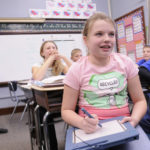
Maggie Wiseman, a sixth-grader at Woodlawn Elementary school, center, uses an Interwrite Tablet to complete a prime factorization exercise while projected on a screen at the front of her class Tuesday, Jan. 6, 2008. Both Republican and Democratic lawmakers said Tuesday that budget cuts to public schools and higher education were possible as the state faces an estimated billion budget shortfall. At left is Woodlawn sixth-grade teacher Haley Bruns.
In a town where state education funding is a major lubricant for the entire economy, Lawrence leaders should be watching the Kansas Legislature nervously this upcoming session.
Both Republican and Democratic lawmakers said Tuesday that budget cuts to public schools and higher education were possible as the state faces an estimated $1 billion budget shortfall.
“There will be severe cuts in many programs,” state Rep. Anthony Brown, R-Eudora, told a crowd gathered for the Lawrence Chamber of Commerce’s Legislative Priorities Breakfast at Maceli’s in downtown Lawrence. “To stand up here and say anything else, would be — at best — misleading.”
Brown went as far to say that cuts in education funding were likely, given that K-12 education funding is the largest single part of the state’s budget.
“If we don’t talk about making some cuts to the big program, then we will be making monstrous cuts to other programs,” Brown said. “I think we should expect cuts across the board for education.”
In Topeka, House Speaker-elect Mike O’Neal, R-Hutchinson, also said education funding may be reduced for the fiscal year that starts July 1.
“There is going to be some pain all the way around,” O’Neal said as he prepared for the legislative session that starts Monday. State revenues have coasted downhill along with the national economy, causing an immediate shortfall of at least $140 million and a possible deficit of $1 billion in future months.
O’Neal said 60 percent to 65 percent of school funding goes to the classroom, with the remainder being administrative expenses that can be trimmed.
“There are ways to cut administrative costs and noninstructional dollar costs that we just haven’t had a reason to do before,” he said.
Lawrence school Superintendent Randy Weseman disagreed, saying even costs for support services and administration go toward the job of teaching children.
Much of the costs of education are tied to teacher salaries, mandates from federal and state governments and services such as nurses and counselors in schools, which people have come to expect, Weseman said.
Bottom line, Weseman said, is that he expects to see cuts in school funding and would prefer to find out about it sooner rather than later for planning purposes.
“The sooner we all know something, the better job we can do,” he said.
In addition to possible spending cuts, O’Neal said the Legislature may consider slowing down the phase-in of tax breaks that have been approved in recent years.
Democratic lawmakers said they would fight against education cuts, but conceded it may come to that.
“We’re going to try not to have that happen,” House Minority Leader Paul Davis, D-Lawrence, said of education cuts. “But the budget is made up largely of funds for K-12 education and for the universities, and when you are facing a billion-dollar shortfall, you have to look at everything.”
Davis said he did not see the possibility of increasing taxes as a way to address the budget shortfall.
“I think that is probably going to be something that is off the table, given the state of the economy,” Davis said.
Gov. Kathleen Sebelius’ budget office has already recommended a $114.4 million cut to higher education. On public schools, Sebelius has said she will try to hold their funding harmless.
About 75 people attended the chamber event, which gives leaders from the city, county, school district, universities and the chamber opportunities to express priorities to the local legislative delegation.
As usual, the top priority expressed by the local groups was support for education funding. Other priorities included funding for transportation projects, support for economic development activities, and allowing local governments to maintain local control.
Sen. Marci Francisco, D-Lawrence, said she picked up a slightly different message from the leaders who attended the chamber event than she has in past years.
“Last year, the message was do no harm,” Francisco said. “I think the message this year may be: ‘Do some good.'”
State Government
GOP’s highest profile figures are on rescue mission in once-reliable Kansas

In debate, Marshall says the Ukraine war, not the Iran war, has caused high diesel prices
Candidates lean on their prominent supporters in District 2 race
TOPEKA — Democrat Don Coover and Republican Derek Schmidt stood with partisan allies as their congressional race ...
Funding for new Chiefs stadium moves forward, setting sales tax revenue district
TOPEKA — State officials answered a key question this week underpinning the complex financing of the Kansas City ...
Voters Guide: A look at the candidates seeking to become Kansas Insurance Commissioner
The Kansas Department of Insurance regulates insurance companies that sell policies in Kansas. Voters will decide ...
Voters Guide: A look at the candidates seeking the job of Kansas State Treasurer
In the Nov. 3 election, Republican Kansas Treasurer Steven Johnson faces two challengers for his job as the chief ...