Firefighter recruits to graduate
From fire hoses to paramedic needles
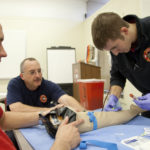
Malcomb Stapel, right, practices drawing blood Monday during training certification as a Lawrence-Douglas County Fire Medical firefighter recruit. At left is recruit Greg Wurdeman, and at center is Lt. David Rector, paramedic instructor. Ten Lawrence-Douglas County firefighter recruits will participate in today’s graduation ceremony at the Dole Institute.
It might be considered the final test of endurance — being stuck in the veins repeatedly with a needle.
A group of 10 Lawrence-Douglas County Fire Medical firefighter recruits spent the week piercing one another’s veins, to practice hooking up IVs to patients. “I don’t like IVs; I was forced to like them,” said Kirk Landau, one of 10 recruits who participated in the medical needlework at the fire training facility, 1941 Haskell Ave. “If you poke other people, they get to poke you.”
They walked around a room with gauze taped to their arms, flicking one another’s wrists, tying on tourniquets and looking for more bulging veins to poke. Each was required to have 20 sticks.
The sometimes-nauseating activity came with the occasional harsh word and joke about passing out, but the men did what they had to do ahead of tonight’s recruit school graduation at Kansas University’s Dole Institute of Politics.
During an intense, 12-week Monday through Friday training course, firefighter recruits spent the first eight weeks learning how to fight fires and respond to hazardous material calls. The last four weeks were for honing their paramedic skills, which will allow them to perform some advanced care on patients.
“It’s been challenging; we’ve learned a lot,” said Tim Reazin, recruit. “I’m hoping to go full time as soon as possible.”
A majority of the firefighters will have to wait to join the force full time, under the unique “extra-board” employment structure created by former Lawrence Fire Chief Jim McSwain.
Only two of the best-performing recruits will become full-time firefighters immediately, because there are only two front-line vacancies on the 120-member force. The others will serve as part-time fill-in workers until there are more openings.
The recruits are ranked and selected to fill positions based on who has the best test scores and performance evaluations from training.
“It actually saves the city a little bit of money (in overtime costs) and allows us to have a pool of people to hire on, when positions open up,” said Pat Talkington, training captain.
The recruits are part of the fire department’s 19th recruit academy and were selected from a pool of 92 applicants — 76 who were qualified and 18 of whom became finalists.
City Government
Developer seeks incentive from City of Lawrence to build 131 units of housing near Wakarusa and Queens

Lawrence city leaders will consider whether to keep Community Building open, make 2 other rec centers free to access
A STAR Bond application raises questions for city leaders about Costco and housing west of the SLT
Soccer gear honoring Lawrence history’s all-star team is now on sale as part of city’s public art exhibition
To honor public servants, Lawrence’s July 4 celebration will have a whole gallery of their photos on display; submissions open now