

Boredom, hunger and fear add to ordeal for pirates’ hostages
Manila, Philippines ? Some hostages are little more than skin and bones, their food running out and illnesses setting in as negotiations for their release drag on, angering their volatile captors. Others report less brutal conditions, even being allowed to fish for extra provisions.
Still, fear is a constant for all the 300 or so merchant seamen now held by Somali pirates. Life for them — and their families back home — is a grueling stretch of days, weeks, even months in cramped conditions, wondering about the future.
Sometimes there are threats of execution, along with worries of what will happen if their employers refuse to pay ransom and their usefulness as bargaining chips ends.
There is a lot of time to pray.
The U.S. Navy may have rescued an American cargo ship captain and French commandos saved a hijacked yacht in the lawless seas off Somalia, but a military rescue is unlikely for most of the hostages because their ships now lie at anchor in pirate strongholds.
Seafarers from the Philippines account for 105 of the prisoners, not surprising for a poor Southeast Asian country that supplies about 30 percent of the world’s 1.2 million merchant sailors.
Released hostage Mark Abalos hails from here, and he had spent 10 uneventful years at sea until his ship was waylaid last summer by Somali pirates who clambered aboard from a pair of twin-engine motor boats, brandishing a grenade launcher, an assault rifle, pistols and knives.
Some of the five pirates wore shorts, and two were barefoot, he recalled. They appeared to range in age from 20 to 50 and clearly hadn’t bathed in a long time.
But Abalos said they were well organized, a sign that their criminal work has turned into a thriving business, complete with its own makeshift port offshore.
The Antigua-flagged MV BBC Trinidad had been a month into a trip hauling logs from Mexico to the Middle East when the pirates boarded last Aug. 21.
Conditions weren’t too bad for Abalos and his 12 crew mates.
“We got pillows and sheets from our cabins and we were all ordered to just stay in the bridge,” which had air conditioning and a CD player that was constantly cranking out Bon Jovi and other rock songs, he said.
“I knew our fuel would eventually run out. I hoped that it will not run out before ransom was paid,” he said.
“We constantly prayed. There was a rosary in my pocket. I’m a Christian. My mother, who is Catholic, gave it to me sometime before when I left for a trip.”
When the ship’s larders ran bare, the pirates brought goat meat and noodles on board.
After 21 days, a tugboat arrived with a long haggled-over $1.1 million ransom.
The pirates began to leave the ship.
“You’re free,” Abalos said they told the crew.
National

Authorities disrupt planned drone, gun attack on White House UFC cage-fight
Rain along the Gulf Coast could become the first named storm of the Atlantic hurricane season
MIAMI (AP) — A cluster of storms along the Gulf Coast could become the first named tropical storm of the 2026 ...
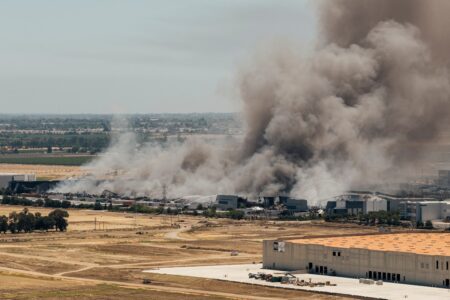
Unhealthy air quality in California city as huge warehouse fire burns for 3rd day
Judge orders Trump administration to restore National Park changes at sites that ‘disparaged’ US
Teens’ reading and math scores have stagnated, US test results show
WASHINGTON (AP) — Younger students have regained ground academically after the pandemic's disruptions while older ...
