Traffic conflicts increase as harvest season gets under way
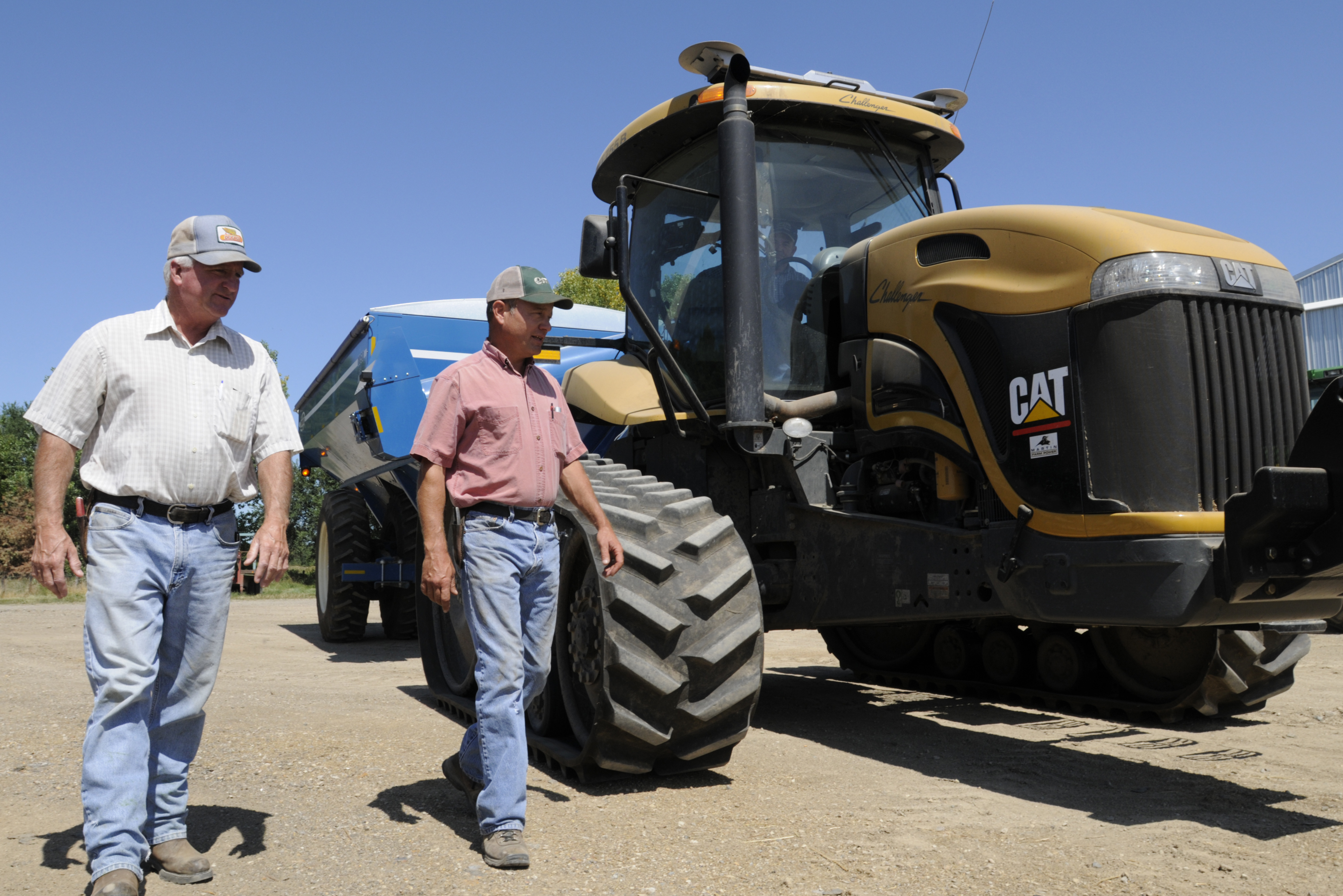
The fall harvest season is near and large machinery hauling corn and soybeans will soon be hitting county and city roads to take the crops to area grain elevators. Drivers should be alert and patient when they find themselves behind the slower machinery. Pat Ross, left, and Kent Nunemaker, owners of Nunemaker-Ross Farms Inc., say the driving is just as tense for the farmers as it is for other motorists on the road, and they try to limit their time on city roads.
Believe it or not, Pat Ross is thinking of you when he perches high in his driver’s seat, slips the vehicle into gear and motors out onto the Kansas River bridge from North Lawrence.
At 22 miles per hour.
“I normally just take the center of the bridge, so they don’t have room to pass,” Ross said, with a guarded chuckle. “It’s just safer that way. It’s safer not to pass on that bridge.”
Rest assured, he’s not kidding.
That’s because Ross, an owner of Nunemaker-Ross Farms Inc., is talking about driving his Caterpillar track tractor, towing a towering grain trailer big enough to handle 30 tons of corn or 29 tons of soybeans.
The rig and its giant rubber tracks and 34-inch wheels easily occupy all of one lane and part of another – enticing frustrated motorists behind to attempt a far-from-sensible pass.
“I know who’s going to lose that one,” said Bill Wood, agriculture agent for K-State Research and Extension in Douglas County.
Wood and others have such matters on their minds these days, as farmers throughout the county prepare to embark on their most important season of the year: fall harvest, when they look to cut some 25,000 acres of corn and 40,000 acres of beans.
All that work means more tractors, combines, trucks and other often slow-moving equipment will be on the roads, exacerbating conflicts that already have contributed to 10 motor vehicle accidents during the past decade.
“It’s important to be careful,” said Mark Workman, chief design engineer for the county’s Department of Public Works, who tracks accident data. “This shows that it can happen.”
The stakes are high.
Economically, county farmers look to bring in about $34 million worth of grain this fall, Wood said.
“A farmer hauling his grain to the elevator to sell it is a lot like you and me taking our paychecks to the bank,” Wood said. “We wouldn’t want anybody crashing into us and our paycheck blowing out the window, or spilling onto the ground.
“And that’s basically it: If somebody runs into a farmer’s truck and spills it into the ditch, that’s a loss of some income, and could hurt the farmer and put him in the hospital. If somebody hit us and put us out of a job and we couldn’t work for a while, and we’re on commission or something, we’re not going to get paid. It’s the same for a farmer.”
The driver of a small car or truck also wouldn’t want to get up close and personal with a combine, or a tractor, or a grain truck of any size – especially a big one, Wood said.
“You and a semi full of grain,” Wood said. “Who’s going to lose in that confrontation?”
Ross, who farms about 2,500 acres along the north side of the Kansas River, works to avoid such confrontations as he moves equipment to the south side of the river, where he has another eight fields.
Driving into Lawrence and using city streets is inevitable, he said, but that’s why he takes on such tasks only after rush hour and only during daylight. He also moves onto rural roads at the first opportunity, and pulls over onto shoulders whenever possible.
“Just have a little patience with us,” he said. “We don’t want to disrupt traffic any longer than we absolutely need to. We’re as anxious to get off the highway as anyone. It’s not a fun time. It’s tense for the farmer, too.
“Just remember: We’re doing the best we can.”
City Government
Developer seeks incentive from City of Lawrence to build 131 units of housing near Wakarusa and Queens

Lawrence city leaders will consider whether to keep Community Building open, make 2 other rec centers free to access
A STAR Bond application raises questions for city leaders about Costco and housing west of the SLT
Soccer gear honoring Lawrence history’s all-star team is now on sale as part of city’s public art exhibition
To honor public servants, Lawrence’s July 4 celebration will have a whole gallery of their photos on display; submissions open now