Bailout passes Senate, House foes soften
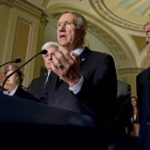
Senate Majority Leader Sen. Harry Reid, D-Nev., talks with reporters during a news conference on the passage of the Senate version of the bailout package Wednesday, Oct. 1, 2008 in Washington. From left, Sen. Christopher Dodd, D-Conn., Reid, Sen. Judd Gregg, R-N.H., and Senate Minority Leader Sen. Mitch McConnell, R-Ky.
Senate adds sweeteners to bitter bailout pill
Key provisions of the $700 billion financial industry bailout and sweeteners added by the Senate to attract votes from constituencies.
The underlying legislation would:
¢ Authorize $700 billion for the government to purchase troubled assets and buy equity in distressed financial firms.
¢ Require the Treasury Department to make rules to prevent excessive compensation for executives whose companies benefit from the rescue, and cap deductibility of executives’ pay packages at $500,000 for firms that get $300 million or more from the program.
¢ Establish an oversight board for the program, a special investigator general to monitor it and regular government audits.
¢ Require that the president establish a plan to recoup the cost from the financial industry if, after five years, there are any losses.
¢ Phase in the money for buying troubled assets, with $250 billion available immediately, $100 billion to be released if the president certifies it is needed, and the last $350 billion available with another certification, but subject to a congressional vote.
Among the sweeteners added are those that would:
¢ Provide business tax breaks, including for production of, investment in, and use of renewable fuels.
¢ Require group health plans that include mental health or addiction treatment to provide coverage for those conditions that is equitable to other medical coverage.
¢ Increase personal credits against the AMT, shielding more than 20 million taxpayers from the tax.
¢ Grant tax relief to victims of natural disasters in the Midwest and elsewhere.
¢ Extend through 2011 a program that funds rural schools and local governments that have low property-tax bases because they lie within or are adjacent to federal lands.
¢ Extend until end of 2009 the deduction for state and local general sales taxes.
¢ Extend until end of 2009 individual tax breaks, including deductions for higher education costs and teachers’ personal expenses.
¢ Increase, from $100,000 to $250,000, the limit on federal bank deposit insurance.
Washington ? After one spectacular failure, the $700 billion financial industry bailout found a second life Wednesday, winning lopsided passage in the Senate and gaining ground in the House, where Republicans opposition softened.
Senators loaded the economic rescue bill with tax breaks and other sweeteners before passing it by a wide margin, 74-25, a month before the presidential and congressional elections.
In the House, leaders were working feverishly to convert enough opponents of the bill to push it through by Friday, just days after lawmakers there stunningly rejected an earlier version and sent markets plunging around the globe.
The measure didn’t cause the same uproar in the Senate, where both parties’ presidential candidates, Republican John McCain and Democrat Barack Obama, made rare appearances to cast “aye” votes, as did Obama’s running mate, Sen. Joe Biden of Delaware.
In the final vote, 40 Democrats, 33 Republicans and independent Sen. Joe Lieberman of Connecticut voted “yes.” Nine Democrats, 15 Republicans and independent Sen. Bernie Sanders of Vermont voted “no.”
President Bush issued a statement praising the Senate’s move. With the revisions, Bush said, “I believe members of both parties in the House can support this legislation. The American people expect and our economy demands that the House pass this good bill this week and send it to my desk.”
The rescue package lets the government spend billions of dollars to buy bad mortgage-related securities and other devalued assets held by troubled financial institutions. If successful, advocates say, that would allow frozen credit to begin flowing again and prevent a deep recession.
Even as the Senate voted, House leaders were hunting for the 12 votes they would need to turn around Monday’s 228-205 defeat. They were especially targeting the 133 Republicans who voted “no.”
Their opposition appeared to be easing after the Senate added $110 billion in tax breaks for businesses and the middle class, plus a provision to raise, from $100,000 to $250,000, the cap on federal deposit insurance.
They were also cheering a decision Tuesday by the Securities and Exchange Commission to ease rules that force companies to devalue assets on their balance sheets to reflect the price they can get on the market.
There were worries, though, that the tax breaks would cause some conservative-leaning “Blue Dog” Democrats who voted for the rescue Monday to abandon it. The bill doesn’t designate a way to pay for many of the tax cuts, and Blue Dogs typically oppose any measure that swells the deficit.
“I’m concerned about that,” said Rep. Steny Hoyer, D-Md., the majority leader.
Raising the deposit insurance limit – along with the SEC’s accounting change – helped House Republicans claim credit for some substantive changes. And with constituent feedback changing dramatically since Monday’s shocking House defeat and the corresponding market plunge, lawmakers’ comfort level with the package increased markedly.
Rep. John Shadegg, R-Ariz., who voted “no” on Monday, said he was leaning toward switching, and Rep. Steve LaTourette,R-Ohio, said he was “getting there.” Several others were weighing a flip, said Republican officials who spoke on condition of anonymity because the lawmakers had not yet announced how they would vote.
Leaders in both parties, as well as private economic chiefs everywhere, said Congress must quickly approve some version of the bailout measure to start loans flowing and stave off a potential national economic disaster.
“This is what we need to do right now to prevent the possibility of a crisis turning into a catastrophe,” Obama said on the Senate floor. In Missouri, before flying to Washington to vote, McCain said, “If we fail to act, the gears of our economy will grind to a halt.”
Critics on the right and left assailed the rescue plan, which has been panned by their constituents as a giveaway for Wall Street, and has little obvious direct benefit for ordinary Americans.
Sen. Jim DeMint, R-S.C., a leading conservative, said the step was “leading us into the pit of socialism.”
Sanders, a self-described socialist, said the rescue was fundamentally unfair.
“The masters of the universe, those brilliant Wall Street insiders who have made more money than the average American can even dream of, have brought our financial system to the brink of collapse,” Sanders said, and are demanding that the middle class “pick up the pieces that they broke.”
Still, proponents argued that the financial sector’s woes were already being felt by ordinary people in the form of unaffordable credit and underperforming retirement savings and without the bailout would soon translate into even more economic pain for working Americans, including more job losses.
“There will be no balloons or bunting or parades,” when the rescue becomes law, said Sen. Chris Dodd, D-Conn., the Banking Committee chairman. But lawmakers will have “the knowledge that at one of our nation’s moments of maximum economic peril, we acted – not for the benefit of a particular few, but for all Americans.”
Sen. Judd Gregg, R-N.H., said the intense, at times contentious, 11-day round of bipartisan talks to craft the bailout – which followed dire warnings of impending economic meltdown from Bush’s economic chiefs to congressional leaders – was an “extraordinary experience.”
“This is the way government’s supposed to work, folks, and it did,” Gregg said.
The Senate specializes in high-stakes legislating by enticement, and the long list of sweeteners it added was designed to attract votes from various constituencies.
In addition to extending several tax breaks popular with businesses, the bill would keep the alternative minimum tax from hitting 20 million middle-income Americans and provide $8 billion in tax relief for those hit by natural disasters in the Midwest, Texas and Louisiana.
Tax cuts new and old are favorites for most House Republicans. Help for rural schools was aimed mainly at lawmakers in the West, while disaster aid was a top priority for lawmakers from across the Midwest and South.
Another addition, to extend the deductibility of state and local taxes for people in states without income taxes, helps Florida and Texas, among others.
Increasing the deposit insurance cap was a bid to reassure individuals and small businesses that their money would be safe if their banks collapsed. It was particularly geared toward small banks that fear customers will pull their money and park it in larger institutions seen as less likely to fold.
The FDIC would be allowed to borrow unlimited money from the Treasury Department through the end of next year as a way to cover the increased insurance limit. If used, it would be the first time the agency has tapped Treasury for a loan since the early 1990s.
The rescue bill hitched a ride on a popular measure that gives people with mental illness better health insurance coverage. Before passing it, senators voted by an identical 74-25 margin to attach the massive bailout and the tax breaks.
Sebelius speaks out
Gov. Kathleen Sebelius on Wednesday urged Congress to approve the $700 billion financial industry bailout, and said she understood why everyday Americans were angered over the proposal.
“People are furious and have every right to be furious that this economic situation got so far out of hand, that Wall Street played Russian roulette with people’s money, and they’re angry about having to put tax money behind what was recklessness on Wall Street,” Sebelius said.
But Sebelius said the economic downturn must be addressed because businesses are suffering from lack of available credit and retirement plans are getting battered in the stock market.
She said she believed a plan could be put together with strong oversight that in the long run could benefit taxpayers.
Sebelius, a Democrat, said Monday’s vote by the House to reject a bailout was “disgraceful.” She said most Republicans who voted against the plan have supported taking away the kind of regulations that could have prevented the financial mess.
“Now, I think, they are trying to distance themselves from a very unpopular president and from an economic turmoil that they helped to cause,” she said.
But Sebelius declined to comment on fellow Kansas Democrat U.S. Rep. Nancy Boyda, who voted against the proposal. She said House Democrats provided more than their fair share of votes for the plan.
City Government

Developer seeks incentive from City of Lawrence to build 131 units of housing near Wakarusa and Queens

Lawrence city leaders will consider whether to keep Community Building open, make 2 other rec centers free to access
A STAR Bond application raises questions for city leaders about Costco and housing west of the SLT

Soccer gear honoring Lawrence history’s all-star team is now on sale as part of city’s public art exhibition
To honor public servants, Lawrence’s July 4 celebration will have a whole gallery of their photos on display; submissions open now