Failure could set off catastrophe
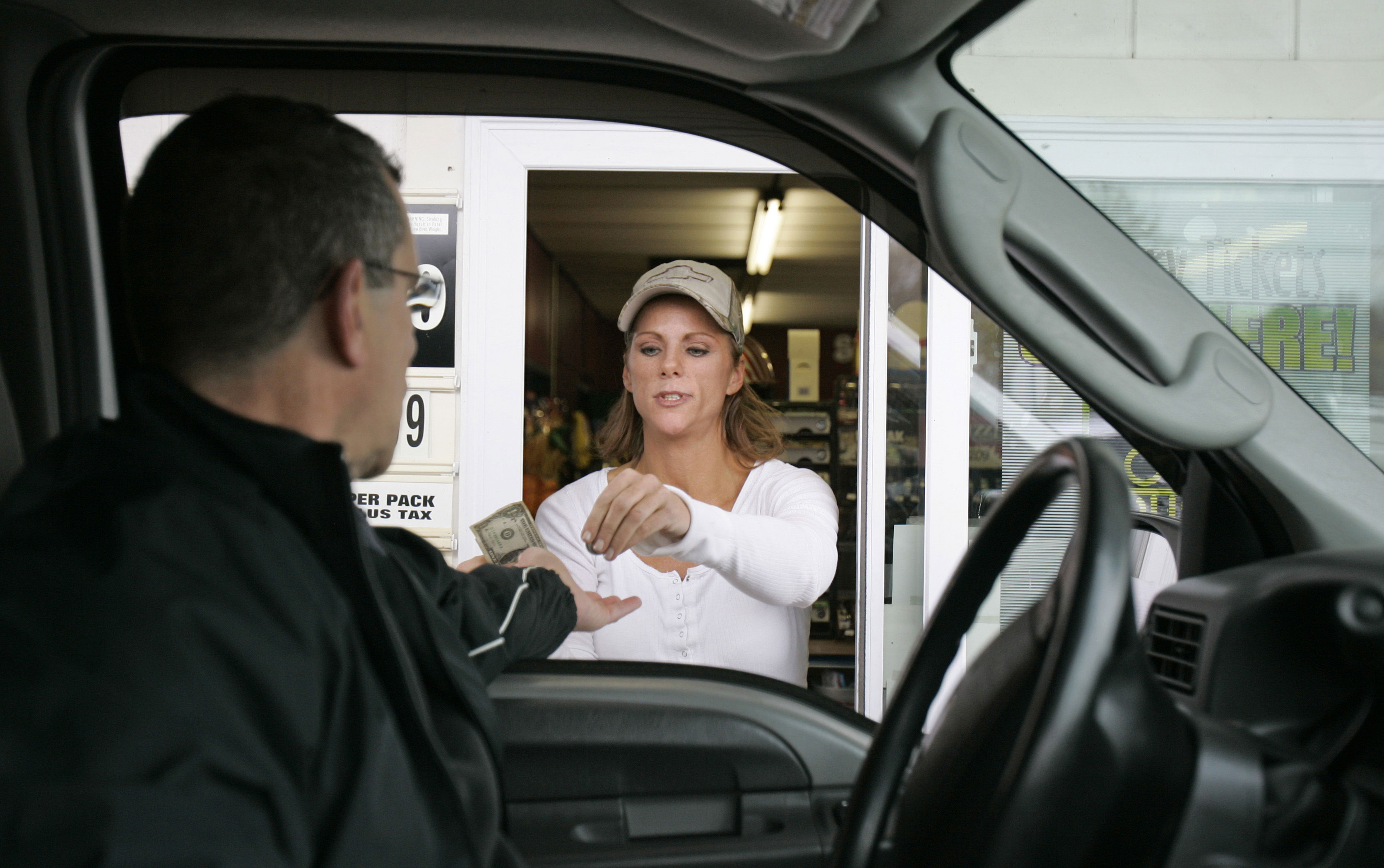
Joellen Spletzer, owner of Hoot-N-Holler convenience store, gives change through the drive-up window to Carmen Denno, 55, Wednesday in Lordstown, Ohio. Spletzer's store is about a mile from the GM plant where the Chevrolet Cobalt and Pontiac G6 small cars are made.
Detroit ? Advocates for the nation’s automakers are warning that the collapse of the Big Three – or even just General Motors – could set off a catastrophic chain reaction in the economy, eliminating up to 3 million jobs and depriving governments of more than $150 billion in tax revenue.
Industry supporters are offering such grim predictions as Congress weighs whether to bail out the nation’s largest automakers, which are struggling to survive the steepest economic slide in decades.
Even if just GM collapsed, the failure could bring down the other two companies – and even the U.S. operations of foreign automakers – as parts suppliers run out of money and shut down.
Concern about the automakers hit new heights Friday when GM and Ford reported they spent a combined $14.6 billion more than they took in last quarter.
GM said it could run out of money by the end of the year.
Ford said it could last through 2009.
All this comes after tight credit and economic uncertainty in October reduced U.S. auto sales to their lowest level in 25 years – with no rebound in sight.
A study by the Center for Automotive Research in Ann Arbor estimated that the failure of Chrysler LLC, Ford Motor Co. and General Motors Corp. would eliminate up to 3 million jobs, including those at parts suppliers and smaller businesses that rely on the automakers.
State, local and federal governments would lose more than $150 billion in tax revenue over three years, the study said.
Next week, Congress plans to consider giving the auto industry part of the $700 billion Wall Street bailout during a lame-duck session.
Opponents of the idea say government money will just delay the inevitable demise of companies that are on death’s doorstep because of years of mismanagement and labor costs far higher than their global competitors.
Opponents also fear that opening the treasury to automakers will invite more industries to plead for federal help.
Automakers say bankruptcy protection is not an option because people would be reluctant to make long-term car and truck purchases from companies that might not last the life of their vehicles.
But others say Chapter 11 might be a better option than government loans.
National

Man pleads guilty to killing a top Minnesota Democrat and her husband
New tornadoes outside Chicago as severe storms pummel the Midwest

Feds won’t seek death penalty in plea deal with man accused of killing top Minnesota Democrat

NASA unveils astronauts to test tech for future moon landing
Social Security’ fund faces shortfall one year earlier than expected
WASHINGTON (AP) — Social Security 's retirement trust fund is projected to face a funding shortfall in 2032, a ...