City has economic development options
The fate of the former Farmland Industries plant isn’t the only economic development issue beginning to heat up at City Hall.
The long-lingering debate of how to appropriately use tax abatements and other incentives will soon get more talk.
City staff members are beginning to solicit feedback from several economic development stakeholders on a variety of ideas related to economic development incentives.
Here’s a look at some of the proposals, which all would require City Commission approval:
¢ Companies that don’t live up to specific projections for new jobs or dollar investments would have their tax abatements reduced under a draft plan from Roger Zalneraitis, the city’s new economic development coordinator and planner.
For the past several years, the city has technically had the ability to reduce tax abatement amounts if companies did not live up to projections they made when applying for the tax abatement. But the city’s own policies have never been specific about when it is appropriate for the city to take action.
Under the proposed policy, if a company’s projections ended up being off by 30 percent or more – for example, a company adds 60 jobs instead of 100 – the company would lose its entire abatement for that year.
The policy sets up a sliding scale that would reduce a company’s abatement by 15 percent to 25 percent if a company’s projections were off by an amount less than 30 percent.
In addition to being penalized for not meeting job projections, a company also could be docked for not meeting projections related to wages or capital investment.
¢ The model the city uses to measure the costs versus benefits of tax abatements could change. Zalneraitis is proposing a new model that could be run in-house rather than the current model run by Kansas University.
The model is used by city commissioners as they decide whether a company seeking a tax abatement could add enough to the local economy to justify a reduction in property taxes.
The proposed model could make it more difficult to justify tax abatements in the future.
That’s because the new model counts the tax break as a cost to government. The current model does not. That’s because it assumes a company wouldn’t come to the city without the abatement.
Zalneraitis said other communities are mixed in how they treat the costs of incentives, and he said he expected the issue to generate significant discussion in Lawrence’s economic development community.
Staff members will be soliciting comments on the proposals from stakeholders and members of the public during the next month. City commissioners are expected to discuss the ideas at their Dec. 9 meeting.
City Government

Planning Commission recommends adding more layers to approval process for data centers in Lawrence
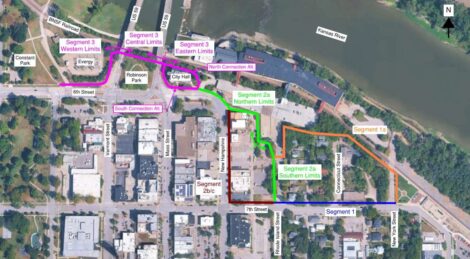
Lawrence Loop trail may go along busy downtown street; city wants to steer clear of Riverfront for development reasons

Opinion: Lawrence’s data center moratorium is wrong in one way, but right in the most important

Current and former elected officials celebrate Lawrence’s new Municipal Services and Operations campus
‘We have to move forward’: On 3-2 vote, Lawrence City Commission approves budget with 1.4-mill hike