City’s electric vehicle hits road
Parking control unit using vehicle that needs no gasoline
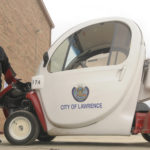
Steve Stewart, fleet manager for the city, shows off Lawrence's electric car in this 2008 file photo. City commissioners are being asked to apply for up to 50,000 in federal stimulus funds that would create new “fueling stations” for electric-hybrid cars, and also allow the city and county to add four new electric vehicles to their fleet.
It looks funny to everybody but the person who pays the fuel bill.
Since November, the city’s parking control unit has been using a red-and-white, bubble-looking, small-wheeled machine that acts like a golf cart on steroids.
And it looks beautiful to the person who signs the checks for the nearly 500,000 gallons of fuel that the city’s vehicle fleet uses each year. The funny looking machine is an all-electric car, a first for the city.
“So far, it has worked out pretty well,” said Steve Stewart, the city’s fleet manager who is monitoring whether the vehicle is a more cost-effective way to accomplish some city tasks.
Thus far, the experiment has been limited to the parking department, where employees use the vehicle to travel back and forth to the downtown parking lots at which they write tickets. The all-electric machine replaces a Ford Ranger that got less than 20 miles per gallon.
“We feel like we’re going to be able to show a significant savings by not using that vehicle,” Stewart said.
The electric vehicle – made by Global Electric Motorcars, or GEM – can last about 30 miles before it needs its batteries recharged. Stewart said the car only needs to be charged overnight – using a simple wall outlet – to meet the parking department’s needs.
“I know 30 miles doesn’t sound like a lot, but 30 miles in town is quite a distance,” Stewart said.
The machine has its limitations. For one, it’s not going to win any high-speed chases. The car’s top speed is about 25 mph, which limits the number of city streets it can safely travel on, Stewart said. He said the car is legal on all Kansas streets with a speed limit of less than 40 mph.
Keeping the car off higher-speed streets is particularly important because the vehicle is not crash tested. Airbags, for example, aren’t part of the package. It does come with seat belts, turn signals, brake lights and headlights that make it legal to drive at night. Other accessories are sparse.
“It has windshield wipers,” Stewart said with a laugh when asked to list its luxurious features.
It also has a heater, which will run the batteries down if left on too long.
The city bought the vehicle – a 2002 model – for $5,200.
City Commissioner Boog Highberger said it may end up being money well spent. He said he wants to the city to continue aggressively looking for ways to not only cut the city’s fuel bill but also cut the city’s greenhouse gas emissions.
“I think the city really ought to take the lead in alternative technology,” Highberger said. “I think it is important for us to show leadership on that.”
The city has 22 vehicles – mainly police cruisers – that can run on E-85 ethanol fuel, and 12 more vehicles are on the way.
Testing on the efficiency of those vehicles is under way, with the city using the new alternative fuel station at Ninth and Iowa streets.
Highberger said he wants the city to proceed cautiously on ethanol because of the amount of energy it takes to produce the corn-based fuel.
Stewart said he’s also keeping an eye on the development of hybrid technology. The city does have hybrid cars that it is testing, but it generally has found the higher upfront purchase prices make it difficult to justify the sometimes limited fuel savings.
But Stewart said that may soon change, and he’s optimistic about the development of medium- and heavy-duty trucks that are powered both by diesel and electricity.
He said major trucking companies such as UPS and FedEx have been ordering the trucks, which are leading to lower production costs for truck manufacturers. That has Stewart thinking that hybrid dump trucks, trash trucks and other large vehicles will become more cost effective.
As for the smaller electric cars, Stewart said he’s researching a three-wheeled motorcycle/pick-up combination that could be used by parks and recreation, the utility department and others that have light hauling tasks.
City Government
Developer seeks incentive from City of Lawrence to build 131 units of housing near Wakarusa and Queens

Lawrence city leaders will consider whether to keep Community Building open, make 2 other rec centers free to access
A STAR Bond application raises questions for city leaders about Costco and housing west of the SLT

Soccer gear honoring Lawrence history’s all-star team is now on sale as part of city’s public art exhibition
To honor public servants, Lawrence’s July 4 celebration will have a whole gallery of their photos on display; submissions open now