Obama defends foreign tour, says McCain shifts on war
Republican criticizes Ill. senator for not visiting wounded troops
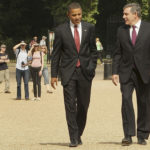
Presidential contender Senator Barack Obama, D-Ill., second right, walks with British Prime Minister Gordon Brown on Saturday through Horseguards Parade, behind Number 10 Downing Street, in London. Presidential contender Barack Obama is meeting with British Prime Minister Gordon Brown on the last leg of his European and Middle Eastern tour.
London ? Democratic presidential contender Barack Obama brushed aside Republican criticism of his overseas trip on Saturday and stood outside the famed 10 Downing Street to say that both President Bush and Sen. John McCain were moving his way on the key issues of Iraq and Afghanistan.
Hours before flying home, Obama also suggested his poll numbers might dip in the coming days, adding: “We have been out of the country for a week. People are worried about gas prices and home foreclosures.”
At the same time, he said the journey to two war zones, the Mideast and Europe was important because “many of the issues that we face at home are not going to be solved as effectively unless we have strong partners abroad.”
Obama flew home to Chicago on Saturday night.
‘Premature victory lap’
Republicans have criticized Obama throughout his trip, and McCain’s campaign said recently the Democrat was taking a “premature victory lap” with more than 100 days remaining in the presidential campaign.
In Arizona on Saturday, McCain took a swipe at the headline-making trip in a radio address on Iraq and energy that his campaign made available to the media: “With all the breathless coverage from abroad, and with Sen. Obama now addressing his speeches to the people of the world, I’m starting to feel a little left out. Maybe you are, too.”
But Obama sought to turn that back on his critics. He said McCain had earlier been “telling me I was supposed to take this trip. He suggested it and thought it was a good idea.”
“John McCain has visited every one of these countries post-primary that I have,” he said. “So it doesn’t strike me that we have done anything different than the McCain campaign has done, which is to recognize that part of the job of the next president, commander in chief is to forge effective relationships with our allies.”
The trip was designed by the campaign to show Obama on an international stage in a way that aides hoped would reassure voters who have doubts about his ability to become commander in chief or chart a course for American foreign policy. Jews at home were an audience of particular concern, reflected in his two-night stay in Jerusalem.
McCain has long opposed Obama’s call for a 16-month timetable for the withdrawal of U.S. combat troops from Iraq. On Friday, though, McCain said, “I think it’s a pretty good timetable, as we should – or horizons for withdrawal,” echoing a phrase Bush used in recent days. “But they have to be based on conditions on the ground.”
At his news conference, Obama jumped on that to say there was now some convergence “around a proposal that we have been making for a year and a half.”
He also said McCain supports sending additional U.S. troops to Afghanistan, “and the Bush administration acknowledges that as well. I have been talking about that since last year,” he said.
Obama’s final day in Europe included meetings with British Prime Minister Gordon Brown at the official residence at 10 Downing Street and with Conservative Party Leader David Cameron in the opposition party’s offices in Parliament. Brown’s government is unpopular, and his party recently lost a local election that underscored its weakness.
Still, Obama said he had no advice for Brown. “You are always more popular before you are actually in charge of things. And then, you know, once you are responsible then you are going to make some people unhappy, and that is just the nature of politics,” he said.
He also breakfasted with former Prime Minister Tony Blair, now a Middle East envoy.
McCain on the offensive
McCain’s campaign on Saturday sharply criticized Obama for canceling a visit to wounded troops in Germany, contending Obama chose foreign leaders and cheering Europeans over “injured American heroes.”
Obama’s campaign called the accusation “wildly inappropriate.” His spokesman has claimed that the visit to a military hospital in Germany was scrapped after the Pentagon raised concerns about political activity on a military base.
Earlier, though, the campaign had said Obama decided the visit might be seen as inappropriate politicking. However, the Pentagon said the senator was never told not to visit.
A new McCain ad that began airing Saturday in selected markets also chides Obama as disrespectful for making “time to go to the gym” during his European visit while at the same time canceling the visit with wounded troops.
“Seems the Pentagon wouldn’t allow him to bring cameras,” according to the ad, which is being televised in Colorado, Pennsylvania and the Washington D.C. area. “John McCain is always there for our troops.”
McCain himself joined in the rebuke, saying in an interview to be aired today by ABC’s “This Week” that “if I had been told by the Pentagon that I couldn’t visit those troops, and I was there and wanted to be there, I guarantee you, there would have been a seismic event.”
Responding, Obama campaign spokesman Tommy Vietor said Obama and McCain both believed that troops should be honored and noted that the Illinois senator had visited troops in Iraq and Afghanistan last week and had made numerous trips to Washington’s Walter Reed Army Medical Center.
Obama still didn’t want injured soldiers “pulled into the back-and-forth of a political campaign,” Vietor said in a statement.
“Senator McCain knows full well that Senator Obama strongly supports and honors our troops, which is what makes this attack so disingenuous. This politicization of our soldiers is exactly what Senator Obama sought to avoid,” Vietor said.
National

Authorities disrupt planned drone, gun attack on White House UFC cage-fight
Rain along the Gulf Coast could become the first named storm of the Atlantic hurricane season
MIAMI (AP) — A cluster of storms along the Gulf Coast could become the first named tropical storm of the 2026 ...
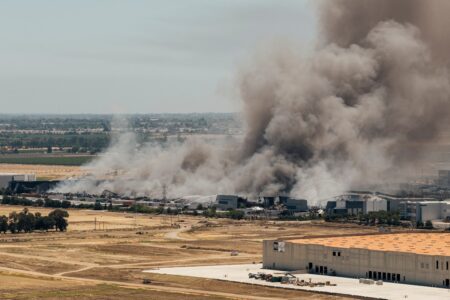
Unhealthy air quality in California city as huge warehouse fire burns for 3rd day
Judge orders Trump administration to restore National Park changes at sites that ‘disparaged’ US
Teens’ reading and math scores have stagnated, US test results show
WASHINGTON (AP) — Younger students have regained ground academically after the pandemic's disruptions while older ...